
Making tough decisions in refugee simulation
Advertisement
Read this article for free:
or
Already have an account? Log in here »
We need your support!
Local journalism needs your support!
As we navigate through unprecedented times, our journalists are working harder than ever to bring you the latest local updates to keep you safe and informed.
Now, more than ever, we need your support.
Starting at $15.99 plus taxes every four weeks you can access your Brandon Sun online and full access to all content as it appears on our website.
Subscribe Nowor call circulation directly at (204) 727-0527.
Your pledge helps to ensure we provide the news that matters most to your community!
To continue reading, please subscribe:
Add Brandon Sun access to your Free Press subscription for only an additional
$1 for the first 4 weeks*
- Enjoy unlimited reading on brandonsun.com
- Read the Brandon Sun E-Edition, our digital replica newspaper
*Your next Free Press subscription payment will increase by $1.00 and you will be charged $20.95 plus GST for four weeks. After four weeks, your payment will increase to $24.95 plus GST every four weeks.
Read unlimited articles for free today:
or
Already have an account? Log in here »
Hey there, time traveller!
This article was published 21/06/2019 (2515 days ago), so information in it may no longer be current.
Ten “refugees” made perilous decisions while sitting in a classroom at Westman Immigrant Services Thursday morning.
In a simulation of the experience refugees face fleeing their homes, people chose how to make it through a series of obstacles, including a military checkpoint, an official border crossing and a refugee camp. The Forced to Flee migration simulation forces participants, grouped into families, to make life-and-death decisions.
The event was hosted to honour World Refugee Day and meant to give non-refugees a sense of what it’s like to escape a crisis. Groups were encouraged to think creatively and to contrast the experience to their own lived experiences.
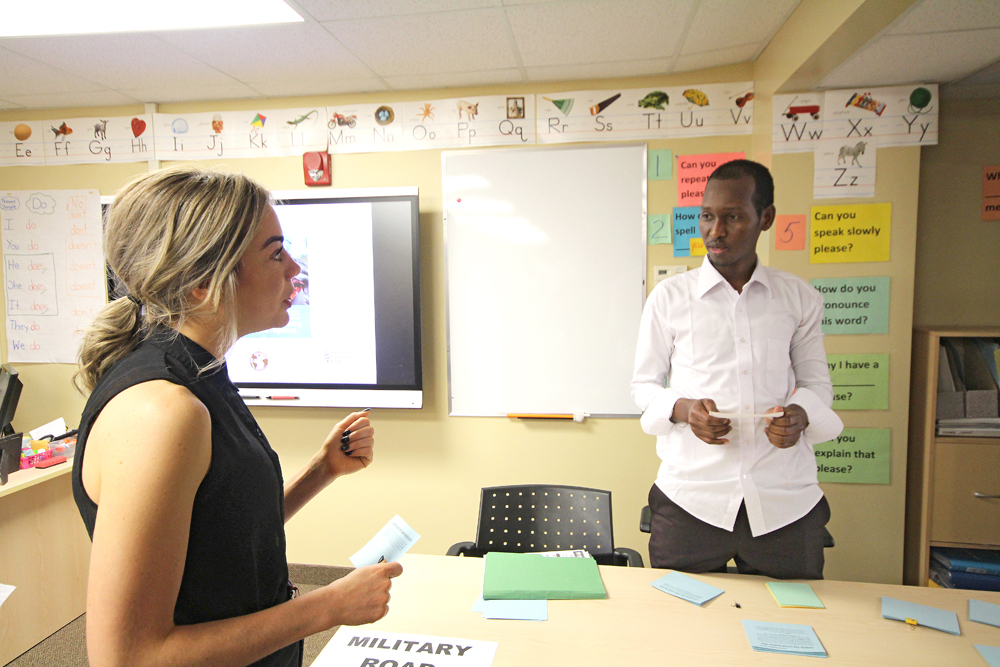
One group, which The Sun joined in with, was presented with a scenario of a family fleeing drought and conflict. Each group was given four each of health, money and food cards to get them through the objective to cross the country’s border.
The first obstacle to cross was a military checkpoint. Upon arriving at the “checkpoint” the guard, played by WIS resettlement assistance facilitator Mohamed Ali, said “you are so rich,” and promptly confiscated all of the group’s cards. He told us to come back later.
Katharine Mercredi, a classroom volunteer at WIS, had the idea to present the guard with identification. Ali again turned the group back.
As a last resort, Brooke Ward, a financial officer at WIS, took a few food and money cards from another group. Presented with the bribe, Ali finally let us past.
The next stage of the simulation, waiting to be processed at the border, was another challenge for the group. The border guard, played by WIS volunteer coordinator Angie Nor Addin, told us no more people were being let across and to wait.
We did wait, eventually being let across after our documents were verified.
At this point, the group had a decision to make: either to go to a refugee camp in the new country or to find shelter elsewhere. The group came to the consensus to go to the refugee camp but was presented with a new challenge after we were told one of us was sick. We traded a camp worker two food cards for the medicine we needed.
Finally in relative safety, we were told this is the journey many refugees from Syria or Somalia face when trying to flee danger. Last year, nearly 1,400 refugees were resettled in Manitoba alone.
Ali, himself a refugee from Somalia, said he spent 20 years living in a camp in Kenya. He came to Canada and attended Brandon University with a scholarship from World University Service of Canada.
Alexander Akhile, another volunteer at WIS and the fourth member of the group, said the simulation showed him what people really go through.
“If you’ve ever been to the situation or you’ve never been in that situation, you would never be able to appreciate it. But when you see things like this, and when you get people to tell you about their experience, you appreciate what they go through and opportunities that this type of position provides.”
Akhile said he is from Nigeria and has lived in Canada for a year. He came as a permanent resident, not a refugee, but said the simulation gave him perspective on how other people are forced to leave.
“There’s a lot of challenges that is going on back home, and then we come into this environment, we see these comforts, it’s a very good thing to see theses comforts. … It’s the least we can do to come out and support people.”
Akhile said he volunteers mostly with summer camps and with youth programs. Doing the simulation gave him perspective into what the children who came to Canada as refugees may have experienced.
“For kids growing up in Brandon and coming from all over the world or places outside of Canada, it’s an opportunity for them because they do not have to experience what their parents have experienced back home.”
» dmay@brandonsun.com
» Twitter: @DrewMay_