
Urban forests are valuable assets
Advertisement
Read this article for free:
or
Already have an account? Log in here »
We need your support!
Local journalism needs your support!
As we navigate through unprecedented times, our journalists are working harder than ever to bring you the latest local updates to keep you safe and informed.
Now, more than ever, we need your support.
Starting at $15.99 plus taxes every four weeks you can access your Brandon Sun online and full access to all content as it appears on our website.
Subscribe Nowor call circulation directly at (204) 727-0527.
Your pledge helps to ensure we provide the news that matters most to your community!
To continue reading, please subscribe:
Add Brandon Sun access to your Free Press subscription for only an additional
$1 for the first 4 weeks*
*Your next subscription payment will increase by $1.00 and you will be charged $20.00 plus GST for four weeks. After four weeks, your payment will increase to $24.00 plus GST every four weeks.
Read unlimited articles for free today:
or
Already have an account? Log in here »
Hey there, time traveller!
This article was published 26/10/2019 (2336 days ago), so information in it may no longer be current.
We are incredibly fortunate here in Brandon to have a beautiful and well-established urban tree canopy. From the picturesque trees that contour the Assiniboine River, to the old growth boulevard trees that line our streets and the vast leafy canopies that provide us with shade in our public parks, our urban forest is an asset we ought not to take for granted. In fact, it might very well be our best-kept secret.
Urban forests (i.e. trees in cities) not only provide important environmental benefits, but they also provide considerable social and economic benefits for communities. Beyond improving the aesthetic of the public realm, it is widely understood that trees absorb CO2, filter pollutants (such as dust, dirt or smoke), and have an ability to help cool the air temperature, which helps to address the “heat island” effect we see in more densely populated cities.
The research also suggests that living in close proximity to trees and green spaces can improve both physical and mental health. Here is something worth noting: In 2015, a team of researchers from Canada, Australia and the United States found that having 10 more trees on a city block improved health perceptions that were comparable to an increase in one’s annual income of $10,000 or being seven years younger.
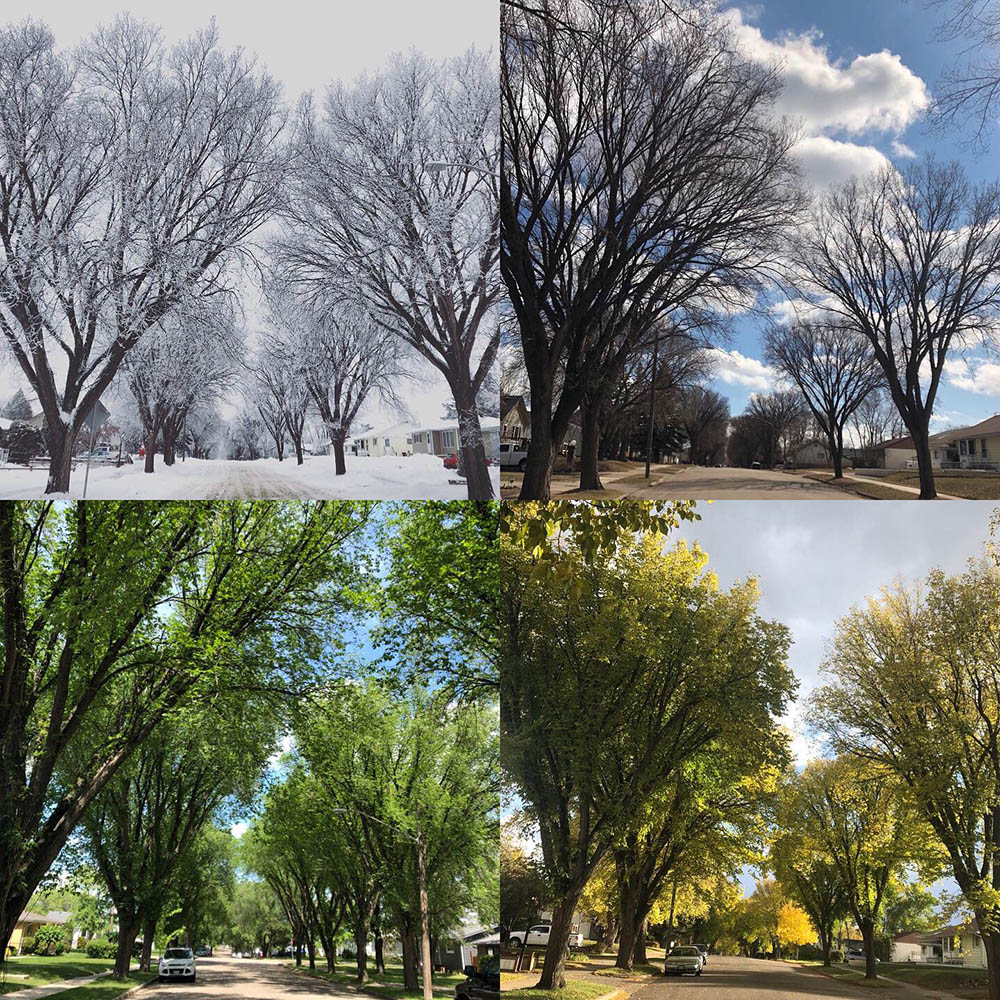
What I think is even more interesting about these findings is that the health benefits associated with trees are almost entirely exclusive to those planted along the streets and in front yards, where people can walk past them and experience them.
Looking beyond their more visible benefits, many cities have sought to better understand the value of their urban forests as a tool to inform public policy and guide city councils in making sound investments that support the preservation and growth of their tree canopy.
A few years ago, the City of Hamilton assigned monetary values to approximately 150 trees throughout the city by actually labelling them with a price tag. For example, the city valued a sugar maple in Gage Park at $21,950, which took into account its replacement cost as well as the many benefits it provides to the community. The intent of this exercise was to promote the idea that the urban forest has considerable value that may not be fully understood.
Likewise, TD Bank conducted a study on Toronto’s urban forest and found that it is worth approximately $7 billion to its local economy, which works out to $700 a tree. TD’s chief economist derived this value by adding the replacement cost with the benefits trees provide to the economy, such as rain and snow management (trees absorb precipitation) and increasing property values and taxes.
Here at home, we have an estimated 33,000 city-owned trees whose canopies cover approximately 21 per cent of our city’s land area. If we were to apply the value from the Toronto study to our local context, our 33,000 public trees would be valued at more than $23 million!
Therefore, the threat of climate change and invasive species is incredibly concerning. The Thanksgiving weekend snowstorm we endured in Manitoba was a stark reminder of the power of Mother Nature. While our trees came out relatively unscathed, Winnipeg suffered considerable damage to its mature tree canopy. Our neighbours to the east estimate it will take five years for its canopy to recover.
The threat of Dutch elm disease (DED) and emerald ash borer (EAB) puts us in a particularly vulnerable state. According to the City of Brandon, DED is an invasive fungus that is spread to American elms via the native elm bark beetle. Sadly, this disease has killed off many American elms in urban forests. EAB is an invasive forest species that attacks and kills all species of ash trees. While EAB has not yet been detected in Brandon, there have been cases in Ontario and Minnesota.
The majority of the large mature trees on Victoria Avenue are American elms, with a sprinkling of Lindens and green ash. Can you imagine how Victoria Avenue would look if it were void of its stately and mature elm trees? Not only would we lose the environmental, social and economic benefits of these trees, it would completely change the way we interact with our public realm.
To the City of Brandon’s credit, it has identified the protection of our urban forest as a priority. Consequently, it is in the process of developing an urban forestry management plan and tree protection policy, which were recommendations of the city’s Green Space Master Plan.
Trees can provide a return on investment two to three times more than the investment made in planting and caring for them. To that end, urban forests should be seen as an essential part of urban infrastructure and should be prioritized in the same manner we would underground water main or road paving projects.
We do not have much of a choice. Our city’s environmental, social and economic health depends on it. If that wasn’t pressure enough, future generations are counting on us.