
Riding Mountain moose mostly tick-free
Advertisement
Read this article for free:
or
Already have an account? Log in here »
We need your support!
Local journalism needs your support!
As we navigate through unprecedented times, our journalists are working harder than ever to bring you the latest local updates to keep you safe and informed.
Now, more than ever, we need your support.
Starting at $15.99 plus taxes every four weeks you can access your Brandon Sun online and full access to all content as it appears on our website.
Subscribe Nowor call circulation directly at (204) 727-0527.
Your pledge helps to ensure we provide the news that matters most to your community!
To continue reading, please subscribe:
Add Brandon Sun access to your Free Press subscription for only an additional
$1 for the first 4 weeks*
- Enjoy unlimited reading on brandonsun.com
- Read the Brandon Sun E-Edition, our digital replica newspaper
*Your next Free Press subscription payment will increase by $1.00 and you will be charged $20.95 plus GST for four weeks. After four weeks, your payment will increase to $24.95 plus GST every four weeks.
Read unlimited articles for free today:
or
Already have an account? Log in here »
Hey there, time traveller!
This article was published 15/02/2020 (2312 days ago), so information in it may no longer be current.
Biologists at Riding Mountain National Park are monitoring the winter tick situation in the park after reports that moose in the northeastern United States were being killed by swarms of tens of thousands of blood-sucking ticks.
Doug Bergeson, a wildlife ecologist in the park, said so far the same increase in tick populations haven’t been seen in Manitoba, but it’s an issue they are keeping an eye on.
“It’s something we certainly want to monitor and keep a close handle on in the next little while but I have to say right now we haven’t seen a large change in the number of ticks on moose,” he said.
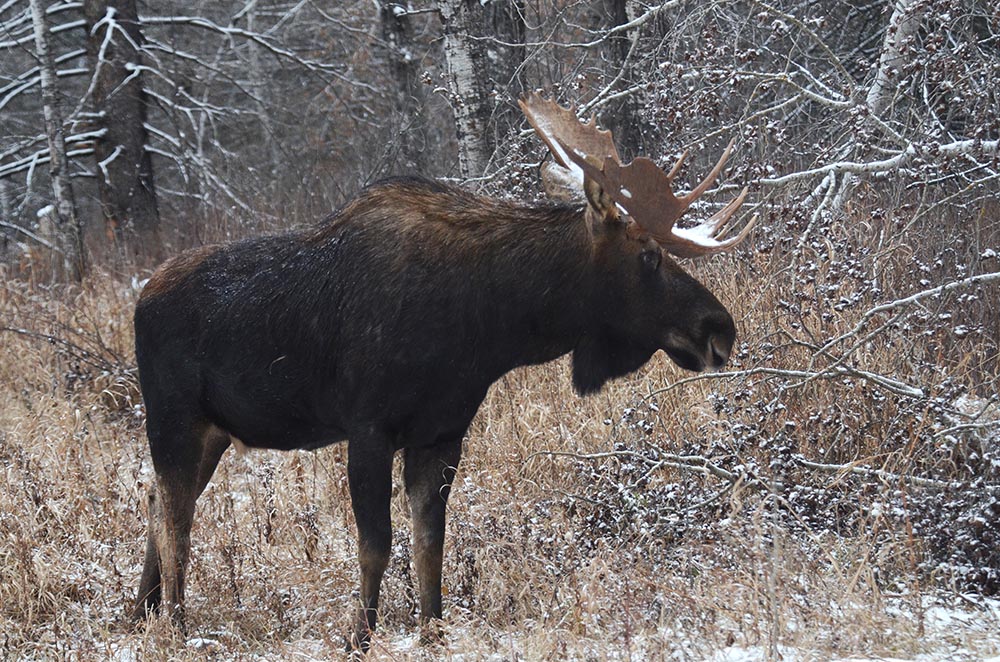
A three-year study from the Canadian Journal of Zoology found 70 per cent of calves in New Brunswick and Maine — which border Quebec and New Brunswick — didn’t make it through their first winter in large part due to being infested with ticks. One moose was found with approximately 80,000 ticks on it.
When so many ticks are on a single animal it spends more time scratching and less time eating, further weakening it.
Canadian moose populations remain healthy, but with climate change bringing warmer winters and less snow on the ground it makes it easier for ticks to survive the winter.
Officials in Riding Mountain National Park aren’t sure why the situation so far is different in Canada, Bergeson said.
“It could be that it’s coming here, or maybe the impact of climate change or their weather patterns are changing more drastically then ours are, I’m not sure,”
It’s not something easy to watch for, but he said park rangers are looking at moose to see if they have large hairless patches or behaviour changes, which could be an indicator. Park visitors can also tell officials if they see an animal that looks like it might be infested.
“They become very irritated by the ticks and they’ll rub hair off and they’ll get patches of hair removed, which is obvious to people … (who) see moose a lot along the trail and roads” he said.
Calves are often the most affected by ticks, Bergeson said. Younger animals are weaker and don’t have the energy reserves built up.
“If people are in the park and they see something unusual or an animal that’s missing significant parts of hair or something, report it to the park office and we’ll look into it,” he said. “Certainly don’t approach an animal that’s acting funny or odd. If it looks like it’s injured or hurt or sick call the park office.”
While winter ticks are a concern, they don’t carry Lyme disease, like the black-legged ticks that bite deer.
Bergeson said there currently aren’t any significant health issues in moose the park is dealing with. He estimates there are between 2,000 to 2,500 moose in Riding Mountain National Park.
» dmay@brandonsun.com
» Twitter: @DrewMay_