
Waxworms research reaching global audience
Advertisement
Read this article for free:
or
Already have an account? Log in here »
We need your support!
Local journalism needs your support!
As we navigate through unprecedented times, our journalists are working harder than ever to bring you the latest local updates to keep you safe and informed.
Now, more than ever, we need your support.
Starting at $15.99 plus taxes every four weeks you can access your Brandon Sun online and full access to all content as it appears on our website.
Subscribe Nowor call circulation directly at (204) 727-0527.
Your pledge helps to ensure we provide the news that matters most to your community!
To continue reading, please subscribe:
Add Brandon Sun access to your Free Press subscription for only an additional
$1 for the first 4 weeks*
*Your next subscription payment will increase by $1.00 and you will be charged $20.00 plus GST for four weeks. After four weeks, your payment will increase to $24.00 plus GST every four weeks.
Read unlimited articles for free today:
or
Already have an account? Log in here »
Hey there, time traveller!
This article was published 10/03/2020 (2245 days ago), so information in it may no longer be current.
Brandon University’s chair of biology Christophe LeMoine has given so many interviews about his research of late that he can’t remember how many he has done.
LeMoine, fellow professor Bryan Cassone and their students’ research into waxworms that eat plastic has captured so much attention that they’ve done interviews with national media outlets like CBC and CTV, but also outlets in other countries like CNN, USA Today, the United Kingdom’s Daily Mail newspaper and an outlet in Australia.
“It’s very overwhelming,” LeMoine told the Sun during an interview in his office. “It almost never happens in science that you get globally picked up like this.”

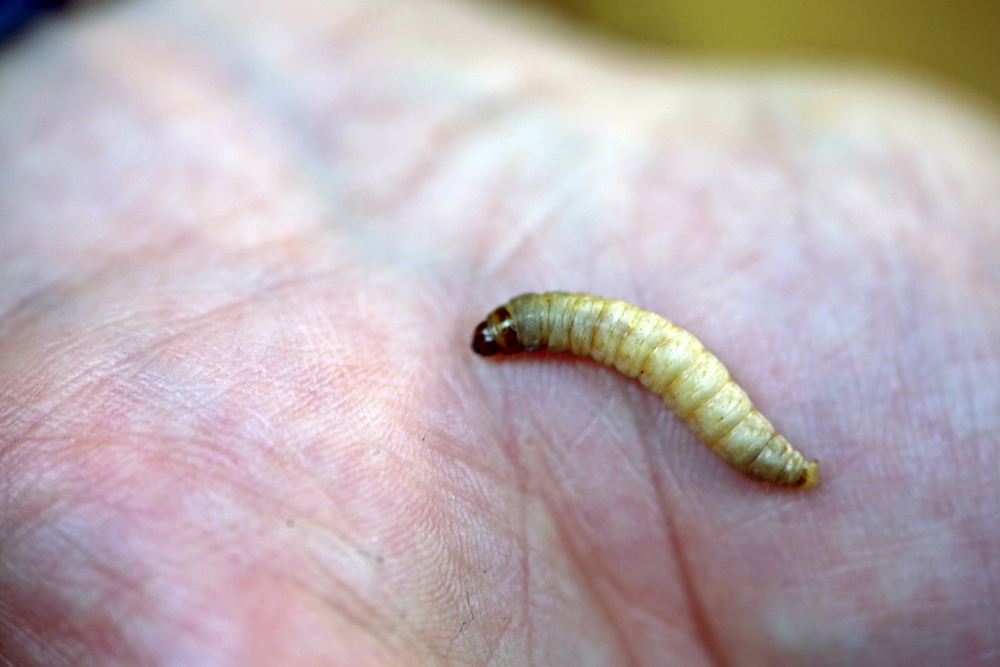
For the past three years, they’ve been looking into how the caterpillars of the greater wax moth, waxworms, are able to subsist entirely on a diet of polyethylene — a type of plastic that is frequently used in shopping bags, among other things.
The worms have been seen to eat styrofoam as well, but that has yet to be studied in as much detail as polyethylene.
Waxworms themselves are not exotic creatures.
“Waxworms are used in the pet trade,” LeMoine said. “You use them to feed your reptiles and some birds also eat them.”
One of LeMoine’s students told his instructors about the original academic paper that first talked about how the waxworms eat plastic, and it captured enough interest to be the subject of ongoing research.
Through research, the BU team was able to discover that one of the types of bacteria contained within the guts of the waxworm was able to survive for more than a year with plastic as its only food source. LeMoine said that the waxworms don’t eat the plastic unless it’s crinkled up first, providing more of a surface to latch onto.
It’s likely because of this that the worms have not simply eaten their way out of the hard plaster containers they’re kept in. In the university’s Insect Vector Lab, there are both groups of waxworms kept in hard plastic containers with honeycombs for food and then other waxworms that are kept in little plastic cylinders with pieces of plastic so that their plastic-eating habits can be observed.
“We think that what’s happening is that the waxworm is kind of munching on the plastic, and by doing so is providing a large surface for the bacteria to start attacking the chemical structure of the plastic,” he said. “Up to now, there’s no animal that has been found to have similar molecular makeup, enzymes as we call them, to break down plastic.”
Waxworms combined with the bacteria were far more effective at breaking down the bacteria than either element by themselves. When the waxworms were given antibiotics to suppress their gut bacteria, they had a diminished ability to process the plastic.
When a reporter from Radio-Canada visited the lab last week, LeMoine said that they put a waxworm onto a piece of plastic and it had started to eat the plastic within an hour.
Once the plastic is consumed and processed by the waxworms, part of what they excrete is glycol, a form of alcohol. “The worm eats it and within 24 hours it’s metabolized,” he said. “Kind of like how we metabolize our food.”
It might seem that these creatures and how they interact with plastic could be a possible solution to reducing the sheer amount of plastic waste existing on earth, but it’s not that simple.
“At this point, we’re just getting started,” LeMoine said. “A lot of people are interested in plastic bio-degradation, obviously. The main issue is we need resources to pursue it.”
They have students available to help them, but students need to be paid for the amount of work they’re doing. Grant money has been limited, so LeMoine is hopeful that some business partners might show some interest in investing in the research now that it has gained publicity.
“That would be fabulous,” he said. “That would be a nice, positive outcome to this.”
Another thing that would help the environment, LeMoine said, would be to reduce the amount of plastic that gets put into landfills in the first place.
» cslark@brandonsun.com
» Twitter: @ColinSlark