
Water treatment sequestration cost city $224K
Advertisement
Read this article for free:
or
Already have an account? Log in here »
We need your support!
Local journalism needs your support!
As we navigate through unprecedented times, our journalists are working harder than ever to bring you the latest local updates to keep you safe and informed.
Now, more than ever, we need your support.
Starting at $15.99 plus taxes every four weeks you can access your Brandon Sun online and full access to all content as it appears on our website.
Subscribe Nowor call circulation directly at (204) 727-0527.
Your pledge helps to ensure we provide the news that matters most to your community!
To continue reading, please subscribe:
Add Brandon Sun access to your Free Press subscription for only an additional
$1 for the first 4 weeks*
*Your next subscription payment will increase by $1.00 and you will be charged $20.00 plus GST for four weeks. After four weeks, your payment will increase to $24.00 plus GST every four weeks.
Read unlimited articles for free today:
or
Already have an account? Log in here »
Hey there, time traveller!
This article was published 24/09/2020 (1951 days ago), so information in it may no longer be current.
It cost the City of Brandon $224,451.10 to sequester workers at the municipal water treatment plant in the early days of the COVID-19 pandemic.
The measure was taken to safeguard the city’s water supply in case of disaster, with qualified workers stationed around the clock March 26 until May 28.
The Sun received the total cost for the effort by filing a freedom of information and protection of privacy (FIPPA) request with the City of Brandon.
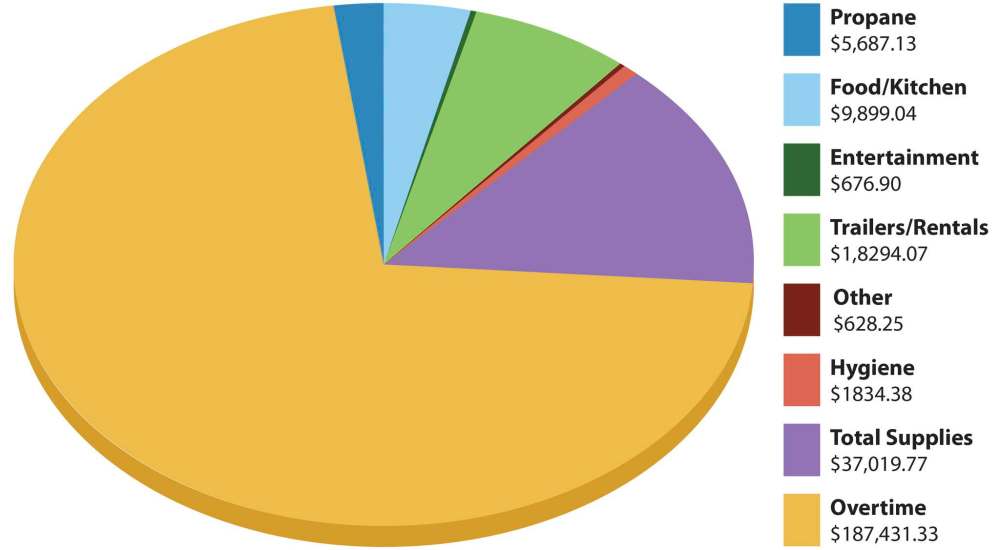
Of the nearly $225,000 spent on sequestration, the bulk of the costs came from overtime costs for the workers involved at $187,431.33.
The second-highest category of expense was the rentals of trailers for the staff to live in, porta-potty rentals and the rental of a fence to surround and protect the compound. Rentals cost the city $18,294.07. A total of $5,687.13 was spent on propane during the sequestration.
Food and kitchen supplies, including the purchase of a dishwasher, cost $9,899.04. Hygiene and bathroom supplies, including the purchase of a washing machine and dryer, cost the city $1,834.38.
Entertainment for the workers was relatively cheap, with the purchase of a television and a couple months’ worth of subscriptions to streaming platforms Netflix and Crave running $676.90. Other assorted supplies, including an exercise bike and AAA batteries, was the cheapest category at $628.25.
Despite the cost of the whole endeavour, the city believes it was the right decision to make at the time and that it was a worthwhile effort.
Mayor Rick Chrest said that at the time the decision to sequester workers was made, there was a lot of uncertainty surrounding the virus, how widespread it would be and how much of an impact it would have on our health-care system.
“Early on, our team, our emergency response group, had to identify the biggest risks to our community,” Chrest said. “Our response was being able to continue to deliver our essential services that citizens require from the municipality. Some of those do include police, fire, paramedics, E911 service, transit and of course providing water treatment and wastewater and sewage treatment.”
With limited personnel qualified to run the water treatment plant, there were concerns about what would happen if some or all of them were to get sick. This, Chrest said, was identified in an emergency preparedness study as the city’s greatest vulnerability.
See ‘Every’ — Page A2
“In other words, if we couldn’t continue to provide potable water, the hospital couldn’t operate” he said. “The health system couldn’t operate if we had no water.”
While Brandon made headlines in major news outlets for their sequestration efforts, it does not appear that any other municipalities in Canada followed Brandon’s lead. In the United States, water treatment workers were sequestered in Des Moines, Iowa, and in the greater Los Angeles area.
“We did garner some attention,” Chrest said. “We got calls from numerous jurisdictions, some from way down in the United States, in fact, quite interested in the situation. I think every plant is different. Parts of our plant are old. I think the issue, to put it in context, paramedics are important but they generally all have similar training and use similar equipment and whatnot. They’re a little more transferrable. If paramedics from one jurisdiction go down, paramedics from another jurisdiction can be supplied to fill in. Not so much for a water treatment plant.”
The move to sequester workers was done in case of the worst-case scenario coming true, but it was after the effort was ended the Brandon experienced its worst months of the pandemic, including a stint under the province’s second-most severe restrictions under its pandemic response plan.
Because more has been learned about the virus since the sequestration has ended and techniques like cohorting have been developed to mitigate the damage of infection, that’s the reason why workers weren’t sequestered again, according to Chrest. He’s not sure more workers will end up getting sequestered going forward, but he doesn’t regret the decision that was made with the information they had at the time.
The city’s general manager of development service, Patrick Pulak, told the Sun earlier this week that if workers needed to be sequestered again, it would take about a week to set up.
“There are a few things we’d do a little differently, but for the most part it’s a repeat of what we did last time,” Pulak said.
He said some of the equipment bought for the sequestered workers, like the washing machine, dryer, television and dishwasher, will be repurposed for the new chemical building connected to the water treatment plant under construction.
» cslark@brandonsun.com
» Twitter: @ColinSlark