
A look back on the flood of the century, Part 2
Advertisement
Read this article for free:
or
Already have an account? Log in here »
We need your support!
Local journalism needs your support!
As we navigate through unprecedented times, our journalists are working harder than ever to bring you the latest local updates to keep you safe and informed.
Now, more than ever, we need your support.
Starting at $15.99 plus taxes every four weeks you can access your Brandon Sun online and full access to all content as it appears on our website.
Subscribe Nowor call circulation directly at (204) 727-0527.
Your pledge helps to ensure we provide the news that matters most to your community!
To continue reading, please subscribe:
Add Brandon Sun access to your Free Press subscription for only an additional
$1 for the first 4 weeks*
*Your next subscription payment will increase by $1.00 and you will be charged $20.00 plus GST for four weeks. After four weeks, your payment will increase to $24.00 plus GST every four weeks.
Read unlimited articles for free today:
or
Already have an account? Log in here »
Hey there, time traveller!
This article was published 10/07/2021 (1728 days ago), so information in it may no longer be current.
A decade ago, the City of Brandon along with many other communities along the Assiniboine and Souris rivers faced some of the most intense flooding in their history.
In the first part of the Sun’s retrospective on the 2011 flood, the people of Westman prepared as best they could after early signs pointed to extreme flooding after heavy winter and spring precipitation. This instalment deals with how those communities fared when the worst came to pass.
In early April, an updated flood bulletin issued by the province indicated that Westman’s rivers were so far handling the extra spring melt, though the weather forecast wasn’t painting a rosy picture.
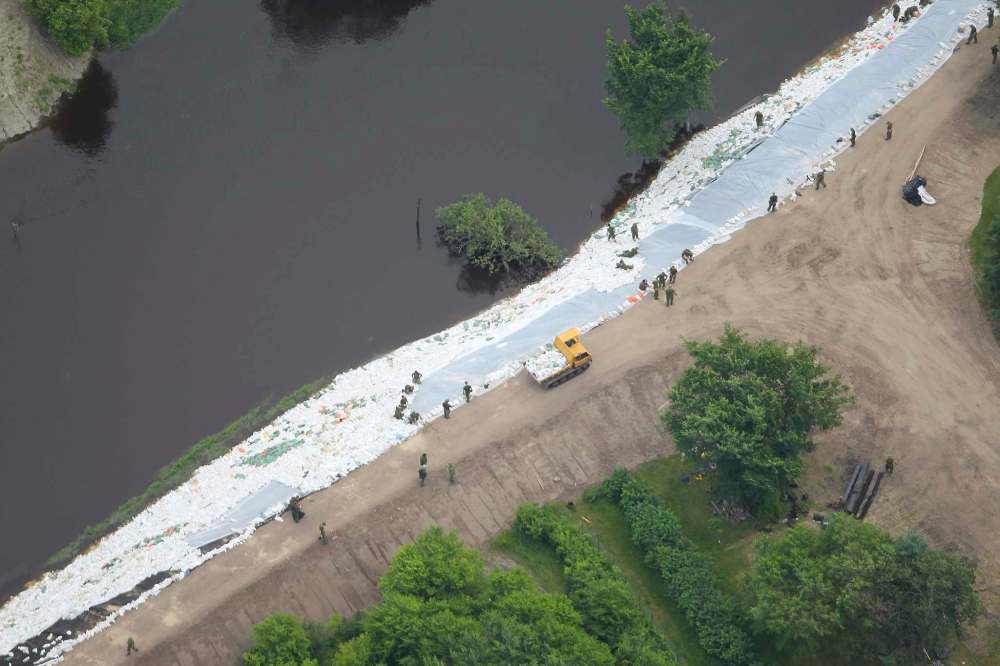
The Melita area was bracing for 30 millimetres of forecasted rainfall. The Souris River was already 90 centimetres above flood stage in the community, though still 2.7 metres below its dikes.
“We are quite relieved that we’ve had a gentle spring in terms of melting,” Brandon Mayor Shari Decter Hirst was quoted in the Sun. “We’ve also been able to avoid the heavy snowfalls and heavy rainstorms. Everything that could go right went right.”
The same day Decter Hirst made those comments, 15 people were evacuated from Sioux Valley Dakota Nation due to flooding on the Oak River. A total of 669 people had been evacuated across the whole province at that point.
In the RM of Cornwallis, volunteers including former reeve and Brandon mayor Reg Atkinson worked hard to help save the home of John Plowman as the nearby Willow Creek spilled over its banks.
Atkinson asked if Cornwallis could use the sandbagging machine, but was told it required upwards of 60 people to safely operate — more personnel than they could provide.
Instead, residents got creative and made their own sandbag filling machine, where a front-end loader or shovels loaded sand into bags via a series of sewer pipes fixed together with wood.
“They may be crude, but they work,” Atkinson told the Sun.
Brandon was able to fill 30,000 sandbags in the month since it had received its machine, with another 30,000 sandbags still in stock and ready to be filled.
In Souris, students from Souris School were conscripted into an effort to build sand dikes to prevent the Souris River from breaching its south bank and damaging nearby homes and a sewage treatment plant.

Rising temperatures loosened sheets of ice covering rivers, creating massive chunks crashing into anything into their path.
A super-sandbag dike breached in Gladstone, forcing eight patients at the Eight Regions Health Centre to relocate to another facility.
On April 14, the Assiniboine finally surged over its banks in Brandon. Water had reached the southwest corner of the intersection between Highway 10 and Grand Valley Road.
Grand Valley Road would be closed the next day, as super sandbags were placed where it meets 18th Street North to provide additional protection.
On Seventh Street North, one homeowner put up a for sale sign labelled “soon to be lakefront property” as the water neared their yard.
Residents of St. Lazare got hit on two fronts at once as the Qu’Appelle River flowed its spring runoff into the Assiniboine.
School divisions around the region faced problems busing students to school as water covered usual routes. Some divisions asked parents to drive their kids to school while others developed alternative routes.
The City of Brandon asked for volunteers as the Keystone Centre was set up to welcome flood evacuees from around the region.
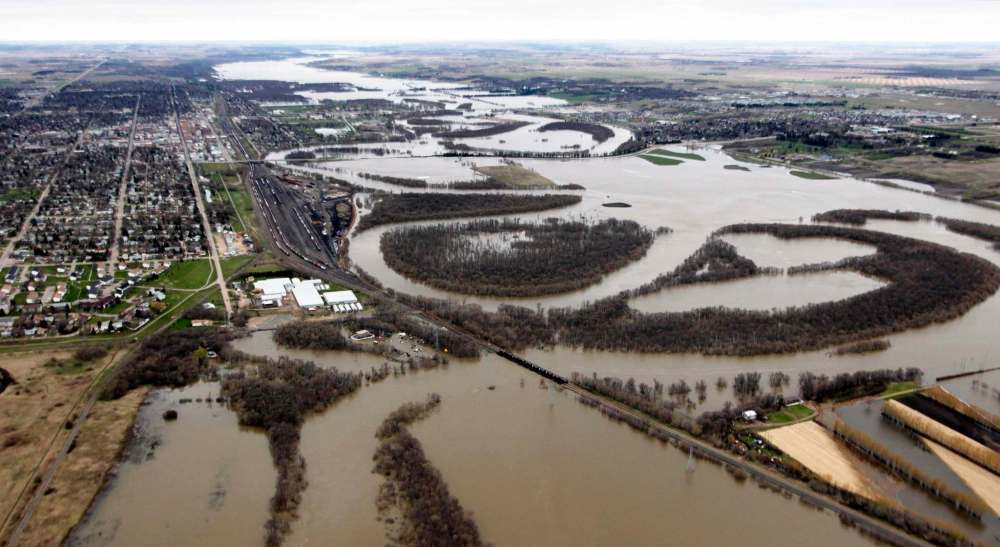
On April 18, water neared the top of the dikes in Melita. High school students came out to help build a secondary dike in case of a breach.
“I don’t think anyone thought this was going to be our big one, but they should have,” Dwight Murray, dealer principal at Southwest Chevrolet in Melita, told a Sun reporter. “There was tons of rain last year, the ground was saturated, every pond is full of water, there’s tons of snow everyone. You would have thought everyone would have been screaming about it this spring. But they weren’t. I’d say it snuck up on us a little bit.”
The dealership was forced to move its vehicles to the town’s arena complex for safety. A farmer next door to the dealership was busy filling steel grain bins with as many bushels as possible to send to the grain terminal in Elva.
April 19 saw St. Lazare residents scrambling to make final fortifications to the town dike with the crest of the Qu’Appelle River expected to arrive within a couple of days. Meanwhile, along the Souris River, communities downstream of Melita feared that the river might crest a second time.
Two houses outside of St. Lazare’s ring dike would be lost after power to the pumps keeping them safe had to be shut off.
Three days later, water in Brandon was covering parts of Grand Valley Road as it crept ever closer toward the Corral Centre.
Wawanesa School had to be closed on April 25. So much water was seeping into a crawlspace underneath the school that maintenance workers were said to be pumping out half a million gallons of water — approximately two million litres — every day.
Manitoba Water Stewardship’s Steve Topping told the Sun that extra water would likely linger in the Assiniboine River valley for six to eight weeks and in the Souris River area for five to seven weeks before receding, causing farmers to worry if they’d get access to their land in time for crop seeding.
In Brandon, water seeped under a super sandbag dike on 18th Street in one part of the city while water covered a lane of First Street near Dinsdale Park.
However, the worst news came in the form of a winter storm.
Westman was hit by a blast of snow and rain, hitting Melita first and knocking out power to all of the town’s residents.
The Assiniboine River reached its second-highest level in Brandon’s history, behind only the flood of 1923. However, the 31 millimetres of snow and rain still didn’t raise the water level above the city’s dikes.
Flooding caused a major fibre optic cable running between Brandon and Winnipeg to break, knocking out internet access to thousands of Westman Communications Group customers for a few days.
An unfortunate twist unfolded on May 7 when the province released that one of its river gauges was faulty, leading staff to create inaccurate water level predictions.
The City of Brandon had to scramble to raise its dikes as the Assiniboine’s crest was expected to arrive within days, especially with another rain storm in the forecast.
Complicating the matter was the number of locals travelling to the river to see the flooding for themselves, blocking traffic and even causing fender-benders when some motorists took their eyes off the road. Decter Hirst tried to stem the tide of sightseers by threatening people getting too close to the river with $50,000 fines.
Aqua dams were installed on top of existing dikes to further reinforce them. In the east end, a sandbag dike breached, flooding a business and a home near 17th Street East.
Kelleher Ford became an unofficial fire hall, with an ambulance and pump truck getting stationed at the dealership to respond to emergencies in the north end.
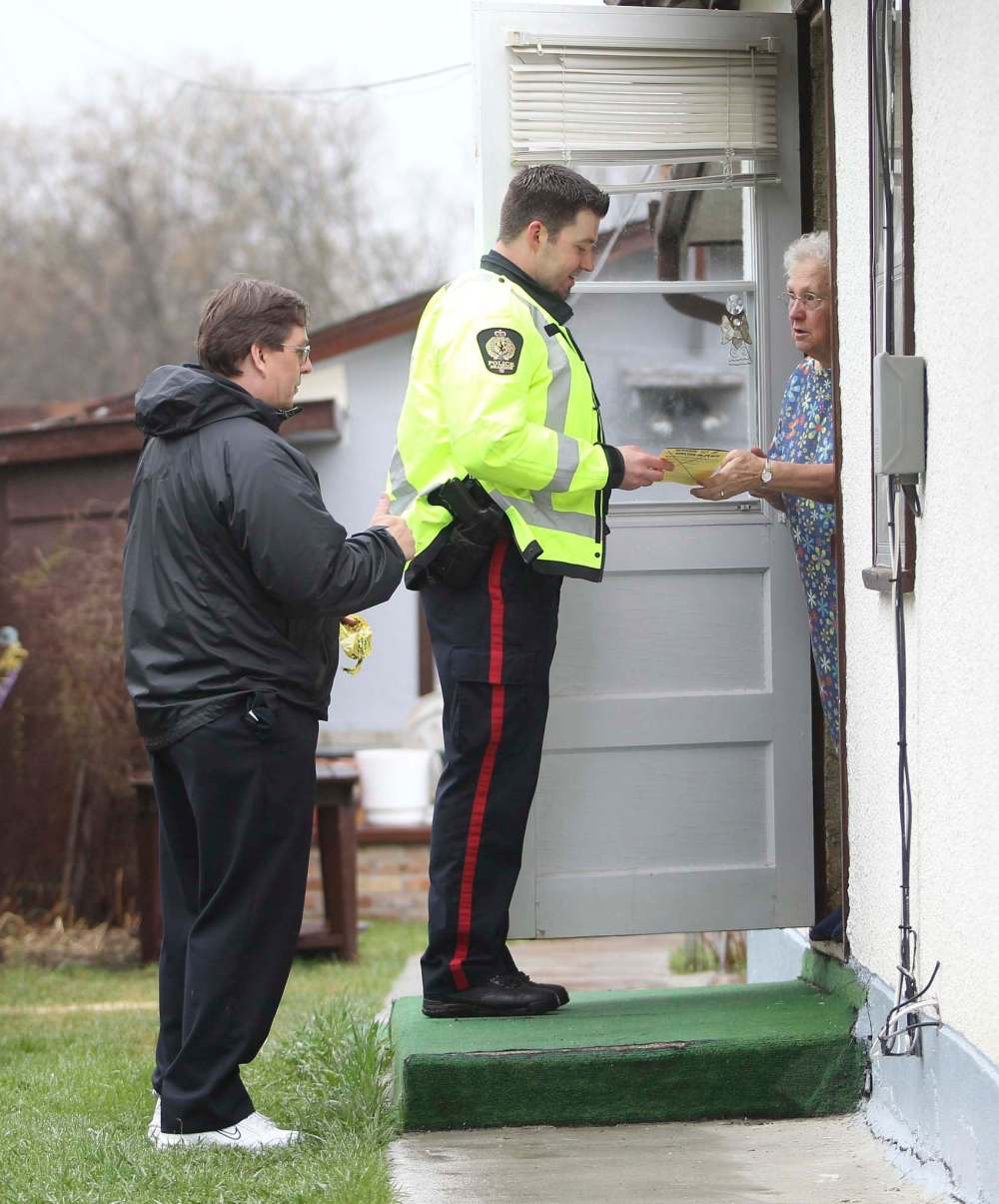
On May 9, evacuation orders were finally issued in Brandon, affecting an estimated 1,000 residents with another 1,000 expecting to be evacuated soon.
Hundreds of volunteers signed up for sandbag duty as the work to fortify dikes continued. Though the bulk of soldiers deployed to assist Manitoba with flooding were deployed east of Brandon to focus on flooding further downstream, approximately 50 members of the 26th Field Artillery Regiment reserve unit were called into help Manitoba Infrastructure crews protect the city’s highways.
Kirkcaldy Heights School was closed due to its proximity to the river, but Brandon University stepped in to offer a temporary learning space for its 400 students.
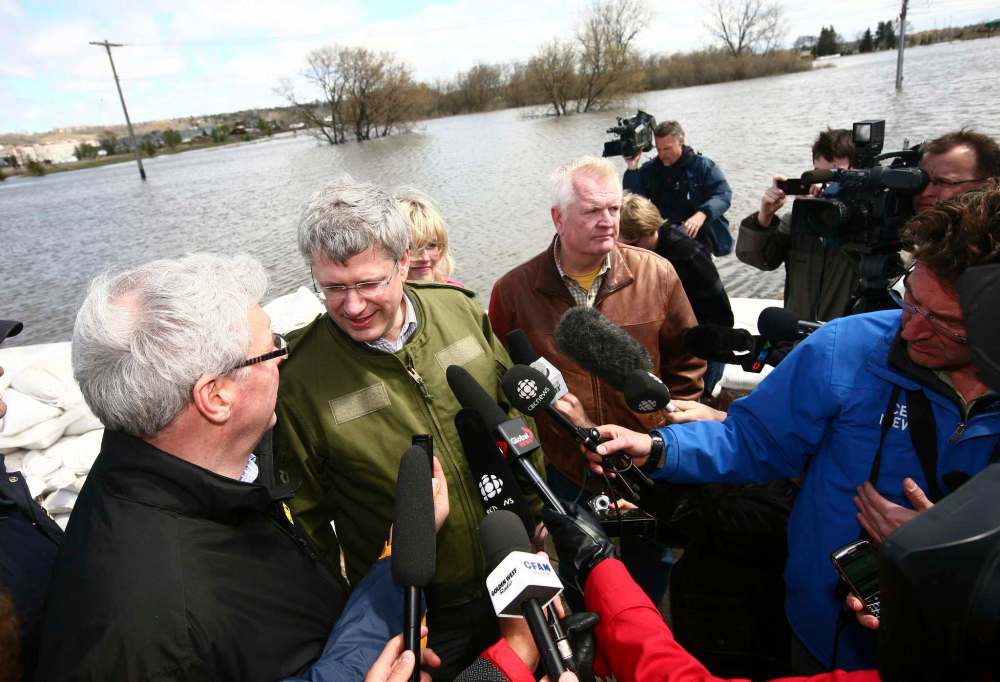
As the work to strengthen the dike continued, Prime Minister Stephen Harper visited the city less than two weeks after winning his first majority government.
“In spite of the volume of water, it is remarkable how much of this has been contained,” Harper told members of the media. “I know it certainly hasn’t all been contained, but a remarkable job has been done, considering the sheer enormity of this. You’ve basically got Lake Agassiz recreated every spring, and it’s really something to behold.”
To Decter Hirst’s chagrin, three households in the evacuation zone were refusing to leave their homes. She expressed frustration that it would cause problems for staff and volunteers if those residents had to be rescued from increasingly dangerous circumstances.
The next day, the holdouts were ordered to leave, along with businesses in the Corral Centre.
With water levels expected to rise further, the Salvation Army began efforts to bring meals to volunteers and staff protecting the city twice daily.
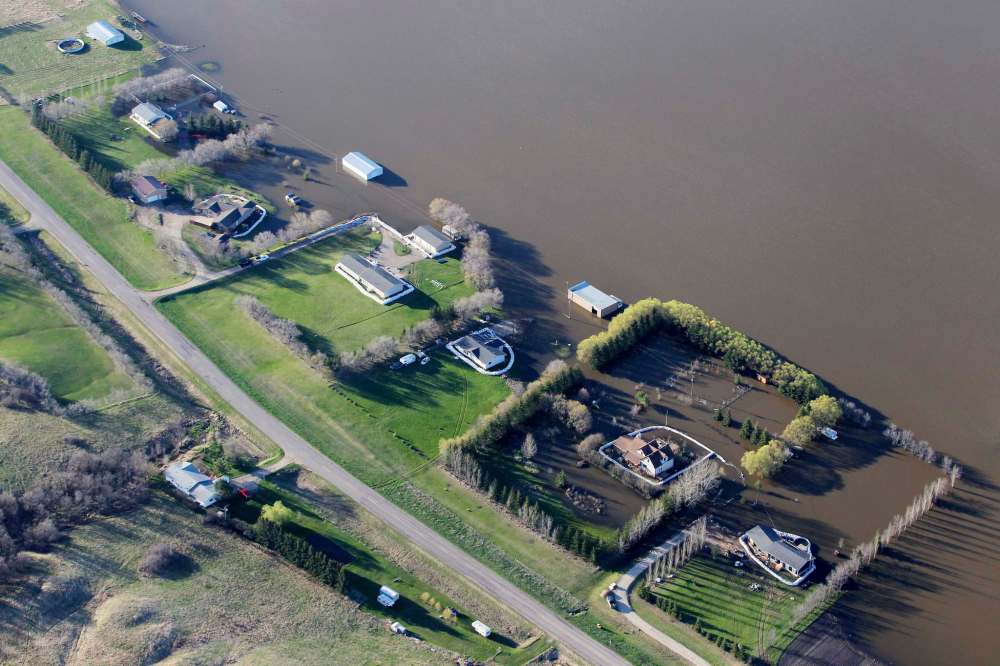
The Assiniboine River in Brandon crested on May 16, coming within 0.3 metres of the top of the dike system.
As water levels started to decline very slowly, city officials warned residents and businesses that it could be more than a month before it was safe for them to return.
Next time: damage is assessed and teamwork is celebrated.
» cslark@brandonsun.com
» Twitter: @ColinSlark