
Restorations bring animals in the ‘dead zoo’ back to life
B.J. Hales taxidermy exhibit preserves historic specimens
Advertisement
Read this article for free:
or
Already have an account? Log in here »
We need your support!
Local journalism needs your support!
As we navigate through unprecedented times, our journalists are working harder than ever to bring you the latest local updates to keep you safe and informed.
Now, more than ever, we need your support.
Starting at $15.99 plus taxes every four weeks you can access your Brandon Sun online and full access to all content as it appears on our website.
Subscribe Nowor call circulation directly at (204) 727-0527.
Your pledge helps to ensure we provide the news that matters most to your community!
To continue reading, please subscribe:
Add Brandon Sun access to your Free Press subscription for only an additional
$1 for the first 4 weeks*
*Your next subscription payment will increase by $1.00 and you will be charged $20.00 plus GST for four weeks. After four weeks, your payment will increase to $24.00 plus GST every four weeks.
Read unlimited articles for free today:
or
Already have an account? Log in here »
Hey there, time traveller!
This article was published 14/01/2022 (1558 days ago), so information in it may no longer be current.
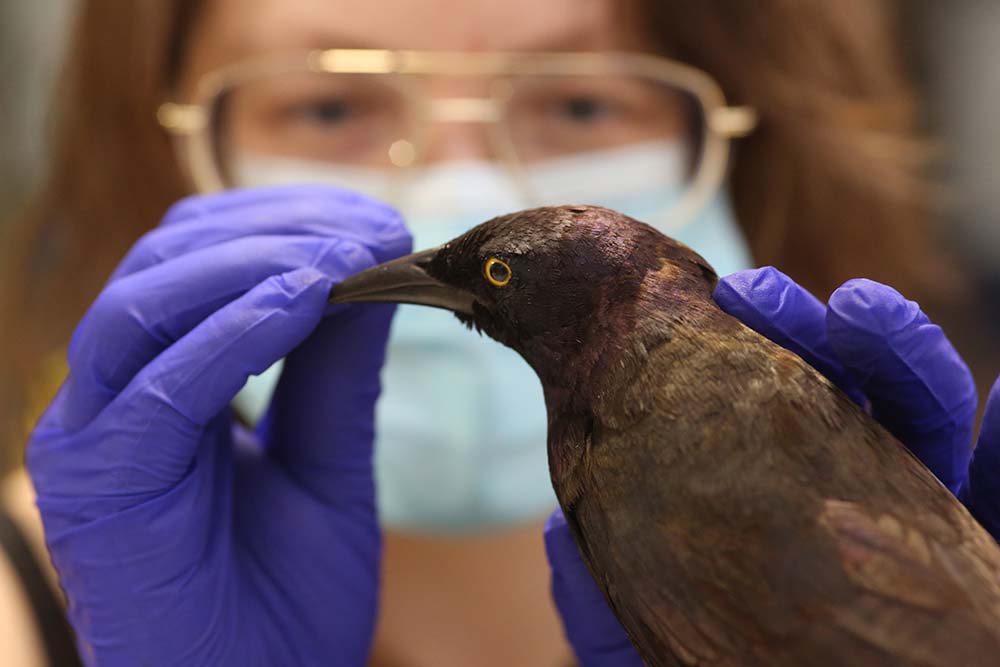
It’s a chilly Tuesday morning in the lead-up to Christmas when I meet Aly Wowchuk in her former office at the Brandon General Museum and Archives. She sports a blue medical mask and a pair of dark-blue rubber gloves when I find her in the middle of wrapping up a ruffled stuffed hawk with a large fold of the Sun’s obituary pages.
It feels oddly appropriate somehow.
The hawk is one of hundreds of bird and mammal specimens in Brandon’s historic B.J. Hales taxidermy exhibit, a collection that has been damaged by both the passage of time and an infestation of carpet beetles that had been ravaging this unique and irreplaceable collection for untold months.
Yet, it’s situations like this where a little luck and effort can pay some dividends.
While the COVID-19 pandemic has caused significant disruption and difficulty beyond the walls of the museum — and forced the local institution to close its Ninth Street location to the public for much of the last two years — it has given the former museum administrator a chance to de-infest the collection and to find a more suitable way to display the specimens, some of which have not seen the light of day in several years.
“When everything shut down, that’s when I started taking things off the walls and cleaning,” Wowchuk says as she leads me through the gallery.
She sits during the interview in the middle of the exhibit floor at a work table, upon which stands a pair of stuffed grackles (a type of blackbird), as well as a pair of large avian skins — a hawk and a great horned owl — used for scientific study and waiting for inspection.
“Just ‘cause no one else was here and I needed something to do. And then I started doing the counts, and said this is bad.”
Just how bad was the infestation, I ask.
“I brought a jar to a board meeting that I collected of larva and eggs,” Wowchuk says.
“[The collection exhibits] were cleaned maybe four or five years ago — just cleaned,” adds board chair Brent Chamberlain, who has joined us in the gallery and quickly jumps into the conversation. “And then [the exhibit] was reconfigured at that time. And from that time on is when it really got infested. But we don’t know, it could have been before.”
A historic collection
The Brandon General Museum and Archives currently occupies a leased space on Ninth Street — the former Manitoba Telephone Service Building that was built in 1917. Tucked away in the east end of the building, through a somewhat dark hallway that leads east past history hall, lies the newly revamped and renovated B.J. Hales gallery.
Blink and you’ll miss it, though. In fact, many visitors to the museum have walked through and back out the front door without ever suspecting they had failed to see a large part of the museum collection.
Two new hallway exhibits have been created as a means to draw visitors to the entrance of the B.J. Hales gallery, but it remains a work in progress.
“We were doing guided tours throughout the pandemic when we were open, not just to make sure we were complying with public health orders,” Wowchuk says, noting how easy it is to miss the entrance. “You can see a lot of Post-it notes are still up [on the walls] to give visitors a bit of context.”
The gallery itself is bright and inviting, and both large and small taxidermy specimens line the walls and floor of the facility. Scores of stuffed songbirds in various poses have been affixed to the western wall, and a display case of study skins has been added for public viewing. Some of the displays also sport the colours of Brandon University — an homage to the school and its previous incarnation as Brandon College, which previously housed the accumulated species.
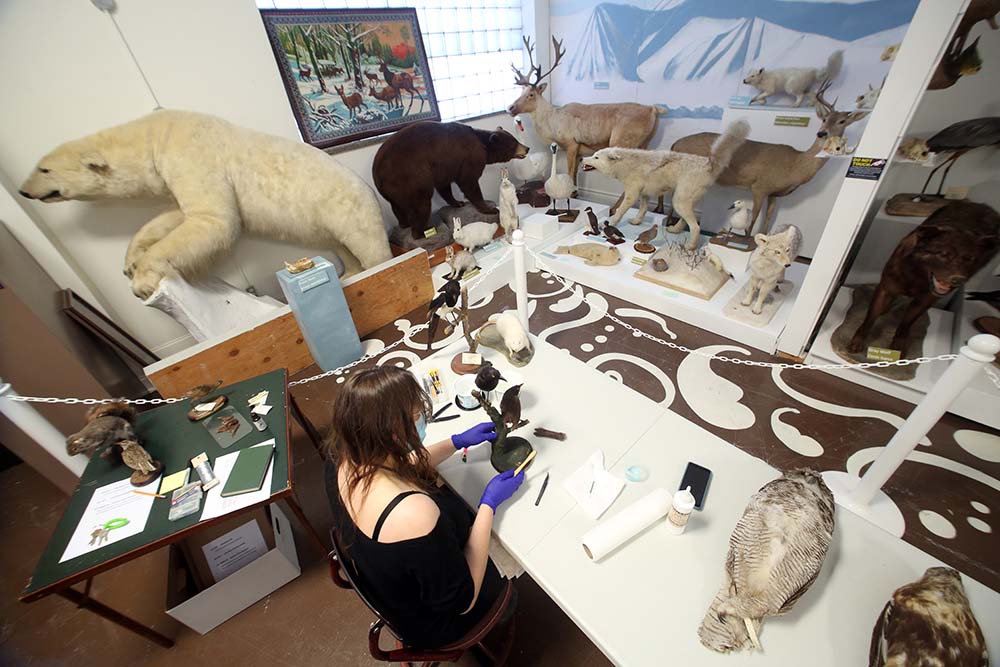
Yet the sheer number of pieces in the 140-year-old collection is daunting, and in spite of Wowchuk’s best efforts to find better ways to utilize the floors and walls, space remains at a premium within the leased facility.
Wowchuk’s work tables have been placed in the middle of the gallery floor, mere feet away from some of the largest animals in the collection. Indeed, her daily companions have been a polar bear, a deer, an arctic fox, a black bear, a baby moose, and several other creatures that co-habit the space.
“That’s one thing we wanted to highlight — that this is an adorable collection,” Wowchuk says.
“I call it the quiet zoo, or the dead zoo.”
All of them share historical ties to western Manitoba, and the collection’s various owners and donors — including taxidermist George Atkinson, who died in 1913 and passed along the collection to its current namesake, Benjamin Jones Hales, founder and principal of the former Brandon Normal School.
The collection, which has been on loan from the Brandon School Division since 2013, has many unique specimens including endangered and threatened species, as well as species that have extirpated — meaning the creature no longer lives in Manitoba, but once did.
Some examples of this are the greater Prairie chicken, the collection’s musk ox that is still housed at Brandon University, and the skull of a pronghorn.
“These no longer exist in this area, but they did at one time,” Wowchuk says. “So these are very special specimens.”
Repairing the damage
During the pandemic, Wowchuk, who recently stepped down as the museum’s administrator, spent many of her days attempting to repair the damage to the collection by removing bugs and eggs and restoring as much of the collection as possible to be ready for public viewing. Like the aforementioned hawk, this involves placing a given specimen inside a freezer for a length of time to kill off any larvae or egg infestations.
Her work tables sport the tools of taxidermy restoration: tweezers, a miniature brush, glue, paper towels, and some old yogurt containers that hold various liquids. Simple tools, but effective in doing significant repairs.
In order to prevent future infestations, Wowchuk also had to reinvent how the collection is displayed within the allotted space at the museum. The previous layout of the exhibit, though it allowed more than 70 per cent of the specimens to be placed on display, proved fertile ground for a carpet beetle infestation.
“Dust is the worst thing,” Wowchuk says, while busily dabbing glue to the broken edge of a stuffed grackle’s tail. “Dust can collect on something, it holds in moisture, it attracts other kinds of things, so constant cleaning is necessary.
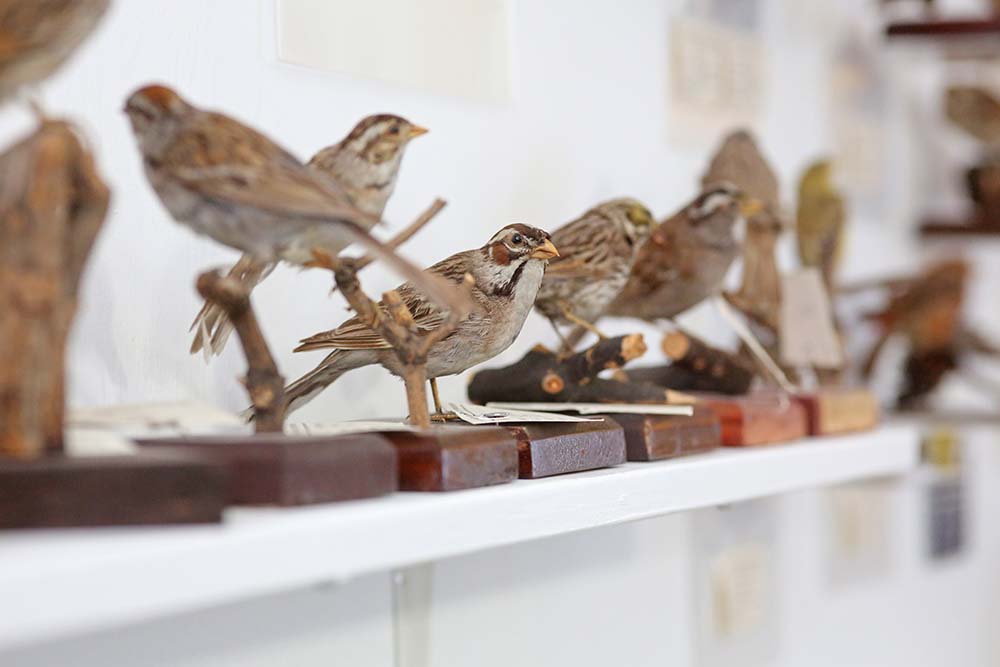
“There were a lot of fun little hiding places for those carpet beetles. That was all taken away, and we now have a clean white gallery look. This allows us to put more specimens on display in a tighter space. And also the white helps us identify any stray bugs that may fly and such.”
Some of the damage to the collection is not bug-related. The exhibit has been in and out of storage in various locations over the span of its existence. Wowchuk suggests it’s been in storage more than it’s been available for public viewing. Years of wear and tear and a basement flood in 2013 have caused considerable damage to the collection.
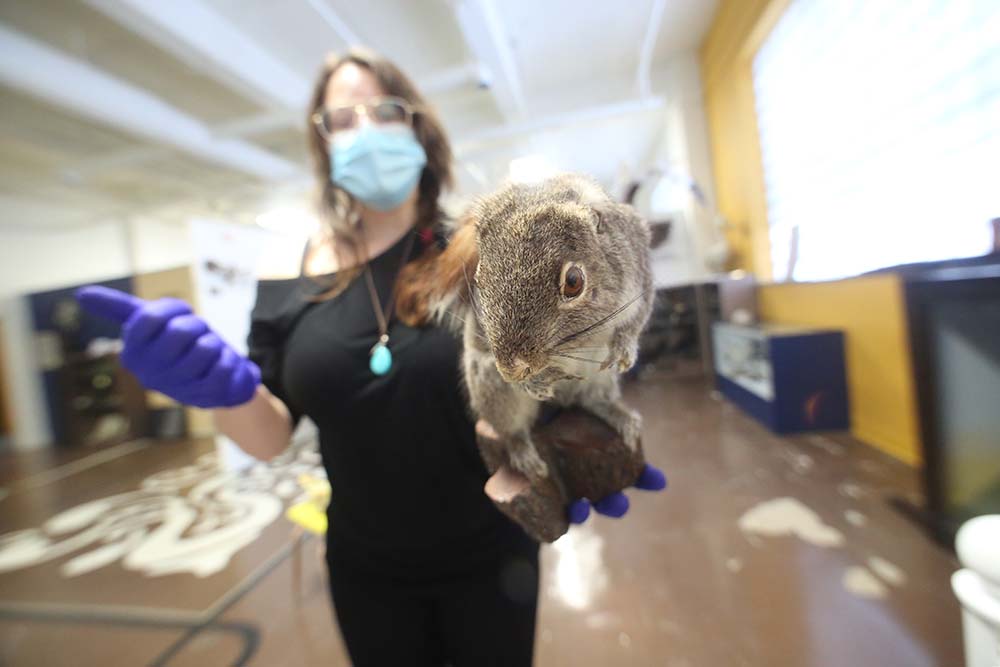
The exhibit has a pair of stuffed squirrels, for example, one of which remains in storage because it’s missing a set of ears. The other — a unique polydactyl animal with six toes — is out on display.
So, too, the collection’s prized baby moose, which suffered water damage to one side of its face, sinking the plaster underneath. The needed repairs to this specimen go beyond Wowchuk’s abilities and would require the expensive efforts of experts who are few and far between.
“To do a full restoration on that baby moose we’d have to remove the entire pelt, rehydrate it, and put it back on a plaster cast,” she said. “It’s a lot of money, very complicated and we don’t have the money and resources for something like that.”
But if there has been a second silver lining during the dark pandemic cloud, it has been the overwhelming support and the wealth of information flowing from other museums and taxidermy experts across North America. Much of her outreach has been to other museums, especially those with older taxidermy collections. This included talking with experts in the United Kingdom who are familiar with Victorian taxidermy, the same unique set of skills that Atkinson brought to his collection.
“It’s very rare to find people who do that sort of thing these days,” she said. “When the pandemic happened, a lot of these people … were stuck at home. And they were doing workshops and work things online for free that people could view.”
Her outreach efforts have paid off. Every animal on display in the newly renovated B.J. Hales gallery has been cleaned and restored in some way, with only a couple hundred pieces left to repair. At least, the pieces that can be restored. The rest will return to storage.
“The goal is anything that is good to display should be on display,” she says.
Finding a new home
The Brandon General Museum and Archives recently celebrated its 10-year anniversary. For part of that time, the board has been on the hunt for a new location. In 2019, previous board chair Barb Andrew told city council that while the museum had a good deal with the landlord, the location, lack of storage space and wheelchair accessibility were issues of concern. And space for displays is an ongoing issue.
Adding to the museum’s challenges, in 2018, city council decided to cut the museum’s operational budget by half to $40,000, with the museum’s future becoming an open question for our elected officials.
As a result, the museum’s current level of funding covers rent and utilities for the building, but not much more. The museum board has had to be shrewd with its fiscal plan in order to continue with an operating budget.
“We’ve been fortunate enough through donations and through just smart management with previous donations, we did build up a bit of a nest egg,” Chamberlain said. “We made a few investments type thing, rather than just have the money sitting there. So we’re using our nest egg for staffing, for supplies.”
Chamberlain hints at some changes coming for the museum, including a possible announcement of a new location later this month.
“I don’t want to go into too many details right now, but there is a plan for the museum to relocate within the core,” he said. “And hopefully with that, funding can be restructured so that more of our grant money, if it remains the same, for example, more of our money can go into staffing and other resources as opposed to rent and utilities. I’ll leave it at that for now. It’s kind of a mega project in the planning stages.”
For the B.J. Hales collection, this could mean some improvements in the future: more space and more permanent staff to take care of the various exhibitions. For Wowchuk, preservation of the historic taxidermy collection has become a labour of love. Though she has recently taken up the position of director of the Western Manitoba Public Library, she has decided to continue dedicating her time to restoring the taxidermy collection.
“We lucked out when we hired her,” Chamberlain said, “and we lucked out when she decided to stay on as a volunteer.”
With a dry smile, Wowchuk adds: “I’m very content being the dead-zoo keeper.”
But to see the collection properly displayed would not only complete her wish list, it would also fulfil the hopes of B.J. Hales who wanted the collection open to the public.
“If we had our own space, have an environment where these guys would last a lot longer, have them displayed and make it accessible to the public. Because that was Mr. Hales’ whole thing — he wanted to have his natural history collection available for new Brandon residents to make them more familiar with their new environment.”
» mgoerzen@brandonsun.com
» Twitter: @MattGoerzen