
Mental health, trade and labour on the agenda at KAP AGM
Advertisement
Read this article for free:
or
Already have an account? Log in here »
We need your support!
Local journalism needs your support!
As we navigate through unprecedented times, our journalists are working harder than ever to bring you the latest local updates to keep you safe and informed.
Now, more than ever, we need your support.
Starting at $15.99 plus taxes every four weeks you can access your Brandon Sun online and full access to all content as it appears on our website.
Subscribe Nowor call circulation directly at (204) 727-0527.
Your pledge helps to ensure we provide the news that matters most to your community!
To continue reading, please subscribe:
Add Brandon Sun access to your Free Press subscription for only an additional
$1 for the first 4 weeks*
*Your next subscription payment will increase by $1.00 and you will be charged $20.00 plus GST for four weeks. After four weeks, your payment will increase to $24.00 plus GST every four weeks.
Read unlimited articles for free today:
or
Already have an account? Log in here »
Hey there, time traveller!
This article was published 28/01/2022 (1520 days ago), so information in it may no longer be current.
Building trade connections, fostering mental health and addressing the ongoing labour crisis were a few of the many topics discussed at the Keystone Agricultural Producers annual general meeting earlier this week.
Keystone Agricultural Producers (KAP) president Bill Campbell said there is a sense of optimism heading into 2022.
Campbell, a grains farmer and livestock producer from Minto, was acclaimed as KAP president.
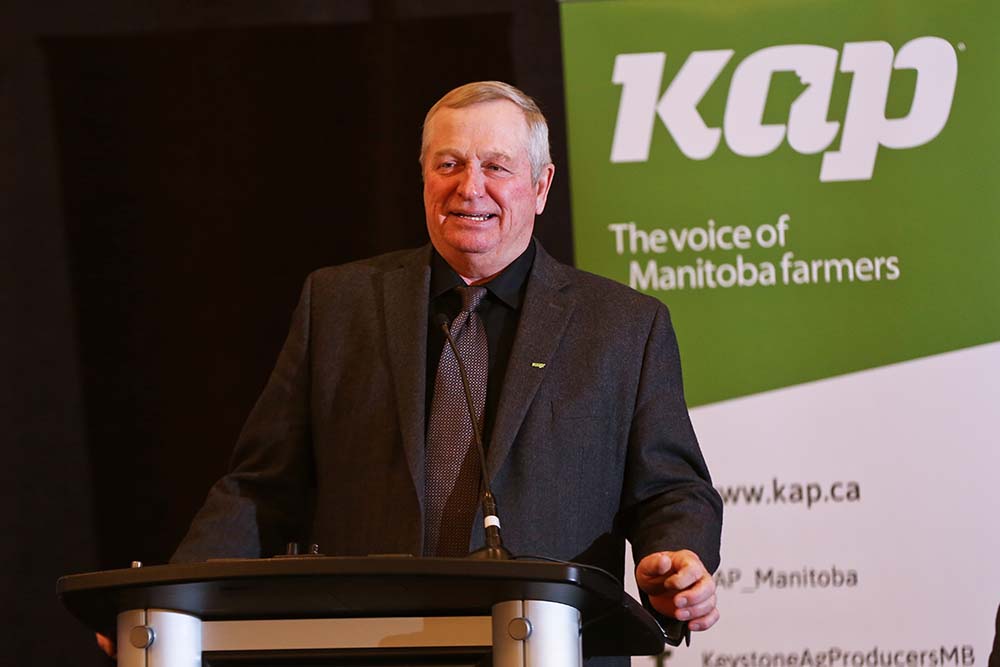
Jill Verwey, who operates a mixed farm near Portage la Prairie, and Jake Ayre, a grains and oilseeds farmer from Minto, were acclaimed as vice-presidents during the meeting which attracted 170 attendees at the virtual gathering.
KAP had a potent agenda to dissect, Campbell said. It involved speakers who tackled topics that included the environment, mental health and farm safety.
A series of resolutions were passed during the meeting, including an action to provide crop breeding support.
“Agriculture and Agri-Food Canada has a plant variety development program and it is based on acreages or values of the crop where the funds are allocated. Some of the smaller niche value crops do not receive adequate funds to do plant breeding programs,” Campbell said.
Discussions regarding public funding for plant breeding have been ongoing and KAP wanted to ensure there is a public component to ensure breeding programs thrive and exist.
At the meeting, it was resolved that KAP lobby Agriculture and Agri-Food Canada to protect the viability of public crop breeding programs by ensuring that AgriScience Clusters provides funding for all crossbreeding activities necessary to bring a new crop variety to market and that KAP lobby Agriculture and Agri-Food Canada that a minimum 70-30 (government-producer) the cost-share funding ratio is reinstated for smaller acre crops that cannot afford to meet the full cost-share ratio.
During the meeting, KAP also passed a resolution to work with Agriculture and Agri-Food Canada to ensure federal trade and market development programs meet the needs of smaller-acre crops and niche commodities through program changes providing; funding for domestic market development, including activities to promote the health benefits of agriculture and agri-food products to Canadians; financial assistance to help sectors resolve emerging non-tariff trade restrictions, including technical and political barriers to trade in overseas markets; flexible funding agreements for commodity associations that are unable to meet existing cost-shared funding ratio requirements.
Trade and market development will focus on both domestic and international growth.
“It’s challenging in so much that it takes a lot of capital and networking to establish trade relationships and it is difficult through a COVID environment globally that we are able to do that,” Campbell said. “There still is consumer demand for these products and so it’s challenging, but we want to ensure that still is an ability to carry on.”
Bringing new products to a fresh marketplace takes stages of development, and consumer awareness is a critical challenge. It takes dedicated networking and meeting with processors, meeting with international markets that can bring it to their consumers to aid in building trusting relationships and promotions.
“It takes a lot of time, commitment and travel,” Campbell said.
Olympian and mental health advocate Clara Hughes was the keynote speaker at the AGM, providing a moving and inspirational presentation on mental health.
Mental wellness has been an ongoing conversation in agriculture, he said, even prior to the COVID-19 pandemic, because “there are always stressors on the farm.”
Producers need to find ways to cope, and these issues have only been compounded by the pandemic, Campbell said.
He noted an update on the Manitoba Farmer Wellness program was also announced. The program was created to provide farmers and their families a safe and flexible way to access mental health and wellness supports.
Another major topic of concern was the ongoing issues with meeting labour demands in agriculture.
Presentations were provided by Minister of Agriculture Derek Johnson and Federal Minister of Agriculture Marie-Claude Bibeau. Both spoke to the issue of labour and moving forward in the agriculture community.
“That is one of the issues that we see — to be able to get our full potential of production and labour is one of those limiting factors that we see,” Campbell said.
Solutions for the challenge include the recently launched KAP labour consultation process to work together with other industries and provincial governments to see what they can do to alleviate labour shortages.
The federal government said dealing with the labour crunch is a top priority. Campbell added potential solutions can include temporary foreign workers and collaborations between horticulture and the vegetable industry with regard to labour to get products to market.
Overall, he said, things look bright for 2022.
“There are some reports that indicate the continual strength of commodity prices. There’s optimism in the beef industry with regards to the summer and fall of 2022 that there could enhance prices. So, I think there is a sense of optimism moving forward,” he said.
“I think agriculture is always about optimism as far as putting the seeds in the ground and expectations of a good harvest.”
» ckemp@brandonsun.com
» Twitter: @The_ChelseaKemp