
Web of connections: Community groups mobilize to deliver essential services
Advertisement
Read this article for free:
or
Already have an account? Log in here »
We need your support!
Local journalism needs your support!
As we navigate through unprecedented times, our journalists are working harder than ever to bring you the latest local updates to keep you safe and informed.
Now, more than ever, we need your support.
Starting at $15.99 plus taxes every four weeks you can access your Brandon Sun online and full access to all content as it appears on our website.
Subscribe Nowor call circulation directly at (204) 727-0527.
Your pledge helps to ensure we provide the news that matters most to your community!
To continue reading, please subscribe:
Add Brandon Sun access to your Free Press subscription for only an additional
$1 for the first 4 weeks*
- Enjoy unlimited reading on brandonsun.com
- Read the Brandon Sun E-Edition, our digital replica newspaper
*Your next Free Press subscription payment will increase by $1.00 and you will be charged $20.95 plus GST for four weeks. After four weeks, your payment will increase to $24.95 plus GST every four weeks.
Read unlimited articles for free today:
or
Already have an account? Log in here »
Hey there, time traveller!
This article was published 20/05/2022 (1498 days ago), so information in it may no longer be current.
When Janis Irvine describes Community Mobilization Westman, she compares it to the dream catcher sitting on top of a shelf in her office.
“We all have to come to that web of connection. We need to do that and get as many people connected and so when a client turns left, they’ve got support; when they turn right, they get support — every direction there’s somebody they know that cares about them that’s ready to step in,” said Irvine, the group’s co-ordinator.
Just like most people, Community Mobilization Westman is working on emerging from the pandemic and is looking ahead to helping Westman residents in new ways.
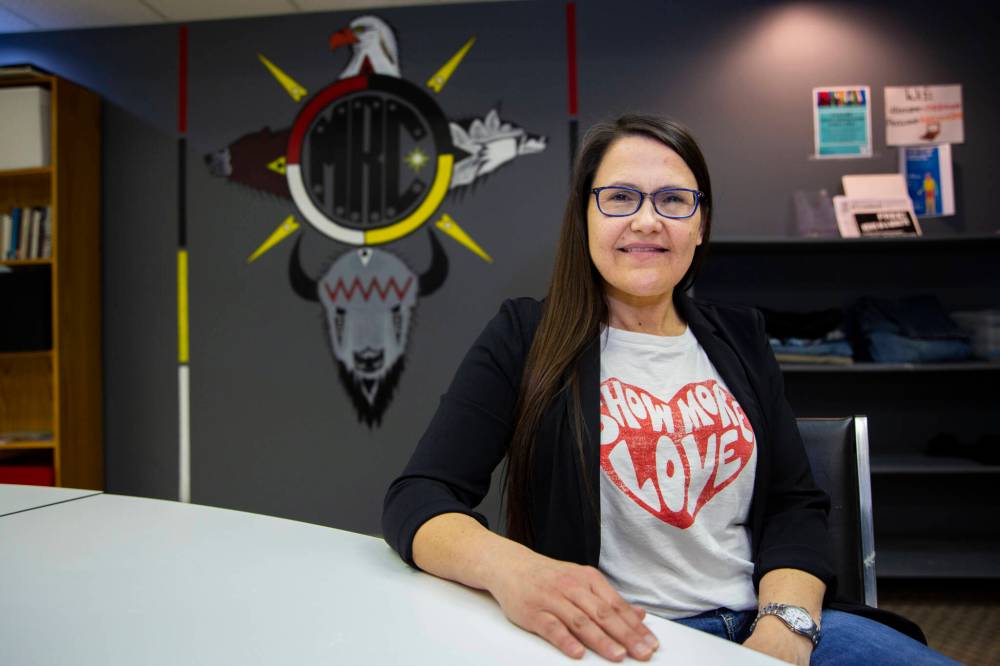
Community Mobilization Westman brings social services together at a HUB table twice a week, on Tuesdays and Thursdays. Representatives from a wide variety of groups — including Prairie Mountain Health, Brandon Police Service, Brandon School Division, Child and Family Services of Western Manitoba, Dakota Ojibway Child and Family Services, and Women’s Resource Centre — work together to evaluate risks and help individuals or families through crises by connecting them with the right supports.
Rather than people having to go to social services for help, the HUB table wraps support around them and brings the social services to them.
The group has been running in the Wheat City since April 2015, recently marking seven years of operation. Similar models exist in Winnipeg and other cities.
When the name of someone who could benefit from support comes forward, the HUB table gets together and assesses the case, said Ross Robinson, the chair of the organization’s steering committee. They look at the social service agencies that the person is already involved with and which other ones could help.
“We will stop at that person’s home, tell them that we’re here to help… and we want to get that help there before it becomes an even greater challenge,” he said.
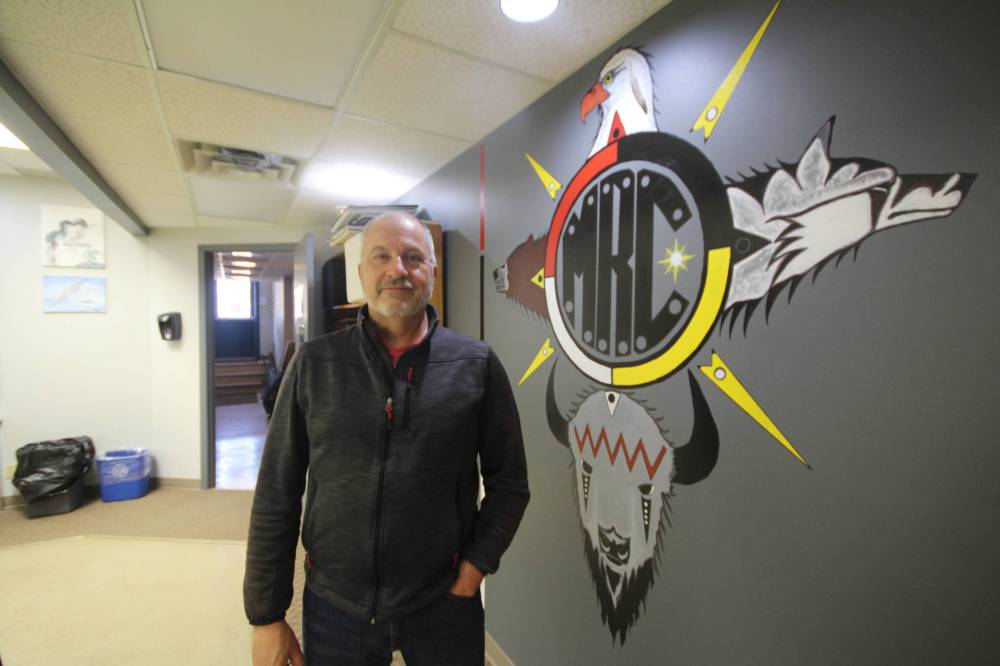
The last two years presented challenges, Robinson said, who talked to the Sun while seated around a table painted red, black, white and yellow like a medicine wheel. Robinson said the organization helps people at an acutely elevated risk.
It became more difficult to find people and get them connected to resources over the last two years, but Robinson said the work didn’t stop. Members couldn’t knock on people’s doors, but found new ways to make contact with people in need.
“Just like everything, for the first couple weeks [of the pandemic], things kind of sucked back … they had to re-tool and get back to the work at hand. The problems never go away,” he said.
Mental health and addiction continued to be big issues for people, he said, just like before the pandemic. On average, people came with nine different risk factors, which the HUB table assesses, such as criminality, emotional violence, suicide and mental health.
“Social service agencies see a lot of challenged people and they deal with that on a daily basis … it’s only in very, very acute elevated risk that get presented to the HUB table, because we don’t have the resources to address everybody out there in the community.”
Over the last seven years, Community Mobilization Westman has helped 790 cases directly, creating a positive outcome in 1,200 lives, Robinson said. Only 31 families or individuals have refused help so far. On average, six agencies team up to create a plan to assist each individual or family.
In 2019, the Manitoba government announced $80,000 in funding for the organization through the Guns and Gangs Suppression Strategy. The money was used to hire a co-ordinator in 2020.
Irvine has worked with the HUB table almost since its inception and was previously the representative from probation. She said she remembers the first meeting, which was in the gym at Crocus Plains Regional Secondary School.
Coming out of the pandemic has been somewhat easier than expected, she said, because of the commitment of everyone around the HUB table as a “united team.”
“If we just boil it down to the basics, it’s people getting around a table … saying ‘I’m genuinely worried about this person,’ and then all of us saying, ‘Then let’s do something about it,’” she said, adding she believes it’s a very Indigenous approach of caring for people.
Community Mobilization Westman started with one stream focused on helping people in crisis. But now Irvine, who worked as a probation officer and started as the co-ordinator in early May, said the group is launching a second stream focused on helping people over the long term.
The second stream is about giving people enhanced supports, by bringing their team together and setting goals.
“Everybody in that support team is accountable to something, so that that person sees that yes they’re doing the hard work, but there’s also supports around them doing that work as well.
“The client has the power to be able to decide if someone needs to leave their team or they want to add somebody to their team.”
The goal is to eventually wean support away once the person has a community built around them.
“Being in the helping service, you get the privilege of kind of saddling up beside somebody and saying ‘I know you’re in a tough time, I just want to ride this little next piece of the road with you, share what I know, maybe introduce you to some friends,’ and I think that’s what the Phase 2 will be about.”
The second phase started in early May. Irvine said she wanted to hit the ground running after losing time to COVID-19, and the HUB table already has a few people in the program.
The plan is for Irvine to meet with people referred to Phase 2 of the program and get to know their goals. From there, she will reach out to their support people to build the team and help people meet their goals.
“We acknowledge that our goal to connect clients to services and supports in meaningful, effective ways can only be done when the relationships we have with each others as professionals is based on mutual trust, respect and a love for this community.”
Winnipeg’s community mobilization, Thunderwing, also has a long-term stream.
Irvine said she believes community mobilization can help with some of the social issues in Brandon by showing a sense of compassion for people, which was more difficult over the pandemic. She said her love and commitment to Brandon runs deep.
“In the absence of love and compassion, you’re always going to see hurt … The ability to love people face to face and show that compassion was depleted and decreased, so absolutely you’re going to see more hurt in the community,” she said.
“We have some really hard questions to ask ourselves. What are we prepared to do for the wellness of all? And it can’t be about spending money on researching things, which is important. However, the money has to go into doing the tangible, feet on the ground work.”
Other downtown agencies, such as the Brandon Neighbourhood Renewal Corporations’ Blue Door Project and Ask Auntie have also done great work in the community, she said
Going forward, Robinson said Community Mobilization Westman is looking at new ways to help in Brandon, including whole neighbourhoods. So far, he said the organization has helped three neighbourhoods in the city by bringing food or social services directly to them, but he declined to say which ones.
One of the most satisfying parts of the work is being proactive rather than reactive, Robinson said. Social services in the city are always looking at new ways of looking at problems and being innovative.
“We’re not just sticking to old models. We’re researching and employing any new technique we know is causing a positive difference in other communities, and we’ll take that on,” he said.
“If we approach everybody in our job with kindness and love … we will as a community be better off.”
» dmay@brandonsun.com
» Twitter: @DrewMay_