
Woman regains independence with sight device
'All I want is to see and do the things I love'
Advertisement
Read this article for free:
or
Already have an account? Log in here »
We need your support!
Local journalism needs your support!
As we navigate through unprecedented times, our journalists are working harder than ever to bring you the latest local updates to keep you safe and informed.
Now, more than ever, we need your support.
Starting at $15.99 plus taxes every four weeks you can access your Brandon Sun online and full access to all content as it appears on our website.
Subscribe Nowor call circulation directly at (204) 727-0527.
Your pledge helps to ensure we provide the news that matters most to your community!
To continue reading, please subscribe:
Add Brandon Sun access to your Free Press subscription for only an additional
$1 for the first 4 weeks*
- Enjoy unlimited reading on brandonsun.com
- Read the Brandon Sun E-Edition, our digital replica newspaper
*Your next Free Press subscription payment will increase by $1.00 and you will be charged $20.95 plus GST for four weeks. After four weeks, your payment will increase to $24.95 plus GST every four weeks.
Read unlimited articles for free today:
or
Already have an account? Log in here »
Hey there, time traveller!
This article was published 08/06/2022 (1446 days ago), so information in it may no longer be current.
Velma Beaudette has regained her independence with a device that looks like something straight out of a science-fiction story.
But this isn’t a movie prop or cosplay accessory. The device known as an eSight helps the soon-to-be 90-year-old recover most of the sight she has lost to age-related macular degeneration.
The device is a combination of a camera, goggles and a headband that looks similar to a virtual reality headset. It works to project enhanced images at her eyes so she can register fine details in her direct line of sight that she had previously lost.
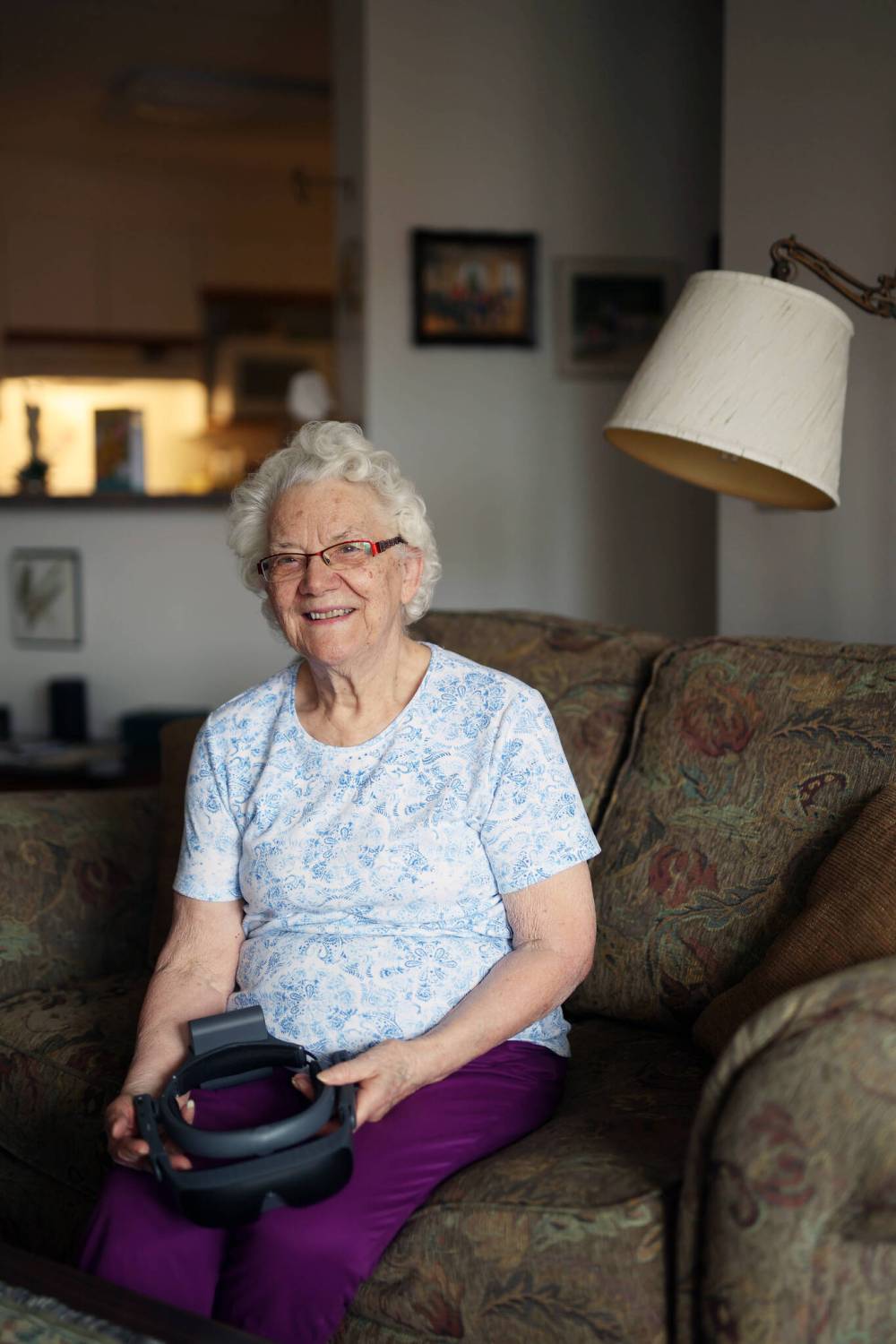
She had been gradually losing her sight since her early 80s, when she noticed she was having a harder time reading words. Then she was diagnosed with macular degeneration.
Since then, her central vision has been declining, but she still has most of her peripheral vision, which helps her navigate around her environment. For a while, it also meant she had to surrender some favourite activities, like sewing, as well as get help reading letters and mail.
Despite the progression of her vision loss, she keeps a sense of humour about it.
“When I found out [about the diagnosis], I thought: ‘Oh, darn. I took after the wrong side of the family,” she quipped. “My mom had it, my sister had it, two of mom’s three sisters and my grandmother [had it], right down the line.”
When her children suggested she try an eSight, Beaudette said she knew of a man in the city who also had one and decided to give it a try. She tried an older model in December 2021, and one of her sons immediately noticed an improvement in her abilities.
“He was amazed I could see things at a far distance and things like that, but that didn’t impress me,” she said. “What impressed me was that I could look at my mail by myself, so I don’t have to wait and come to read it to me. I could even do a little bit of sewing. The things that I need, the commonplace things that really make a difference in my life.”
Macular degeneration is the gradual loss of central vision, which is needed for fine tasks like reading, driving and recognizing faces, according to Medlineplus.gov. The condition is caused by the gradual loss of light-sensing cells in the back of the eye, known as the retina. Macular degeneration specifically affects the central part of the retina, known as the macula.
While there is no definitive link between the disorder and genetics, it does appear to run in some families. An estimated 15 to 20 per cent of people with macular degeneration have one first-degree relative, such as a sibling or parent, who also develops the condition.
Beaudette has since upgraded to the latest model, the eSight 4, and said she has regained most of her sight. If there is any complaint, it’s that the device gives her slight headaches when she wears it for extended periods of time. The company told her it can be worn like a hat, but she said that doesn’t help with the encroaching discomfort.
However, Beaudette said she only needs it to do activities like reading, sewing and when she is out running errands. When she is home, she doesn’t need it as often, or to navigate around her apartment.
Whenever someone buys or leases an eSight, they get access to a coach and weekly seminars.
Beaudette said the basic instructions were enough for her.
“I was entitled to a lot more coaching and seminars, but I told them all I need is to get around. I’m not a young person trying to work and earn a living,” she said. “All I want is to see and do the things I love.”
The purpose of eSight is to help users regain a sense of normalcy and quality of life for as long as possible, according to the manufacturer.
Macular degeneration is progressive, and there is no cure or treatment to stop it from advancing, said Roland Mattern, director of product marketing for eSight, but the device helps the brain perceive images with near 20/20 or 20/30 vision.
The device includes a high-definition camera located just above the bridge of the nose that takes video and feeds a digital signal to a software algorithm to optimize the images being captured, Mattern said.
Those images are then projected to the person’s eyes through two small LED screens pointed at each eye in the visor, where the remaining functioning photoreceptors in the eyes take the images and feed them into the central nervous system to the brain, specifically the central cortex. The cortex processes the information as it would any normal information picked up by the eyes.
From there, the eSight device enhances the images.
“What patients have described to us is that central image the camera picks up that they can no longer perceive and overlays it on the blind spot they have,” Mattern said. “They describe the blind spot shrinking away as they zoom in on the images.”
The best part about it is the cameras adapt to match the progression of the macular degeneration, and they are always working on upgrades, he said.
This isn’t just about providing a product and service for profit — it’s about helping people maintain their independence, he said. Losing one’s vision has serious physical and mental consequences, especially for people who had normal or near-normal sight most of their life and may not be able to adapt to oncoming blindness.
Technology like this is going to be needed more than ever as the North American population ages, Mattern said.
Age-related macular degeneration is the leading cause of vision loss in people over the age of 50, affecting approximately 2.5 million Canadians, according to the charity Fighting Blindness Canada.
More about eSight can be found online at esighteyewear.com/.
» kmckinley@brandonsun.com
» Twitter: @karenleighmcki1