
Tories have the money to make deadly stretch of highway safer
Advertisement
Read this article for free:
or
Already have an account? Log in here »
We need your support!
Local journalism needs your support!
As we navigate through unprecedented times, our journalists are working harder than ever to bring you the latest local updates to keep you safe and informed.
Now, more than ever, we need your support.
Starting at $15.99 plus taxes every four weeks you can access your Brandon Sun online and full access to all content as it appears on our website.
Subscribe Nowor call circulation directly at (204) 727-0527.
Your pledge helps to ensure we provide the news that matters most to your community!
To continue reading, please subscribe:
Add Brandon Sun access to your Free Press subscription for only an additional
$1 for the first 4 weeks*
*Your next subscription payment will increase by $1.00 and you will be charged $20.00 plus GST for four weeks. After four weeks, your payment will increase to $24.00 plus GST every four weeks.
Read unlimited articles for free today:
or
Already have an account? Log in here »
Hey there, time traveller!
This article was published 18/08/2022 (1284 days ago), so information in it may no longer be current.
Whatever the Manitoba government’s excuse is for not twinning the final stretch of the Trans-Canada Highway to the Ontario border, it’s not for a lack of money.
The provincial Tories have underspent their infrastructure budget by about a half-billion dollars a year since 2017. They also have hundreds of millions in unallocated infrastructure dollars over the next three years that could go toward the highway-expansion project. The money is there; the only question is whether the political will exists to get the job done.
Calls to twin the last stretch of the Trans-Canada Highway from Falcon Lake to the Ontario border have been renewed after the tragic death of a father and son in a head-on collision near Barren Lake in 2019. Mark Lugli, 54, and his son Jacob, 17, were driving to Selkirk for a junior golf tournament when an eastbound tractor-trailer swerved into their lane, killing them. The family is calling on government to twin the highway to reduce the risk of future highway deaths.
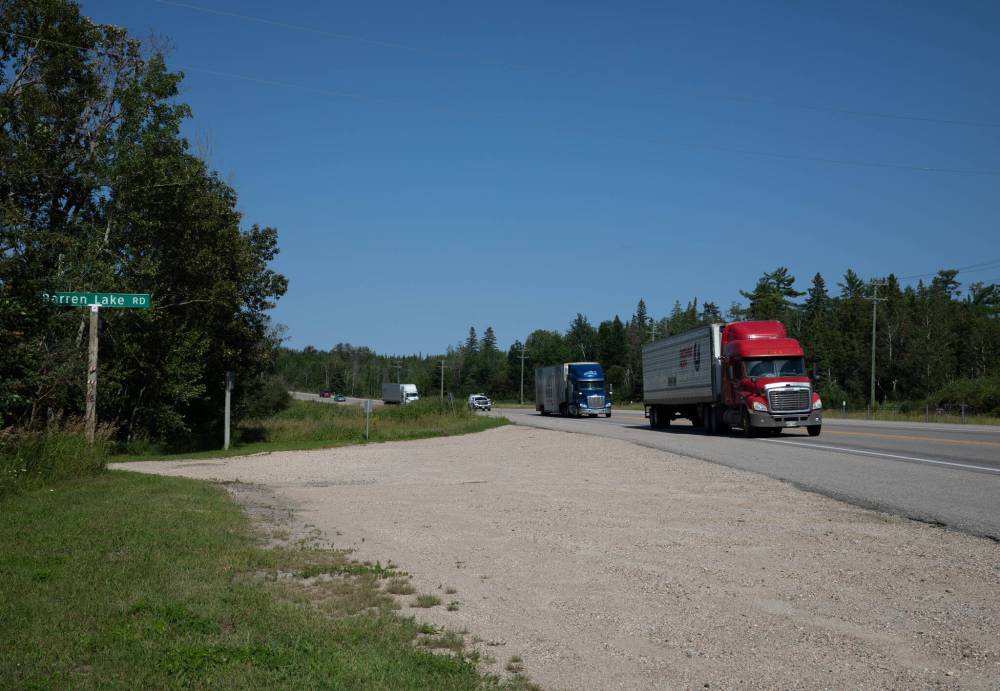
The intersection of Barren Lake Road and the Trans-Canada Highway near the Ontario border is shown earlier this month. In 2019, Mark Lugli and his son Jacob Lugli were killed at this intersection when an eastbound transport truck plowed into Mark’s westbound truck. There was stopped traffic trying to turn left and the transport driver was trying to avoid stopped vehicles and drove into the westbound lane. (Winnipeg Free Press)
Transportation and Infrastructure Minister Doyle Piwniuk said twinning that part of the highway is something his department plans to look at in the future. In other words, it’s not even on government’s radar. It should be. The rookie cabinet minister said it would require a “substantial” investment to widen that part of the highway, given the rocky topography. Naturally, it’s expensive. However, the province has the budget to do it — it could start by spending the money it allocates to infrastructure projects every year.
In 2017-18, the Tories underspent their infrastructure budget by $487 million. In 2018-19, they were $566 million under budget. Just for context, that would have been enough to pay the entire cost of the North End sewage treatment plant’s Phase 2 upgrade (which is being cost-shared by three levels of government). The following year, the Tories underspent the infrastructure budget by $404 million.
In 2020-21, the province budgeted $2.18 billion for infrastructure, but spent only $1.67 billion of it. A lot of infrastructure dollars have been left on the table in recent years.
Some of that was for legitimate reasons, such as project delays. But in other cases, government was simply trying to save money. There’s a cost to that: the longer infrastructure is neglected, the more expensive it becomes to fix. In the case of the Trans-Canada, further delays in twinning could result in more deaths and serious injuries.
For those wondering how the province can afford new infrastructure projects when it’s running a deficit, capital costs aren’t paid for all at once through operating budgets. The province borrows money to pay for things such as highways, bridges, new schools and hospital expansions. The cost is amortized over the useful life of the asset and the debt to pay for it, including servicing charges, is repaid over time.
Provincial debt, which includes accumulated deficits, has to be carefully managed. Governments require sufficient revenue to cover financing charges and their debt has to be sustainable in the eyes of bond-rating agencies. There is no single metric to gauge that. However, government’s net debt as a percentage of the economy is one of the standard barometers. The Manitoba government’s debt-to-GDP is projected to fall slightly to 35.9 per cent this year (it has fluctuated between approximately 21 per cent and 39 per cent over the past 25 years). If that trend continues, and it’s expected to, it’s a very manageable debt load.
Meanwhile, there are hundreds of millions in unallocated infrastructure dollars over the next few years that could be used for projects like twinning the Trans-Canada, according to the province’s 2022 budget.
The province allocated $2.1 billion for infrastructure this year (not including Crown corporations). It’s projecting $1.9 billion and $1.8 billion in infrastructure spending the following two years, respectively. That doesn’t mean it’s planning to spend less in those years; those figures represent projects already chosen. There’s room for more, according to the budget documents.
“This should not be interpreted as a downward commitment from the government,” the budget states. “As future years are budgeted, new projects will be added to the three-year capital plan.”
Twinning the Trans-Canada Highway should be among them.
» Tom Brodbeck has been covering Manitoba politics since the early 1990s and joined the Winnipeg Free Press news team in 2019. This column originally appeared in the Free Press.