
BU student recognized for palynology research
Advertisement
Read this article for free:
or
Already have an account? Log in here »
We need your support!
Local journalism needs your support!
As we navigate through unprecedented times, our journalists are working harder than ever to bring you the latest local updates to keep you safe and informed.
Now, more than ever, we need your support.
Starting at $15.99 plus taxes every four weeks you can access your Brandon Sun online and full access to all content as it appears on our website.
Subscribe Nowor call circulation directly at (204) 727-0527.
Your pledge helps to ensure we provide the news that matters most to your community!
To continue reading, please subscribe:
Add Brandon Sun access to your Free Press subscription for only an additional
$1 for the first 4 weeks*
- Enjoy unlimited reading on brandonsun.com
- Read the Brandon Sun E-Edition, our digital replica newspaper
*Your next Free Press subscription payment will increase by $1.00 and you will be charged $20.95 plus GST for four weeks. After four weeks, your payment will increase to $24.95 plus GST every four weeks.
Read unlimited articles for free today:
or
Already have an account? Log in here »
Hey there, time traveller!
This article was published 22/08/2022 (1466 days ago), so information in it may no longer be current.
After finishing her honours program last year, Brandon University master’s student Nidhi Patel is already garnering a lot of attention for her new research into palynology, having received three academic awards this summer alone.
These accolades include the Winifred Goldring Award (presented by the Association for Women Geoscientists and the Paleontological Society), an Outstanding Student Research Award from the Mid-America Paleontology Society and an Annual Student Research Award from the Canadian Association of Palynologists.
While Patel applied to be in the running for these awards, and the grant money that comes along with them, she never expected to win all three.
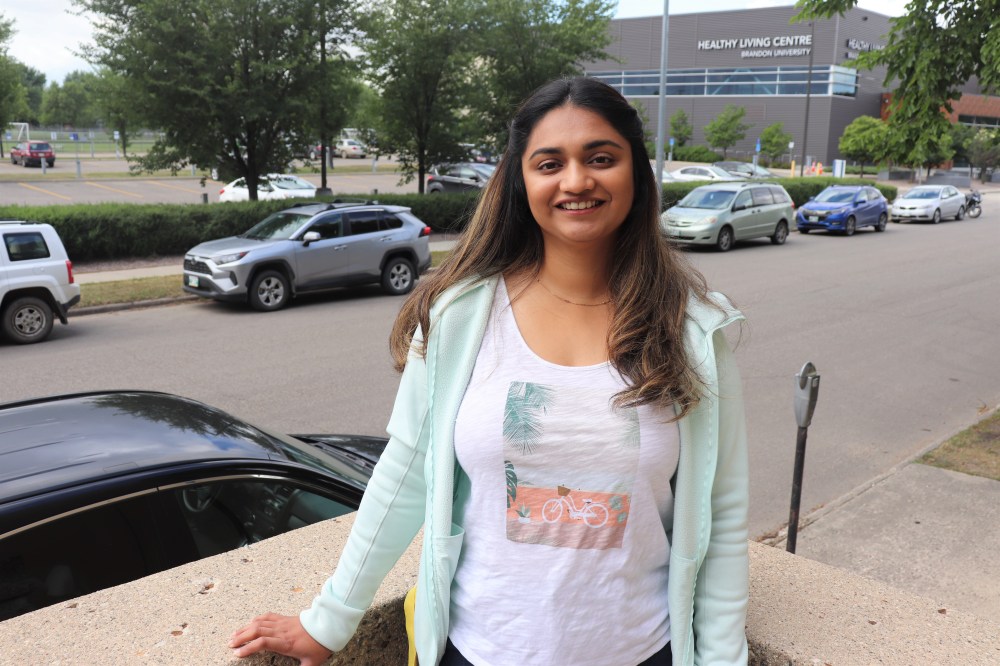
Nidhi Patel poses for a photo outside Brandon University's John R. Brodie Science Centre on Friday. Patel is currently pursuing a master's degree in environmental and life sciences and recently received three academic awards for her research into fossilized pollen and spores. (Kyle Darbyson/The Brandon Sun)
“I was quite surprised that everyone liked my research proposal and the brief descriptions that I had to send in and everything,” she said last week.
Since 2019, Patel has been laser focused on studying fossilized pollen and spores (also known as palynology), having been introduced to this specific field of study through BU professor David Greenwood, who is a noted researcher of ancient plants.
“And then I decided to pursue my honours in his lab, where we were working on a project in Manitoba, in the Turtle Mountain region,” she said, describing how she and Greenwood used sediment found in a streambank outcrop to reconstruct terrestrial plant ecology from millions of years ago.
“We finished that project successfully, and I also got my first author publication from that. And from then on, I was hooked.”
Now that she is pursuing a master’s degree in environmental and life sciences, Patel has moved on to studying a rock outcrop located on Vancouver Island that contains remnants from before the Cretaceous-Paleogene mass extinction event that wiped out all non-avian dinosaurs.
Since a handful of sediment can hold tens of thousands of microscopic pollen and spores, Patel and her team, which includes researchers from the University of Victoria, believe that this outcrop holds the key to better understanding how forests and swamps on the west coast responded to this cataclysmic event.
Prior to this study, the scientific community’s understanding of this mass extinction in North America was restricted to areas east of the Rocky Mountains.
“I wish to resolve questions pertaining to extinction, recovery post-extinction and evolution of plant communities after a drastic disturbance event,” Patel said in a recent BU news release.
While Patel’s master’s thesis has been progressing nicely, she admits that the ongoing pandemic has had a noticeable impact on her work in the lab and out in the field.
“In fact, my field work this summer got curtailed because one of our team members got COVID,” she said.
“But I’ve still been busy in the lab because we already had someone collect some samples for us, so we’re getting new slides prepared.”
Even after this current project wraps up, Patel already has her eye on the future, as she is planning to pursue a PhD and build a career in paleontology.
However, Patel admits that enrolling in this specific PhD program would require her to move away from her adopted home of nine years to live in the United States, which is a tough pill to swallow.
“I really like Brandon. It’s home, and I’m not sure if I’m ready to move anywhere,” said Patel, who originally hails from India. “So I am thinking of that, but it will be a difficult decision to make.”
But for right now, Patel is just happy that her work is being recognized through these recent academic awards.
Outside of injecting her research with around $3,450 worth of grant money, these accolades also reaffirm her belief that good things come to those who choose to pursue their passion.
“If you like something, you should take a leap of faith and get into it,” she said. “Because by the end of the day, you’ll be happy that you are there. You’ll be rewarded.”
» kdarbyson@brandonsun.com
» Twitter: @KyleDarbyson