
One couple’s journey with Alzheimer’s disease
Advertisement
Read this article for free:
or
Already have an account? Log in here »
We need your support!
Local journalism needs your support!
As we navigate through unprecedented times, our journalists are working harder than ever to bring you the latest local updates to keep you safe and informed.
Now, more than ever, we need your support.
Starting at $15.99 plus taxes every four weeks you can access your Brandon Sun online and full access to all content as it appears on our website.
Subscribe Nowor call circulation directly at (204) 727-0527.
Your pledge helps to ensure we provide the news that matters most to your community!
To continue reading, please subscribe:
Add Brandon Sun access to your Free Press subscription for only an additional
$1 for the first 4 weeks*
*Your next subscription payment will increase by $1.00 and you will be charged $20.00 plus GST for four weeks. After four weeks, your payment will increase to $24.00 plus GST every four weeks.
Read unlimited articles for free today:
or
Already have an account? Log in here »
Hey there, time traveller!
This article was published 16/09/2022 (1252 days ago), so information in it may no longer be current.
An Alzheimer’s diagnosis can be life-changing for a person and their loved ones, but the experience of one Brandon couple shows how it can be managed.
Ever since her husband Keith Kennedy was diagnosed with early-onset Alzheimer’s, Jill Kennedy said, they’ve developed a system to help manage his condition, stay active and keep mentally stimulated.
Much of that, she said, is thanks to the support she’s received from friends, family and the Alzheimer Society of Manitoba.
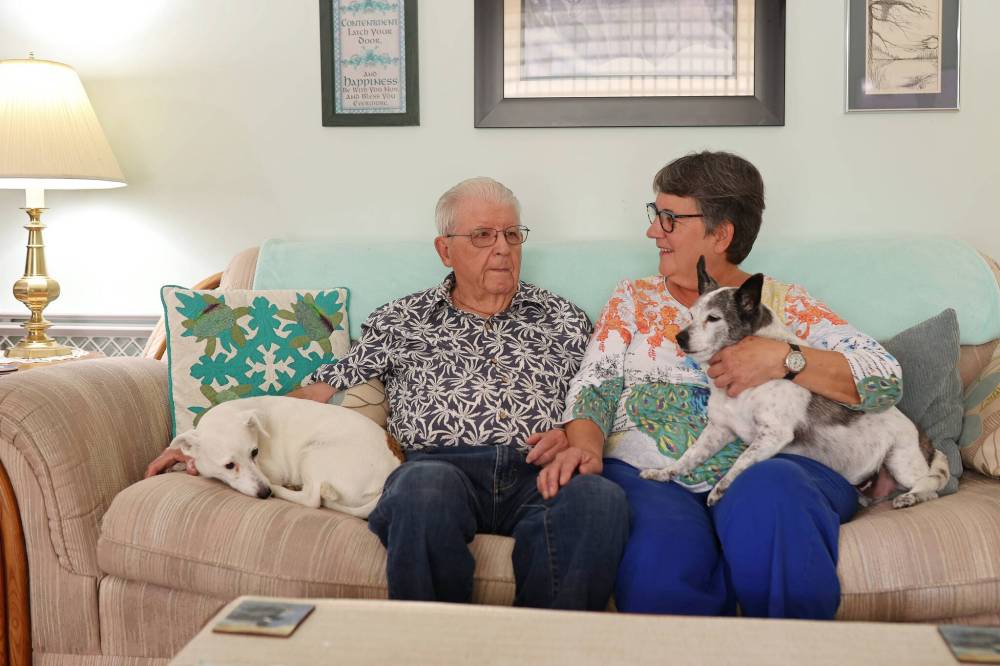
Keith and Jill Kennedy with their dogs Nala and Brindie at their home in Brandon. Keith is living with early-onset Alzheimer's disease with the help of his wife Jill. (Tim Smith/The Brandon Sun)
Jill has noticed some subtle changes in Keith’s mobility, speech and memory during the few years leading up to his diagnosis in 2020.
“He had said he thought it was his eyes and he couldn’t read, but my interpretation was it was comprehension,” Jill said. “Then he was having trouble holding the remote, then over the course of three years he was walking slower, then started struggling to find the right words. It was just little things.”
She encouraged her husband to keep a notebook of the names of people and places, which helps him remember things.
Keith was sent for tests and referred to a geriatrician, who confirmed he had early-stage Alzheimer’s disease.
Alzheimer’s is a branch of dementia, an overall term for a set of symptoms that are caused by disorders affecting the brain, according to the society. Alzheimer’s destroys brain cells and impacts a person’s cognition. More than 500,000 Canadians live with dementia, and the society expects that number to increase to 912,000 by 2030.
Keith’s diagnosis wasn’t a big shock, Jill said, but she had to explain to her husband the disease was in its early stages, not “mild” Alzheimer’s, because the disease is progressive, but it doesn’t progress the same way for everybody.
“It hurt his motivation to do things,” she said. “The doctor pointed out that happens and that’s the Alzheimer’s speaking and he may have less interest in going to do things, so the doctor suggested I gently encourage him to be active.”
After the diagnosis, she had questions about Keith’s care, including medications and how to help him manage the condition. There are some medications that help, she said, including Memantine, which helps maintain the motivation of Alzheimer’s patients. However, she was told her husband must take it for the rest of his life.
The couple has been leading an active life since the diagnosis, going to events like the Johnny Reid concert, visiting their campsite north of Brandon, walking the dogs, and Keith riding his tricycle at home.
Keith has always been an active man, Jill said, but over the summer he started to have small falls and balance problems. He had to surrender his driver’s licence due to his diagnosis, after running a red light.
Four weeks ago, Jill surprised him with an electric golf cart to navigate their campsite and take her and friends for joyrides.
“He’s not anxious to do it, but I encourage him,” she said. “It perks him up a little when he goes for a drive. I know he was disappointed when he had to surrender his licence.”
Keith has always been a soft-spoken man with a gentle nature, his wife said. One of her biggest concerns was personality changes, which a counsellor said he may have as his condition progresses, including mood swings. Jill said there was only one time, last April, where he lost his cognitive abilities to the point where he couldn’t stand.
She got him to lie down and called the geriatrician, who said it’s a type of delirium that’s usually temporary.
“Half an hour later, he was fine, but we went to the hospital for blood work just to make sure it wasn’t something like a mini-stroke.”
But among the most helpful resources she and Keith have received has been with a support group offered through the Alzheimer Society. Through the group, she has had one-on-one talks with fellow caregivers and experts.
She received a lot of information through pamphlets, online resources and one-on-one talking, she said. Through the society, Keith has also played on a lawn bowling team.
Starting this October, he will also be in another program for dementia patients called Prime Time at Fairview Personal Care Home, which involves a series of physical and mental activities. As a couple, they’ve also been going to the society’s Minds in Motion program, which includes activities like chair yoga and games.
Closer to home, they must maintain a routine and have a support system with neighbours and friends to keep Keith active and safe.
In the event she must go somewhere and leave Keith for a while, she said she knows she can count on the support system to help.
“I had to think about, ‘What if I end up in hospital, who will take care of Keith?’ Or, if I have to slip out for a while,” she said. “I have a good neighbour who comes over and checks on him. I don’t worry too much about him, but I think he may forget to feed and walk the dogs, or it’s time for supper and he should eat.”
There are long-term plans as well, including selling the house if Keith must move into assisted living and Jill living in a nearby apartment.
Helping families like the Kennedys is why the Alzheimer Society of Manitoba exists, said program director Erin Crawford.
“We come to them to let them know what programs are available, what they can access and what may come next,” Crawford said. “There are different supports, but the approach is the same for each case.”
September is World Alzheimer’s Month, so the society is spreading awareness on the programs and resources that exist for families dealing with a dementia diagnosis.
» kmckinley@brandonsun.com
» Twitter: @karenleighmcki1