
Manitoba deficit smaller than expected: Friesen
Advertisement
Read this article for free:
or
Already have an account? Log in here »
We need your support!
Local journalism needs your support!
As we navigate through unprecedented times, our journalists are working harder than ever to bring you the latest local updates to keep you safe and informed.
Now, more than ever, we need your support.
Starting at $15.99 plus taxes every four weeks you can access your Brandon Sun online and full access to all content as it appears on our website.
Subscribe Nowor call circulation directly at (204) 727-0527.
Your pledge helps to ensure we provide the news that matters most to your community!
To continue reading, please subscribe:
Add Brandon Sun access to your Free Press subscription for only an additional
$1 for the first 4 weeks*
- Enjoy unlimited reading on brandonsun.com
- Read the Brandon Sun E-Edition, our digital replica newspaper
*Your next Free Press subscription payment will increase by $1.00 and you will be charged $20.95 plus GST for four weeks. After four weeks, your payment will increase to $24.95 plus GST every four weeks.
Read unlimited articles for free today:
or
Already have an account? Log in here »
Hey there, time traveller!
This article was published 30/09/2022 (1348 days ago), so information in it may no longer be current.
The Manitoba government is reporting a deficit of $704 million in the 2021-22 fiscal year — less than half of the $1.597-billion deficit originally projected.
The information was presented by Finance Minister Cameron Friesen Thursday as part of an update on the province’s finances. Not only is it an improvement over the forecasted budget, but it was also $1.3 billion better than the deficit in the previous fiscal year. Documents provided to the media stated the lower deficit is a result of a “stronger than expected rebound in the economy, combined with prudent fiscal planning.”
Reflecting on the budget delivered in April 2021, Friesen said we’re living in a dramatically different world.
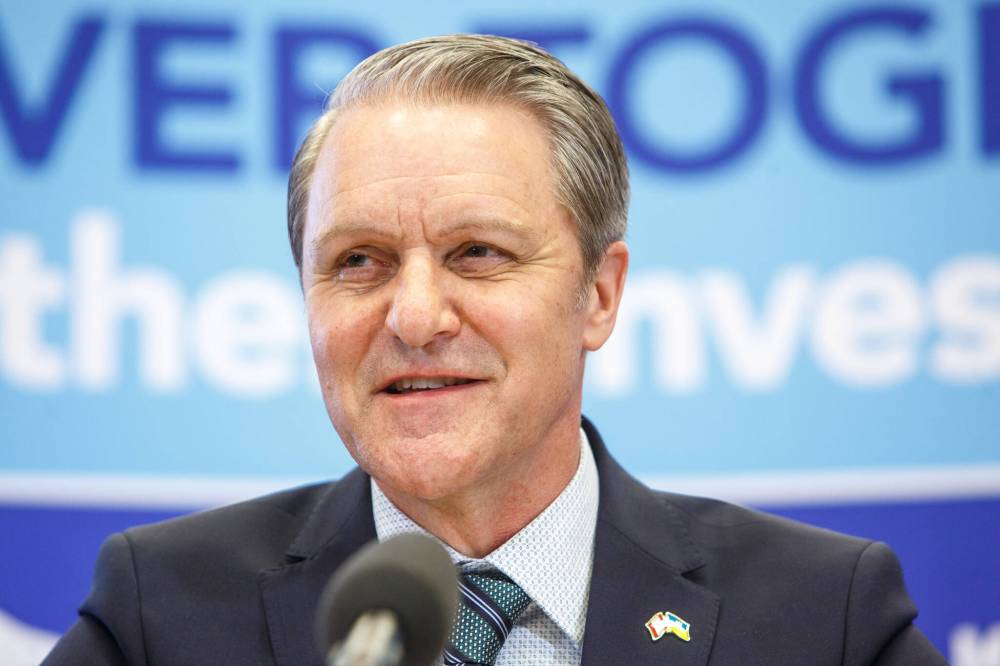
Finance Minister Cameron Friesen. (File)
Manitoba is no longer in a race to vaccinate people as new variants of COVID-19 overwhelm the health-care system, residents are allowed to gather in groups and businesses are open again, he said.
“It’s evident now that experts underestimated the speed and scale with which the economy would rebound after two and a half years of a global pandemic,” Friesen said. “In 2021-22, the economy did begin to recover … our revenues are significantly up from the previous year.”
The revised deficit figure includes increases in revenues from personal and corporate income taxes, the one-time $145-million Canada Health Transfer from the federal government, federal funding for early learning and child care and an Agri-Recovery drought assistance program.
According to Friesen, retail sales rose 13.3 per cent in the last fiscal year. Manufacturing sales grew 14 per cent in 2021 and 16 per cent in the first five months of 2022.
These factors, the province stated, have led to revising the original gross domestic product growth rate of 5.5 per cent predicted at budget time to 9.3 per cent at year’s end.
Contributing to some higher than expected expenses were the continuation of COVID-19 business supports and vaccination programs, the costs associated with last year’s drought, increased health-care and child-care bills as well as more family-related programming.
The finance minister noted that health-care spending was up $180 million over budget.
While there were costs associated with fighting forest fires exacerbated by the drought, the province said it also harmed Manitoba Hydro’s ability to generate electricity at its hydroelectric dams.
“We know that last year, Hydro dramatically changed its position,” Friesen said. “First of all, anticipating a net gain on year and finally indicating a loss — a shift of over $400 million to the worse. That is in large part due to severe drought conditions in the summer of 2021.”
Other financial difficulties the province said prevented a stronger recovery include supply-chain issues, inflation, labour shortages and the Russian invasion of Ukraine.
Summary revenues for that year were reported as being $1.3 billion higher than expected while summary expenses were $376 million more than budgeted.
In a list of expenses, the province reported it had spent $27 million less than budgeted on reducing its debts in 2021-22.
When it comes to the amount of money the province borrowed in recent years, the $32.418 billion it borrowed in 2021-22 was an increase over the $31.339 billion borrowed in 2020-21.
After Manitoba updated legislation mandating that a balanced budget be achieved within eight years, the province said this result is a solid first step toward that goal.
Friesen’s report also included a financial update for the current fiscal year.
This year’s budget originally forecasted a deficit of $548 million, but that has been reassessed to an expected deficit of $346 million.
According to the provided financial documents, Manitoba’s net debt has decreased by approximately $1 billion because of the improved deficit, with debt servicing costs coming in around $1 billion a year.
Part of that improvement comes from a forecasted increase in revenues by $537 million, made up of a $72-million one-time health transfer from the federal government and a $465-million increase in Manitoba Hydro revenues.
Friesen attributed the Hydro revenue increase to “one-time unanticipated earnings, which go to spot markets.”
On the health-care front, Friesen reiterated his government’s call for the feds to increase health transfer payments to the provinces on a permanent basis.
Expenses for this fiscal year are forecasted to rise by $191 million, which the province attributes to health-care challenges and recent affordability measures.
Economic growth is predicted to be weaker in 2023, with a projected GDP growth of 3.8 per cent compared to the 9.5 per cent increase in 2022.
In a phone interview, Manitoba NDP Leader Wab Kinew said that if the province has extra resources available, it should be putting them toward health care.
“Given what Manitobans are seeing on the frontlines of our health-care system, most folks would like to see some of those resources used to help invest in repairing the situation our nurses and doctors are facing,” he said.
“Certainly in western Manitoba, you’ve seen a lot of facility closures and you’ve seen vacancies in Brandon. The impact is being felt by patients.”
Despite Friesen touting the money spent on surgical and diagnostic backlogs, Kinew said Manitobans are waiting longer than ever before for emergency care and surgery. A lot of the current crisis, he said, is due to cuts implemented by the current government.
During his report, Friesen also provided an update on Manitoba’s efforts to help Ukrainians fleeing the war in their country. Originally, the province had estimated that around 3,000 Ukrainians had arrived, but the actual number is more than 9,500.
With approximately 85,000 total refugees having settled in Canada, that means Manitoba has welcomed more than 10 per cent of Ukranians coming to the country.
As refugees continue to arrive, Friesen said, the province needs the federal government to re-engage on the cost of settling them.
» cslark@brandonsun.com
» Twitter: @ColinSlark