
Gardewine’s electric vans leading the charge
Advertisement
Read this article for free:
or
Already have an account? Log in here »
We need your support!
Local journalism needs your support!
As we navigate through unprecedented times, our journalists are working harder than ever to bring you the latest local updates to keep you safe and informed.
Now, more than ever, we need your support.
Starting at $15.99 plus taxes every four weeks you can access your Brandon Sun online and full access to all content as it appears on our website.
Subscribe Nowor call circulation directly at (204) 727-0527.
Your pledge helps to ensure we provide the news that matters most to your community!
To continue reading, please subscribe:
Add Brandon Sun access to your Free Press subscription for only an additional
$1 for the first 4 weeks*
*Your next subscription payment will increase by $1.00 and you will be charged $20.00 plus GST for four weeks. After four weeks, your payment will increase to $24.00 plus GST every four weeks.
Read unlimited articles for free today:
or
Already have an account? Log in here »
Hey there, time traveller!
This article was published 12/11/2022 (1228 days ago), so information in it may no longer be current.
WINNIPEG — A year after experimenting with the region’s first electric shunt truck to move trailers around its yard, Gardewine has likely become the first commercial carrier in Western Canada to put a small fleet of electric courier vans on the road.
Gardewine will deploy the seven zero-emission electric Ford Transit vans in cities such as Thompson, Dauphin, Brandon and Winnipeg to deliver cargo under 23 kilograms to the last mile.
The vehicles will have capacity to travel about 200 kilometres fully charged.
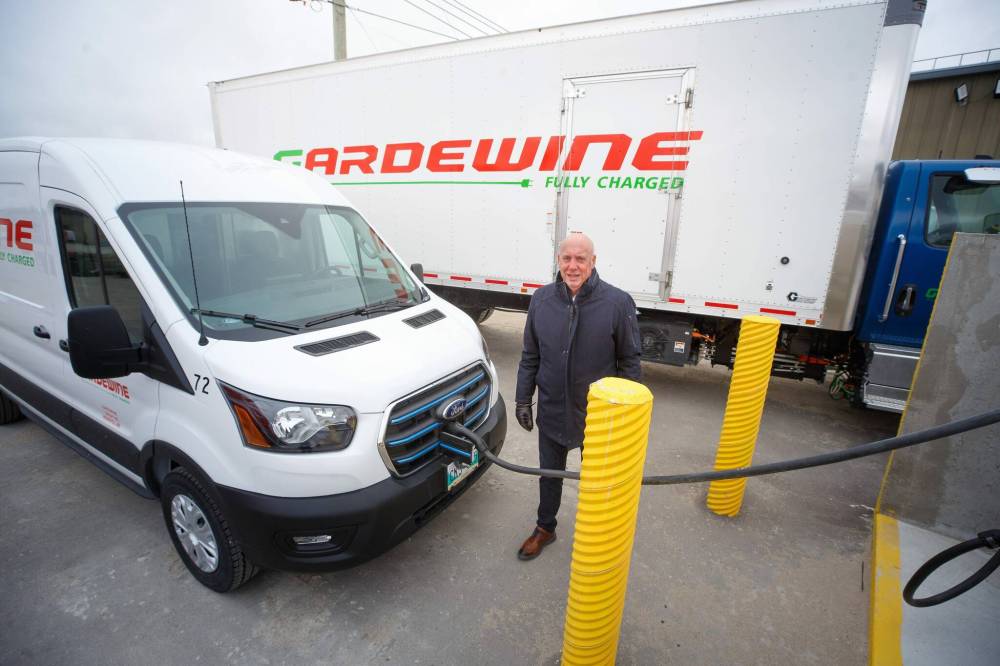
Darin Downey, president and chief operating officer of Gardewine, charges up one of a fleet of seven zero-emission Ford Transit vans the company has invested in. (Winnipeg Free Press)
Gardewine president and chief operating officer Darin Downey said the industry needs to make a commitment to reducing greenhouse gas emissions, and he’s proud that Gardewine, owned by the Calgary-based Mullen Group, is a leader.
“We’re really cutting the swath here,” he said.
In addition to purchasing seven Ford Transit vans, the company also has a five-tonne electric International MV truck on the road on a trial. It, too, is likely the only one of its kind in Western Canada.
Last year when it purchased a $250,000 electric shunt truck, Downey said it was just the beginning for Gardewine.
“We made this commitment, we stuck to it, and here we are with a sustainable solution we believe in,” Downey said.
Last year the company received about $150,000 from the province for the purchase of that vehicle from the province’s $1-million Conservation and Climate Fund.
But that fund was over-subscribed and there is currently no financial support from the province available for that type of purchase.
However, there is support from the federal government available through the Incentives for Medium- Heavy-duty Zero-Emission Vehicles (iMHZEV) Program.
Trucking companies apply to the original equipment manufacturer when the purchase is made, and the dealer gets the rebate applied to the purchase price.
Downey would not say how much the electric Ford Transit vans cost, but said they are reasonably priced.
What he believes will be important in the near term is for some public sector assistance to build the infrastructure to support e-trucks.
In addition to installing charging stations, many truck depots will also need to upgrade their electrical service.
“We are working with the province and Manitoba Hydro to try to develop a plan,” he said. “We’re pioneering this, and we really need Hydro to step up and be part of it.”
He said discussions with Manitoba Hydro are only at the preliminary stages.
Aaron Dolyniuk, the general manager of the Manitoba Trucking Association, said there are not many electric commercial trucks on the road in Manitoba right now.
“Gardewine is definitely a leader in this initiative,” he said.
Encouraging the province to provide some sort of support for the kind of fleet overhaul that is coming has been a priority for the MTA.
“We want Manitoba to be a leader in this area,” Dolyniuk said. “Our green hydroelectricity could put Manitoba in a great strategic position relative to the rest of Canada.”
But having said that, the province does not currently have any financial support programs available.
Meanwhile the cost of electric vehicles, especially for commercial trucking companies, is substantially more than diesel trucks.
“The business case has yet to be figured out,” said Dolyniuk.
While none of Gardewine’s sister companies in Mullen Group have yet made the investment in electrification, Downey said they will all be privy to the performance metrics and costs associated with Gardewine’s project.
Downey believes support from the province for infrastructure will be important to speed up implementation.
“Private industry is not going to stick its neck out and invest in the infrastructure until it is economically feasible for them,” he said.
After a full year of operating the shunt truck, Downey said winter temperatures depleted battery life by 10-12 per cent, but that there were “unreal” savings on fuel and maintenance.
Downey said the next move is to acquire a big electric highway tractor that can haul 36,000 kilograms.
“We’re the guys leading the charge,” he said. “We really want to get our hands on one of those tractors.”
Gardewine has long been a leader in the northern Manitoba and northwestern Manitoba market. It has a network of 34 terminals, and serves communities and customers from B.C. to Quebec while also providing single-source, third-party logistics to national and global markets.
» Winnipeg Free Press