
Manitoba eyes more immigration
Advertisement
Read this article for free:
or
Already have an account? Log in here »
We need your support!
Local journalism needs your support!
As we navigate through unprecedented times, our journalists are working harder than ever to bring you the latest local updates to keep you safe and informed.
Now, more than ever, we need your support.
Starting at $15.99 plus taxes every four weeks you can access your Brandon Sun online and full access to all content as it appears on our website.
Subscribe Nowor call circulation directly at (204) 727-0527.
Your pledge helps to ensure we provide the news that matters most to your community!
To continue reading, please subscribe:
Add Brandon Sun access to your Free Press subscription for only an additional
$1 for the first 4 weeks*
*Your next subscription payment will increase by $1.00 and you will be charged $20.00 plus GST for four weeks. After four weeks, your payment will increase to $24.00 plus GST every four weeks.
Read unlimited articles for free today:
or
Already have an account? Log in here »
Hey there, time traveller!
This article was published 15/02/2023 (1073 days ago), so information in it may no longer be current.
WINNIPEG — Manitoba is welcoming growth and bracing for a challenge in 2023, with another record-breaking year for immigration expected to relieve a shortage of labour while adding to demand for housing.
Last year, the province welcomed a record number of immigrants through its provincial nominee program; this year, it has asked the federal government to open the door to thousands more.
“We have a labour shortage in many sectors,” Manitoba Labour and Immigration Minister Jon Reyes said at a news conference Tuesday.
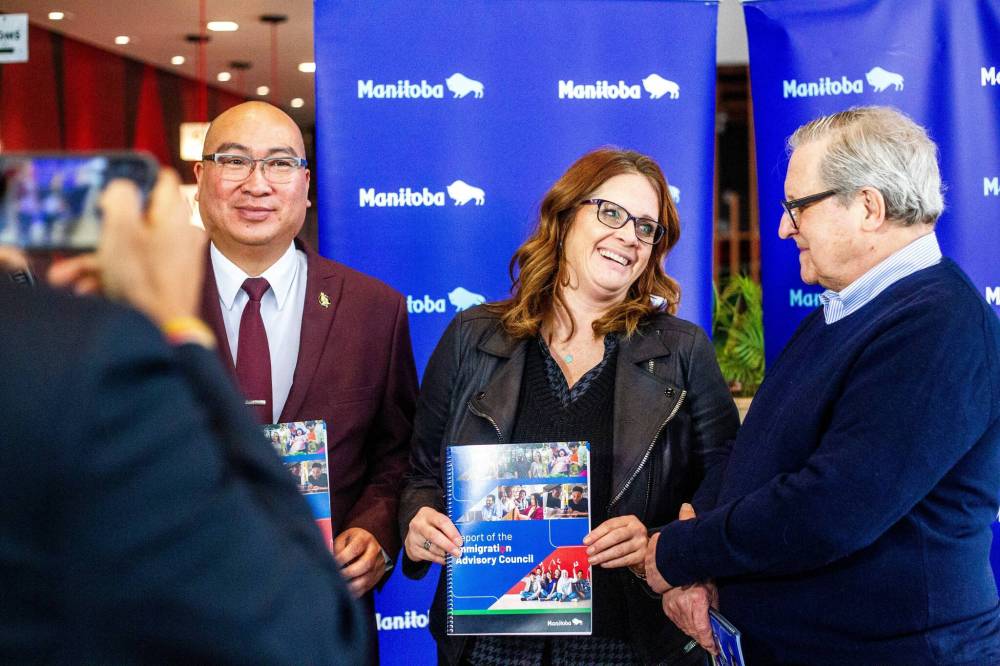
Immigration Minister Jon Reyes (left), immigration advisory council member Kerri Korabelnikov and council co-chair Lloyd Axworthy. (Winnipeg Free Press)
In 2022, 6,367 nominations were issued. It marked the highest number since the program, which attracts and retains immigrants who meet labour market needs and have ties to Manitoba, was founded in 1998, Reyes said.
Manitoba has asked Immigration, Refugees and Citizenship Canada Minister Sean Fraser to allocate at least 10,000 nominees this year to better address labour market needs and skill shortages, he added.
Ottawa’s answer is expected by the end of March.
When asked if Manitoba is prepared to house 10,000 nominees (and their spouses and children), Reyes said the government is working with municipalities to prepare for such an influx.
“We have to make sure whether it’s the City of Winnipeg or the Town of Virden, that it’s ready to accept these newcomers when they’re coming here,” he said after releasing a report by the province’s immigration advisory council outlining 70 recommendations.
“We’re very cognizant that it’s very important newcomer settlement support has to be there, and that includes the proper infrastructure to ensure that we have that welcoming feeling for those newcomers.”
The council with representatives from all sectors across the province was set up a year ago. It is headed by Reyes and Lloyd Axworthy, a former foreign affairs minister who is chairman of the World Refugee & Migration Council.
On Tuesday, Axworthy said business has a role to play.
“The private sector has been loud and clear — they need skilled people. If that’s the case, they also need to be a partner in making sure there’s effective accommodation in settlement,” the former University of Winnipeg president said, bringing up the issue of converting empty buildings into housing.
“The way we regenerate the downtown is having people who live there.”
The head of the Manitoba Business Council said the demand for housing is a challenge and the private sector can help.
“We need to increase the amount of housing period, not just for newcomers,” said Bram Strain, adding high interest rates have slowed the pace of developments, as has the shortage of labour to build them — driving the push for more provincial nominees.
For example, the town of Neepawa — “a shining example of a success story” — was refreshed by nominees who arrived with jobs at pork processor HyLife, Strain said.
They needed housing, and investors and developers followed. “They started building four-plexes and apartment buildings. The whole town has rejuvenated itself,” he said.
However, the challenge is making sure those needing affordable housing don’t lose it.
“You don’t want to force those folks out to bring more people in, because then you just exacerbate your problem,” said Strain, a member of the immigration advisory council.
Its recommendations include: improving recruitment efforts by working with communities and business; streamlining the nominee program process; and enhancing foreign credential recognition programs so more immigrants choose to stay in Manitoba.
“We need effective, new thinking,” said Axworthy. “Colleges of professional associations need to become engaged at an earlier stage.
“Rather than waiting for someone to arrive in Winnipeg, who then finds themself having to take a job as a day labourer while they’re waiting to get their medical credentials, they start earlier on and understand the requirements and characteristics of licensure in Manitoba.”
Reyes said the province wants to work with regulatory bodies to ensure the credentials recognition process is as seamless as possible, so newcomers can put their skills to work in Manitoba. If that doesn’t work, the province has the authority to issue compliance orders, he said.
“If there’s a situation where it’s affecting providing services to Manitobans, then we’re going to have some further discussions and, ultimately, take action to make sure we best serve Manitobans.”
The federal government has announced it wants Canada to welcome 500,000 newcomers annually. Axworthy said Manitoba’s share of that would be 20,000.
Urban and rural centres of the province need to be ready to manage that opportunity for growth, and the advisory council has laid the groundwork, he said.
“We have to start preparing for the future,” Axworthy said. “This is really the catalyst to generate a serious discussion among Manitobans about what role we play.”
» Winnipeg Free Press