
INTERNATIONAL VIEWPOINT: China facing decline in population, power
Advertisement
Read this article for free:
or
Already have an account? Log in here »
We need your support!
Local journalism needs your support!
As we navigate through unprecedented times, our journalists are working harder than ever to bring you the latest local updates to keep you safe and informed.
Now, more than ever, we need your support.
Starting at $15.99 plus taxes every four weeks you can access your Brandon Sun online and full access to all content as it appears on our website.
Subscribe Nowor call circulation directly at (204) 727-0527.
Your pledge helps to ensure we provide the news that matters most to your community!
To continue reading, please subscribe:
Add Brandon Sun access to your Free Press subscription for only an additional
$1 for the first 4 weeks*
*Your next subscription payment will increase by $1.00 and you will be charged $20.00 plus GST for four weeks. After four weeks, your payment will increase to $24.00 plus GST every four weeks.
Read unlimited articles for free today:
or
Already have an account? Log in here »
Hey there, time traveller!
This article was published 20/03/2023 (1033 days ago), so information in it may no longer be current.
Xi Jinping was confirmed for a third term as president of China at the National People’s Congress this month, and not one of the 3,000 delegates voted against him. Why would they? Everything is perfect in the People’s Republic of Oz, and the chief Wizard doesn’t even to need to hide behind a curtain.
Meanwhile, in Washington, the one topic on which both Democrats and Republicans can agree is the Chinese Threat. The politicians posture, the strategists warn and the armed services rejoice in the emergence of a “peer competitor.”
Russia long ago ceased to fill that role satisfactorily, and even a Russia that has now gone full rogue doesn’t do much to expand the U.S. defence budget. It’s still “Upper Volta with nuclear weapons,” and doesn’t provide the American military with an adequate pretext for building new rockets and aircraft carriers.
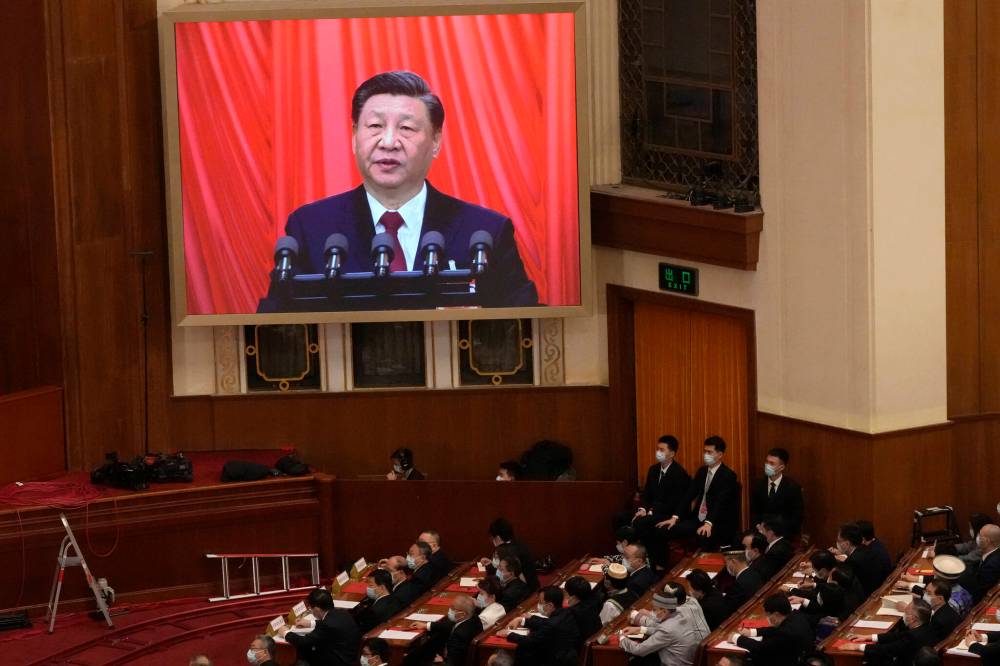
Chinese President Xi Jinping is displayed on a screen as he delivers a speech at the closing ceremony for China’s National People’s Congress at the Great Hall of the People in Beijing on March 13. (The Associated Press)
China has been a very useful peer competitor for the American military because it’s big, it looks powerful and it talks tough. Its economy has stalled, its population is crashing, and its 74-year-old political system is fraying badly, but as long as everybody in the Pentagon and Congress pretends not to notice, it will continue to serve that purpose.
In the real world, however, China came off the old high-speed growth track about seven years ago, although its statisticians and economists managed to hide it for a while.
Official Chinese statistics are, as former premier Li Keqiang once tactfully put it, “man-made,” but for what it’s worth, China says its economy grew last year by three per cent, about the same rate as the United States. In reality, it probably shrank by one to two per cent last year, owing to the endless COVID-19 lockdowns.
Even in good years, China’s economy has been growing as slowly as developed economies in the West since the middle of the last decade. It’s not catching up, and there’s a strong possibility that it is caught in the same trap that struck the Japanese economy in 1992: stuck with low to no growth forever more.
The Japanese are bearing up under their misfortune remarkably well, mainly because their per capita GDP was already more than $31,000 when their economic miracle stalled. Per capita income in China now is only $12,000, and people may be a lot less forgiving if that is where the Chinese “miracle” stops.
It probably has stopped, if the other “miracle” economies of east Asia are anything to go by. They all had 30 years of high-speed growth and then a return to normal or below-normal growth. China’s 30 years started much later, in the later 1980s, but it’s probably all over now.
All the more so because the population is starting to fall at an unprecedented speed. In the past seven years, the number of births in China has literally halved, and it’s still falling. The most recent forecast predicts 771 million Chinese by the end of the century. That’s half what it is now, and not even twice the American end-of-century population.
Very long-term predictions are rarely correct in detail, but they often get the trend-line right. If these economic and demographic predictions come to pass, then China will never become a world-bestriding colossus.
Meanwhile, the dawning realization that genteel poverty is probably the future for most Chinese, combined with the reality of an all-powerful state that seeks to control every detail of private life, is already having a profoundly negative impact on the attitudes of the young.
In a recent opinion piece in the Washington Post, economist Nicholas Eberstadt of the American Enterprise Institute noted the rapid rise among Chinese youth of a passive sort of civil disobedience, expressed in slogans like “tang ping” (lying flat) and “bai lan” (let it rot). They see no hope for the future, and they don’t see the point in even trying.
The old men who rule China know that something has gone wrong — that’s why they caved in so fast last year to the popular protests against constant lockdowns — but they haven’t the faintest idea how to fix it. In fact, they probably can’t fix the economy, and they certainly can’t fix the birth rate.
So they will go on using propaganda backed up by intimidation and occasional violence, the traditional levers of power of any authoritarian state, even though the younger elements of the population can see through their game. They have no other options.
“The floggings will continue until morale improves,” as the apocryphal Captain Bligh put it.
» Gwynne Dyer’s new book is “The Shortest History of War.”