
NDP renews call to suspend border policy
Advertisement
Read this article for free:
or
Already have an account? Log in here »
We need your support!
Local journalism needs your support!
As we navigate through unprecedented times, our journalists are working harder than ever to bring you the latest local updates to keep you safe and informed.
Now, more than ever, we need your support.
Starting at $15.99 plus taxes every four weeks you can access your Brandon Sun online and full access to all content as it appears on our website.
Subscribe Nowor call circulation directly at (204) 727-0527.
Your pledge helps to ensure we provide the news that matters most to your community!
To continue reading, please subscribe:
Add Brandon Sun access to your Free Press subscription for only an additional
$1 for the first 4 weeks*
- Enjoy unlimited reading on brandonsun.com
- Read the Brandon Sun E-Edition, our digital replica newspaper
*Your next Free Press subscription payment will increase by $1.00 and you will be charged $20.95 plus GST for four weeks. After four weeks, your payment will increase to $24.95 plus GST every four weeks.
Read unlimited articles for free today:
or
Already have an account? Log in here »
Hey there, time traveller!
This article was published 04/04/2023 (1294 days ago), so information in it may no longer be current.
EMERSON — A refugee who narrowly survived a treacherous walk across the Canada-U.S. border fears more migrants will die, after the neighbouring countries amended a decades-old asylum policy.
Seidu Mohammed, 30, believes last week’s changes to the Safe Third Country Agreement will divert desperate asylum seekers to more dangerous routes or clandestine methods to cross the international boundary.
“This is going to put a lot of people in danger,” said Mohammed, who lost his fingers and thumbs to frostbite after he walked across the border near Emerson on Christmas Eve 2016.
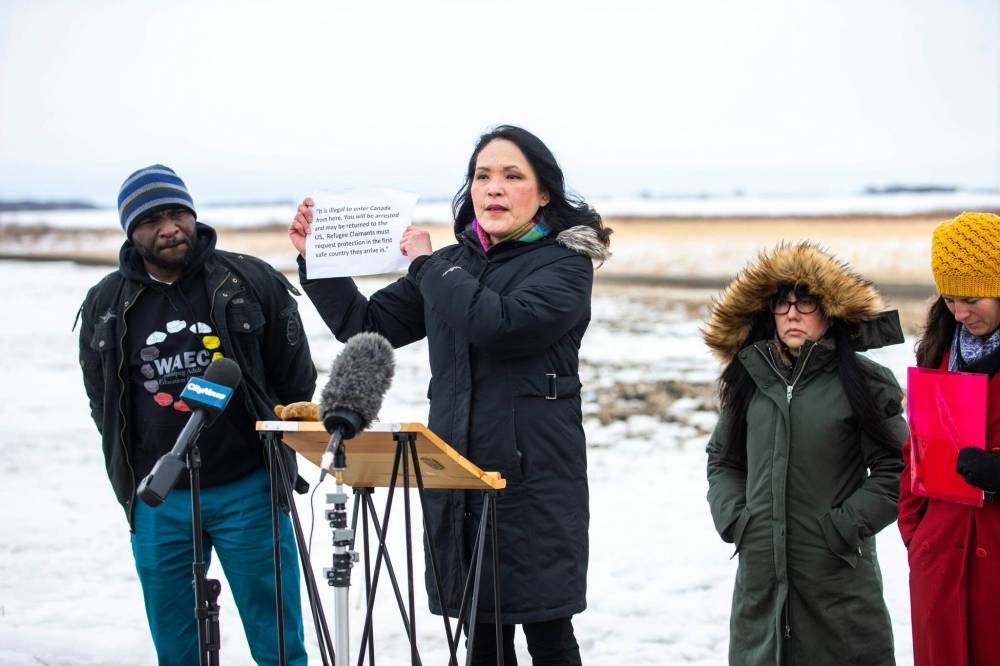
Jenny Kwan (speaking), NDP critic for refugee, immigration and citizenship, fears the change will push asylum seekers "further underground" and lead to an increase in human trafficking and deaths. (Mikaela Mackenzie/Winnipeg Free Press)
He fears the amendment will lead to more migrants being detained and sent back to countries where they could face persecution.
On Monday, Mohammed joined NDP members of Parliament Leah Gazan (Winnipeg Centre) and Jenny Kwan (Vancouver East) in Emerson — a small community on the Manitoba side of the border — to renew the party’s calls for the STCA to be suspended.
Under the pact, which came into effect in 2004, asylum seekers are required to apply for protection in the first “safe” country they arrive in, be it Canada or United States.
Before it was amended March 25, the STCA allowed either country to turn away asylum seekers at official ports of entry, but not those who entered via irregular crossing sites, such as Emerson or heavily used Roxham Road in Quebec.
Those in the latter group were permitted to remain in the country while their asylum claim was considered.
The policy now applies to the entire land border. Barring limited exceptions, migrants who enter via unofficial crossings are to be turned back to Canada or the U.S. if they are found within 14 days of their arrival.
Kwan, the NDP critic for refugee, immigration and citizenship, fears the change will push asylum seekers “further underground” and lead to an increase in human trafficking and deaths.
Last week, the bodies of eight people — four from India and four of Romanian descent — were recovered from the St. Lawrence River. They died trying to cross into the U.S. from Akwesasne Mohawk territory in Quebec.
In January 2022, a family of four from India were found frozen to death in a snowy field just east of Emerson during an attempt to walk into the U.S.
Ottawa had faced pressure from the federal Conservatives and Quebec to amend the STCA following a record number of arrivals into Canada, mostly at Roxham Road.
The RCMP intercepted more than 39,000 asylum seekers between official ports of entry in Quebec last year, compared with 72 in Manitoba, according to federal data.
Between Oct. 1 and Feb. 28, U.S. Customs and Border Protection agents intercepted 86 people in the Grand Forks sector, which stretches from North Dakota to Wisconsin, according to CBP data published online.
For Ghana-born Mohammed, his visit to Emerson on a cold spring day was his second since he and Razak Iyal, also from Ghana, were rescued by a driver during their seven-hour walk through snowy fields and ditches.
“It’s a little bit emotional,” Mohammed told the Winnipeg Free Press just steps from the border. “Now, I see how it is in the daytime. I don’t want this kind of experience that I had to happen to anybody.
“I don’t want people to face the difficulties that I faced, so that’s why the Safe Third Country Agreement is not a good thing for anyone.”
Mohammed was detained for a year following his arrival in the U.S. in 2015. He fled to Canada after his bid for asylum was denied.
He said he likely would have been deported had the amendment been in place when he travelled to North America for safety reasons.
He was scared for his life in his homeland, where same-sex relationships are illegal, after being outed as bisexual while playing soccer in Brazil.
Mohammed and Iyal were granted refugee status in 2017. The friends recently became Canadian citizens.
Shauna Labman, associate professor of human rights at the University of Winnipeg and executive director of its Global College, said refugees have a legal right to claim protection.
She believes the amended STCA will drive desperate people, including parents with young children, to cross in more remote and more dangerous places.
“They may have closed the orderly and relatively safe access asylum seekers had found at Roxham Road, but it will not seal our border,” Labman said during the news conference. “Fewer people will gain access to the protection they need here in Canada, and maybe fewer people will cross, but more will die trying.”
She fears people who go into hiding to wait out the 14-day period will face added risks.
For years, Labman has called for the STCA to be suspended or eliminated to allow people to make their asylum claims at official ports of entry.
The Supreme Court is considering a legal challenge to the STCA, after opponents argued Canada violates the Charter of Rights and Freedoms by automatically sending asylum seekers back to the U.S.
Ottawa contends the STCA’s changes promote “regular” pathways and safe migration.
“These tragic stories do not start at the Canada-U.S. border,” Bahoz Dara Aziz, a spokeswoman for Immigration Minister Sean Fraser, wrote in an email. “Individuals are facing immense danger from the moment they leave their country of origin and all throughout their journey.
“That’s why it’s important for individuals to seek asylum in the first safe country they are in, and prevent further risk to their health and well-being.”
As part of the renegotiated agreement, Canada will accept an additional 15,000 migrants from the Americas through official channels.
» Winnipeg Free Press