
Too few up for the farming life
Two-thirds of Canadian producers have no succession plan: Report
Advertisement
Read this article for free:
or
Already have an account? Log in here »
We need your support!
Local journalism needs your support!
As we navigate through unprecedented times, our journalists are working harder than ever to bring you the latest local updates to keep you safe and informed.
Now, more than ever, we need your support.
Starting at $15.99 plus taxes every four weeks you can access your Brandon Sun online and full access to all content as it appears on our website.
Subscribe Nowor call circulation directly at (204) 727-0527.
Your pledge helps to ensure we provide the news that matters most to your community!
To continue reading, please subscribe:
Add Brandon Sun access to your Free Press subscription for only an additional
$1 for the first 4 weeks*
- Enjoy unlimited reading on brandonsun.com
- Read the Brandon Sun E-Edition, our digital replica newspaper
*Your next Free Press subscription payment will increase by $1.00 and you will be charged $20.95 plus GST for four weeks. After four weeks, your payment will increase to $24.95 plus GST every four weeks.
Read unlimited articles for free today:
or
Already have an account? Log in here »
Hey there, time traveller!
This article was published 11/04/2023 (1271 days ago), so information in it may no longer be current.
Unlike his kids, Russell Loewen’s chickens haven’t flown the coop.
“Henny — guess what? It’s my birthday coming up,” Loewen says, strumming a guitar with a hen on his shoulder.
He then breaks into song — The Beatles’ “When I’m Sixty-Four.”
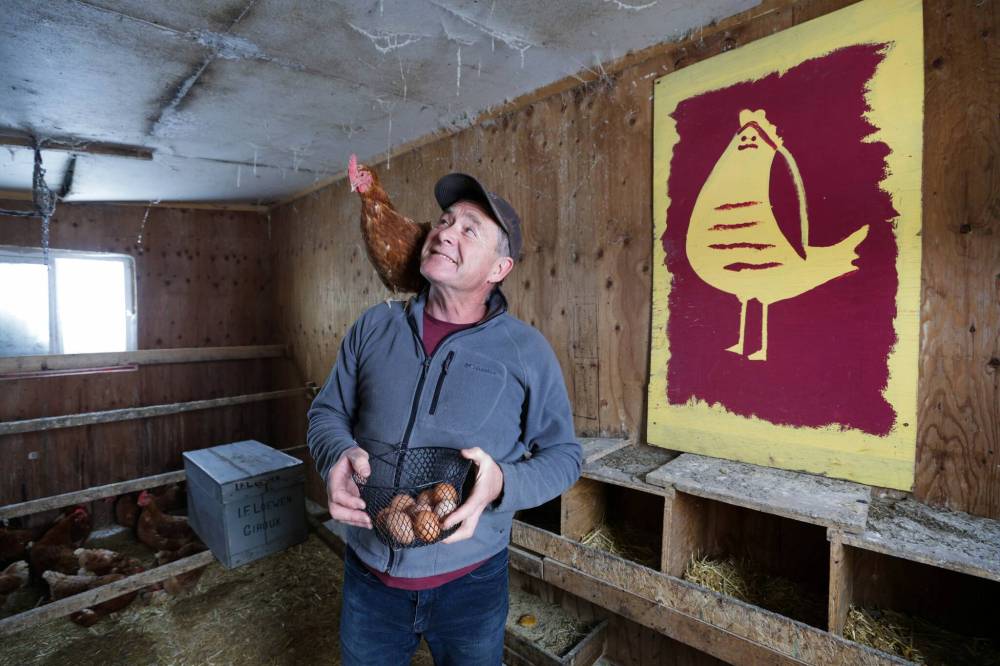
Russell Loewen, who runs Loewen Homestead just south of St. Norbert, fetches fresh eggs from his feathered friends in his chicken coop Monday. Russell is planning to retire in the next five to 10 years, but his kids will not be taking over. (Ruth Bonneville/Winnipeg Free Press)
Loewen, a farmer in Howden, Man., sings with his birds regularly. He uploads videos of himself and the Morning Jabber Cackle Choir (his take on the Mormon Tabernacle Choir) for his grandkids to view on YouTube.
His children have settled across North America and Germany. They’ve carved out paths different from the farm life offered on Loewen’s 80 acres south of St. Norbert.
“None of them are really interested in farming,” said Loewen, who produces vegetables and eggs.
He rents about 70 acres to a local farmer. He’s in no rush to retire — maybe another five, 10 years.
“(This) wouldn’t be handed down to my kids,” he said. “If I have some grandkids that would be interested, that’s another story.”
He won’t know for another decade, likely. Maybe the land will go to another farmer, maybe it will become development — Loewen is unsure.
Two-thirds of Canadian producers don’t have a succession plan in place, according to a new RBC report.
Meantime, 56 per cent of Manitoba farm operators are older than 55 years old. In the next decade, more than half of the province’s current farmers will be at least 65.
Between 2016 and 2021, Manitoba saw a three per cent decrease in its number of farm operators.
“I could, actually, any time disband the operation and rent out all the land I’m farming now,” Loewen noted.
He’s not upset with his children, he added — he’s happy for their accomplishments in other sectors.
“A lot of these farm operators are going to be retiring within the next decade,” said Mohamad Yaghi, the lead author of RBC’s latest Next Green Revolution report. “It’s really about, ‘Who’s able to take over that?’”
RBC is anticipating a shortfall of 24,000 general farm, nursery and greenhouse workers across Canada by 2033.
In its report, it recommends attracting 30,000 permanent immigrants, blending different university faculties with agriculture studies and investing more — publicly and privately — into agricultural research and development.
“We’re short of workers in the barn, we’re short of veterinarians, we’re short people to drive trucks, we’re short of people to work in the processing plant,” said Cam Dahl, Manitoba Pork’s general manager. “Every step of the production chain, labour shortages are an issue.”
He estimates the average pork barn is 20 to 25 per cent understaffed. Labour is the main inhibitor to the industry’s growth, he said.
“There is still room for growth in pork production in Manitoba,” Dahl noted, adding 90 per cent of pork produced in Manitoba is exported.
He’s seeing succession planning. Even so, “there’s always room for more research,” he said.
Canadian agricultural firms spend, on average, less than their foreign competitors on research and development — 1.4 per cent of revenue to foreigners’ 4.6 per cent in 2020, according to RBC’s report.
RBC compared Canada to top food exporters like the United States and Australia, Yaghi said.
“It’s a very low amount of private, in-house (research and development) actually spent here in Canada when it comes to agriculture, and that’s something that needs to be addressed immediately,” he said. “It’s vital to have an innovative agricultural sector.”
The industry accounted for 6.6 per cent of Manitoba’s real gross domestic product in 2021, according to a June 2022 report by the province.
“Farmers across Canada are extremely intelligent,” Yaghi said. “It’s really about, ‘What tools can be given to them so that they can focus on more pressing issues than the manual jobs?’”
Increased mechanization will help bridge the labour gaps long-term, Yaghi said.
In the short-term, immigration is crucial, he added. He pointed to farmers from New Zealand and the Netherlands. Some have been told to downsize or risk closure as part of their country’s climate action initiatives.
“Canada presents an opportunity to welcome these immigrants from around the world,” Yaghi said.
A pathway to permanent residency for experienced temporary foreign workers will help bridge agriculture labour gaps, the RBC report argues. Many farmers rely on Ottawa’s Temporary Foreign Worker Program for employees.
Such a change to the government program worries Paul Gregory, vice-president of the Manitoba Beekeepers’ Association.
“If that were to happen, we would lose our workers,” Gregory, 65, said. “It’s a very seasonal industry.”
Filipinos and Nicaraguans usually frequent his Fisher Branch apiary between May and October.
“They’re great people. They’re experienced,” Gregory said. “We fly them back to their families in October, November and they have all winter off, and they come back in the spring.”
Around 20 years ago, it was easy to find kids for summer work, he added.
“(Now) we don’t have the young kids. The families are smaller,” he said. “In our town of Fisher Branch, we have trouble hiring someone on the Green Team to cut grass… I don’t know what the beekeepers do that don’t hire foreign workers.”
Drawing Canadians to beekeeping is tough, he added — there’s summer heat, thick beekeeping suits and heavy boxes to lift and carry.
Henry Holtmann, 60, hires Canadian citizens at Rosser Holsteins. The dairy operation usually requires 16 staff and, until recently, it was common to have a position or two vacant.
Hiring difficulties began in 2019, Holtmann said. Since the pandemic, there’s been “a bit of a void at the entry level,” he added.
His sons, and his brother’s son, will continue Rosser Holsteins when the current generation retires.
Manitoba had the highest proportion of farm operators below 35 years old — 11.5 per cent — across Canada in 2021. The average age was 54.
“The lifestyle is certainly different,” Holtmann said. “It requires you to be around all the time, 365 (days), so that works for some folks and some not.”
He tries to retain employees through flexibility, “fairly robust” on-the-job training and celebrating individual achievements and birthdays.
“It sure would’ve been nice to have been beside a business owner that has had the employer training,” Holtmann noted. “The technology has been wonderful, but to find people that will help us manage farms or (staff) will be our greatest challenge.”
The number of Manitoba farms decreased 1.7 per cent — to 14,543 farms — between 2016 and 2021. The average farm size dropped 1.3 per cent, and the province’s overall farm area shrank to 17.1 million acres in 2021 from 17.6 million in 2016.
“Sometimes the only opportunity you get (to be a producer) is to carry on a family farm,” said Bill Campbell, the Keystone Agricultural Producers’ former president.
It can be too pricey to start your own venture otherwise. Many part-time farmers have separate full-time jobs, Campbell noted.
He encouraged more integration of agricultural programming in other faculties at the post-secondary level, and further awareness of the industry in elementary and high schools. It’s not just farming, he noted — everyone from engineers to geneticists are needed in agriculture.
No full-time MBA program among Canada’s top 10 business schools offers electives in agriculture, the RBC report noted.
» Winnipeg Free Press