
Human smuggling driving border-crossing spike: U.S. official
Advertisement
Read this article for free:
or
Already have an account? Log in here »
We need your support!
Local journalism needs your support!
As we navigate through unprecedented times, our journalists are working harder than ever to bring you the latest local updates to keep you safe and informed.
Now, more than ever, we need your support.
Starting at $15.99 plus taxes every four weeks you can access your Brandon Sun online and full access to all content as it appears on our website.
Subscribe Nowor call circulation directly at (204) 727-0527.
Your pledge helps to ensure we provide the news that matters most to your community!
To continue reading, please subscribe:
Add Brandon Sun access to your Free Press subscription for only an additional
$1 for the first 4 weeks*
- Enjoy unlimited reading on brandonsun.com
- Read the Brandon Sun E-Edition, our digital replica newspaper
*Your next Free Press subscription payment will increase by $1.00 and you will be charged $20.95 plus GST for four weeks. After four weeks, your payment will increase to $24.95 plus GST every four weeks.
Read unlimited articles for free today:
or
Already have an account? Log in here »
Hey there, time traveller!
This article was published 22/04/2023 (1266 days ago), so information in it may no longer be current.
Organized human smuggling groups are fuelling an increase in illegal crossings from Manitoba to the U.S., an American border agent told the Winnipeg Free Press after the latest rescue of migrants.
Nine men found in a flooded bog near Warroad, Minn., at about 5 a.m. Tuesday, had crossed the border in an organized smuggling operation, said David Marcus of U.S. Customs and Border Protection.
“There’s no doubt that there are a lot of these groups coming across,” he said in a phone interview Thursday.
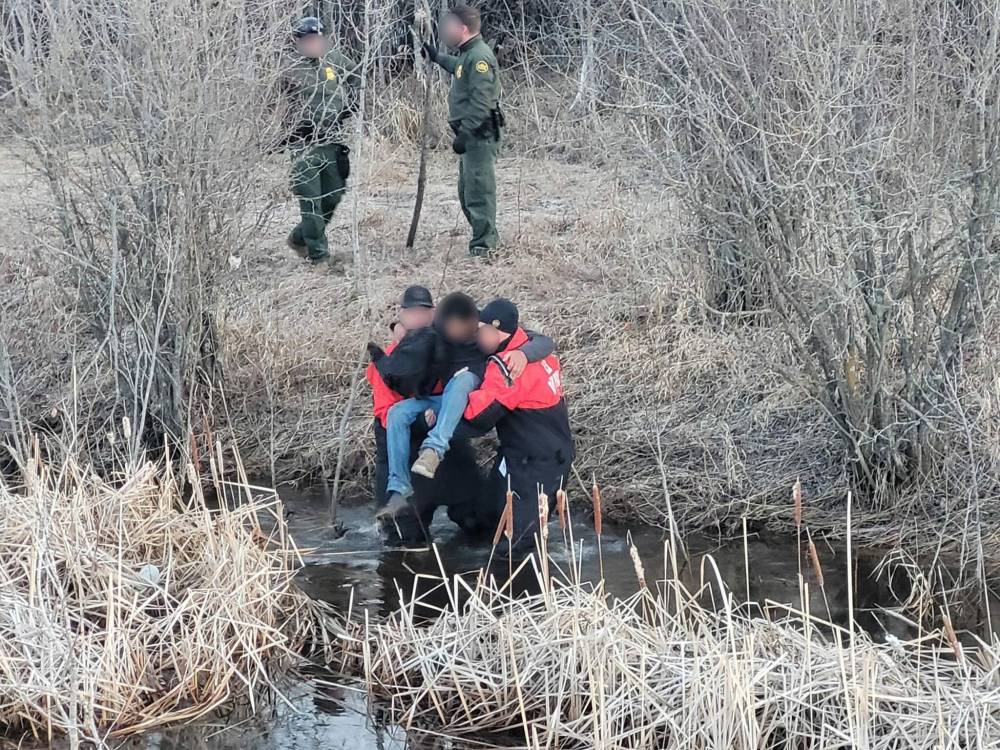
At least seven of men detained in Tuesday's crossing were from Mexico, whose citizens do not require a visa to enter Canada. Photo blurred by U.S. Customs and Border Protection. (Submitted)
There has been an increase in interceptions on both sides of the border since COVID-19 pandemic travel and other restrictions were lifted.
In recent months, about 70 per cent of the people caught trying to walk into the U.S. from Manitoba were Mexican citizens, said Marcus.
At least seven of men detained in Tuesday’s crossing were from Mexico, whose citizens do not require a visa to enter Canada.
According to the CBP, migrants are flying to Canada and trying to walk across the northern border, because they think it will be easier than illicitly crossing the southern border.
“It’s not the case. It’s very rural out here… and then you add into that the weather that we experience,” said Marcus, who works in the CBP’s Grand Forks sector.
It is responsible for patrolling almost 1,400 kilometres of northern border in North Dakota, Minnesota and Wisconsin.
Marcus said many of those who try to enter the U.S. illegally through Manitoba — some with young children — are escaping hardship or violence.
Human smugglers are preying on and profiting off of that desperation.
John Bruning of Minneapolis-based Advocates for Human Rights said migrants are looking for different routes into the U.S. due to the precarious and dangerous situation on the southern border.
“It’s absolutely inhumane what people are forced to endure at the southern border, so it’s no wonder migrants are beginning to come to the northern border, where there is no violence or risk of kidnapping or extortion, no risk of detention in the desert without shelter, and a much better chance of even being able to apply for asylum,” Bruning, an attorney with the AHR’s refugee and immigrant program, wrote in an email.
RCMP officers in Manitoba are aware of human smuggling, and are working with U.S. authorities to combat the problem, said spokeswoman Cpl. Julie Courchaine.
The RCMP integrated border enforcement team patrols the international boundary regularly, she said.
In Tuesday’s incident, the nine men, ranging in age from 19 to 46, were dropped off on the Manitoba side and told it would be a 20-minute walk before they would be picked up, said Marcus.
However, it turned into an all-night ordeal, with the men unprepared for the conditions.
The group walked through a forest near Sprague, about 150 kilometres southeast of Winnipeg, while the temperature dropped to about -5 C overnight.
U.S. authorities found the men in a flooded bog about 12 km south of the border, after one of the migrants made an emergency phone call that was received by RCMP.
The men were treated for exposure.
Seven, all Mexican nationals, were taken into custody by U.S. Immigration and Customs Enforcement. The nationalities of the other two weren’t determined by the CBP. Those men was taken to medical facilities for further treatment.
None of the migrants had immigration documents allowing them to enter or remain in the U.S. legally, the CBP said.
Marcus said the situation had a “fortunate” outcome.
In January 2021, a family of four from India, including a three-year-old boy and 11-year-old girl, died while trying to walk into the U.S. east of Emerson in a -35 C blizzard.
Between Oct. 1, 2022, and March 30, U.S. border agents reported 100 “encounters” — apprehensions, expulsions and people deemed inadmissible — within the Grand Forks sector, which extends south to Kansas and Missouri.
A total of 81 “encounters” was reported in the 2021-22 fiscal year.
Some of the incidents involved illegal crossings at the Manitoba-U.S. border.
Manitoba RCMP have also reported an increase in interceptions of asylum seekers between ports of entry.
The number increased to 72 in 2022, from 19 in 2021. A total of 39 occurred in the first three months of 2023.
In March, Canada and the U.S. amended the Safe Third Country Agreement to allow either nation to turn away asylum seekers who cross the border irregularly.
Human rights advocates fear the change could divert asylum seekers to more dangerous routes or clandestine methods.
» Winnipeg Free Press