
Province invests in Indigenous mental health
Advertisement
Read this article for free:
or
Already have an account? Log in here »
We need your support!
Local journalism needs your support!
As we navigate through unprecedented times, our journalists are working harder than ever to bring you the latest local updates to keep you safe and informed.
Now, more than ever, we need your support.
Starting at $15.99 plus taxes every four weeks you can access your Brandon Sun online and full access to all content as it appears on our website.
Subscribe Nowor call circulation directly at (204) 727-0527.
Your pledge helps to ensure we provide the news that matters most to your community!
To continue reading, please subscribe:
Add Brandon Sun access to your Free Press subscription for only an additional
$1 for the first 4 weeks*
- Enjoy unlimited reading on brandonsun.com
- Read the Brandon Sun E-Edition, our digital replica newspaper
*Your next Free Press subscription payment will increase by $1.00 and you will be charged $20.95 plus GST for four weeks. After four weeks, your payment will increase to $24.95 plus GST every four weeks.
Read unlimited articles for free today:
or
Already have an account? Log in here »
Hey there, time traveller!
This article was published 27/04/2023 (1309 days ago), so information in it may no longer be current.
In response to rising mental health crises in First Nations, the Manitoba government is providing more than $2.1 million to Indigenous-led organizations to develop capacity for providing care.
The funding is a first step toward helping First Nations people in Manitoba who are struggling with mental health, said Indigenous Reconciliation and Northern Affairs Minister Eileen Clarke.
“In the last several weeks, there’s been some real tragedies up in northern Manitoba First Nations,” Clarke told the Sun. “It’s really difficult for chiefs and councils to deal with these issues, especially when they’re in remote areas where there’s very little access to any kind of professional help.”
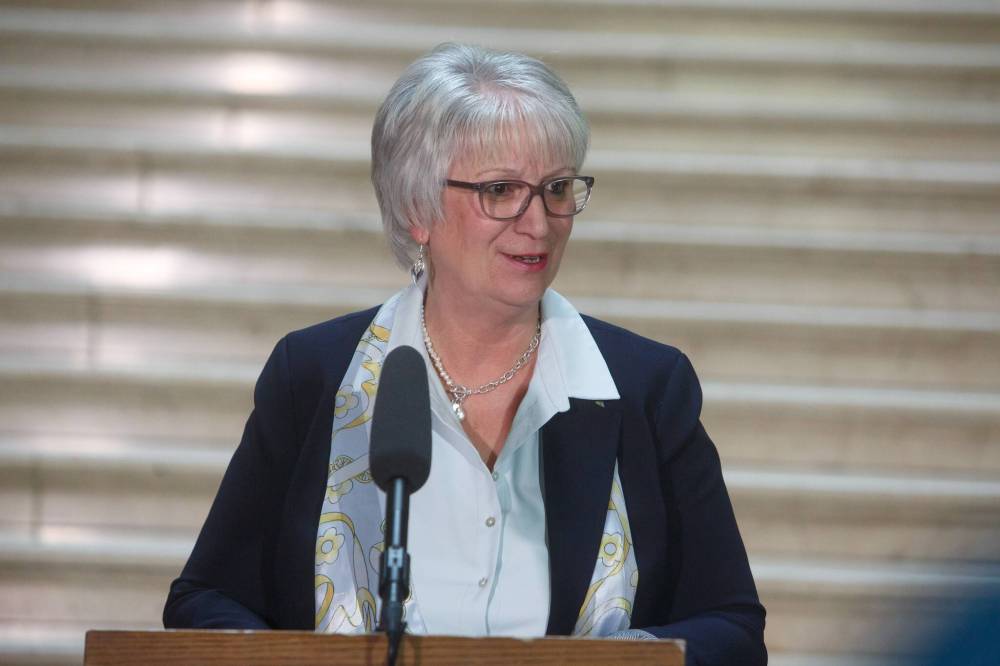
Indigenous Reconciliation and Northern Relations Minister Eileen Clarke said funding announced on Tuesday is in direct response to cries for help from leaders of Indigenous communities who are at crisis point. (File)
Last month, the Keewatin Tribal Council (KTC) in northern Manitoba declared a regional state of emergency, calling for immediate government action in the face of deficiencies in public safety, health services and infrastructure. Eleven other Manitoba First Nations declared states of emergency in March as well, with leaders citing rapidly deteriorating conditions in their communities.
The issues facing those regions include suicide, violence, inadequate medical services, drug overdose, complications from diabetes and other preventable circumstances, said KTC Grand Chief Walter Wastesicoo.
Hospitalization rates for acute, chronic and mental health-related conditions are significantly higher in First Nations compared to other Manitobans, a 2021 study from the Canadian Journal of Public Health states.
The rate of suicide attempts for First Nation people is four times higher than for all other Manitobans, and the rates of deaths by suicide among First Nations people is much higher than for the rest of the province, a report from the Manitoba Centre for Health Policy says.
The one-time grant funding the province announced Tuesday is a direct response to Wastesicoo and other Indigenous leaders’ concerns, Clarke said.
“This was one step we could take towards truth and reconciliation to meet needs as quickly as possible, but to give us time to work more collaboratively with communities to try to find solutions going forward,” Clarke said.
The Southern Chiefs’ Organization, which has an office in Brandon, is receiving $1.069 million for its mobile crisis response team to increase capacity to deliver emergency care across southern First Nations.
By increasing the SCO’s 11-person mobile crisis response team, more trauma-informed and culturally appropriate mental health and wellness services can be offered, which will create more positive outcomes for Anishinaabe and Dakota people, said the organization’s grand chief, Jerry Daniels.
“Supporting southern First Nation citizens, families and communities during times of crisis is of utmost importance to me and my fellow leaders,” Daniels said.
Manitoba Keewatinowi Okimakanak is receiving $1.069 million to support its all-Indigenous mobile crisis response team for First Nations across the province.
While the one-time funding is not a permanent solution, it’s one that Clarke hopes the province of Manitoba can build upon.
“It’s not a long-term response, but it’s one that our government could make at the time,” she said. “There’s still a lot of work to do, but it’s a matter of working together. That’s what will make a difference.”
Clarke, who recently met with KTC, said the response she’s been hearing from them and other Indigenous groups is one calling for the province to come together with Indigenous-led organizations to put together a formal emergency response plan and tackle broader community social issues.
“I think we all recognize that there is a very strong desire to do exactly that – find solutions, work together and ensure that our families and kids are taken care of,” she said.
» mleybourne@brandonsun.com, with files from The Canadian Press
» Twitter: @miraleybourne