
SCO program to help veterans
Advertisement
Read this article for free:
or
Already have an account? Log in here »
We need your support!
Local journalism needs your support!
As we navigate through unprecedented times, our journalists are working harder than ever to bring you the latest local updates to keep you safe and informed.
Now, more than ever, we need your support.
Starting at $15.99 plus taxes every four weeks you can access your Brandon Sun online and full access to all content as it appears on our website.
Subscribe Nowor call circulation directly at (204) 727-0527.
Your pledge helps to ensure we provide the news that matters most to your community!
To continue reading, please subscribe:
Add Brandon Sun access to your Free Press subscription for only an additional
$1 for the first 4 weeks*
*Your next subscription payment will increase by $1.00 and you will be charged $20.00 plus GST for four weeks. After four weeks, your payment will increase to $24.00 plus GST every four weeks.
Read unlimited articles for free today:
or
Already have an account? Log in here »
Hey there, time traveller!
This article was published 03/06/2023 (991 days ago), so information in it may no longer be current.
A new program from the Southern Chiefs’ Organization aimed at helping southern Manitoban First Nations veterans has received the seal of approval from retired Cpl. Melvin Swan, who grew up in Lake Manitoba First Nation.
The Southern Chiefs’ Organization (SCO), an independent political organization that represents 34 First Nations in Manitoba, is launching the project to engage southern First Nations veterans to identify programming and service needs and gaps in existing services. The new project will also connect veterans to services and supports.
Swan, who will be providing spiritual and cultural care to veterans through the program, says he is very happy that First Nations veterans will have another avenue of support to those who have served their country.
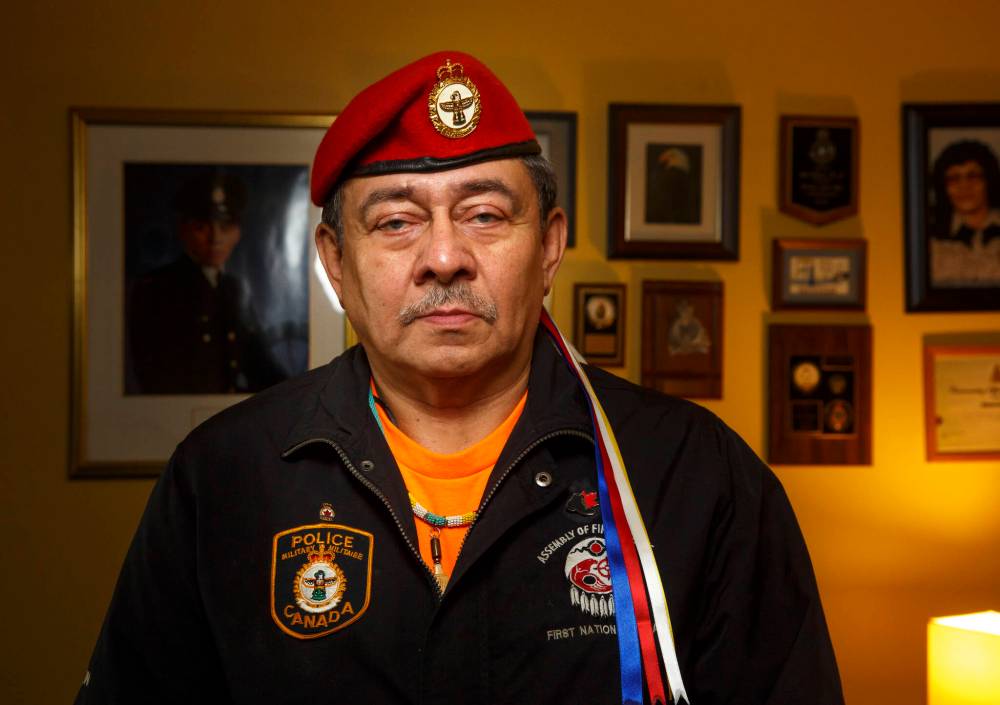
Retired Cpl. Melvin Swan served four years in 2nd Battalion, Princess Patricia's Canadian Light Infantry and seven years in the military police. (File)
“I am looking forward to being involved and providing the spiritual and cultural care that have been lacking for so many years,” said Swan, a knowledge keeper, sun dancer and pipe carrier.
As part of the program, the SCO plans to host a large gathering this fall and will also develop a monument and commemoration ceremony for southern Manitoba First Nation veterans.
The entire project sets the tone for enhanced culturally appropriate and relevant services and supports for veterans, SCO Grand Chief Jerry Daniels said.
“The SCO is looking forward to learning from and supporting the empowerment of our First Nations veterans,” he said.
“We know it is essential to provide our citizens with culturally responsive, trauma-informed supports when accessing programs and services.”
Swan was born in Ashern, Man., located 279 kilometres northeast of Brandon, to Chief Raymond Swan and Mary Emma Jane Spence. He began attending the Lake Manitoba Day School, where he was sexually abused, at six years old. He ran away from the day school when he was 14 but was caught and eventually placed in the McKay Residential School in Dauphin, 150 kilometres from his family home. He left school for good at age 17.
Shortly after, Swan decided to enrol in the army as a way of shaping his own future.
“After all the abuse I saw and experienced in day school and in my community, I decided I could be my own man in the military,” he said.
Swan served in the Canadian military from 1976 to 1988. As a young man, he joined the Col. Barker Air Cadets in Dauphin, located 166 km north of Brandon, and as a reservist with the 26th Field Regiment. He served with the 2nd Battalion, Princess Patricia’s Canadian Light Infantry (2PPCLI) with B Company as a rifleman in heavy weapons and has been posted throughout Canada and abroad in England, Germany and Norway as a military police officer.
He was the only 2PPCLI member selected to go through the military police course in 1980.
He retired from the military after a string of personal tragedies. Two of his brothers died by suicide and a nephew died in a freak accident months prior. His brothers, both day school and residential school survivors, were haunted by the trauma of the past and the abuses they suffered, he says. His first wife also died during that time.
Swan tried to take a leave from work, but was accused of gaming the system. He says the treatment from his superiors and colleagues only got worse from there, and he was eventually targeted with false charges of sabotage. Even though his case was ultimately dismissed, the damage to his career and reputation was done.
When Swan got out of the military, he took odd jobs to try to adapt to civilian life, but the transition was hard. After turning in his badge and his gun, Swan said he felt naked and lost.
Swan filed a human rights case against the military in 1988 for the discrimination he suffered during his career.
“In some places more than others, I discovered that Aboriginal discrimination was alive and well. Behind my back and to my face, I was mocked, ridiculed and scorned. Of course, they said they were ‘just joking,’ but I knew they weren’t,” he said.
Swan won a settlement six years later, but the process nearly broke him, he says. However, like so many of the challenges he has faced in his life, he never gave up.
“I carried the truth of my ancestors, and I kept going. My ancestors were warriors, and that’s part of my healing, my journey. No journey is the same, but mine is specific to being a warrior,” Swan said.
Being part of SCO’s new program to support veterans is something that feels true to who Swan is, and it’s a continuation of his life as a warrior, he said.
“I plan to go along in the same way, honouring our veterans. They should be remembered.”
» mleybourne@brandonsun.com, with files from the Winnipeg Free Press
» Twitter: @miraleybourne