
New addiction services for PMH, Brandon
Advertisement
Read this article for free:
or
Already have an account? Log in here »
We need your support!
Local journalism needs your support!
As we navigate through unprecedented times, our journalists are working harder than ever to bring you the latest local updates to keep you safe and informed.
Now, more than ever, we need your support.
Starting at $15.99 plus taxes every four weeks you can access your Brandon Sun online and full access to all content as it appears on our website.
Subscribe Nowor call circulation directly at (204) 727-0527.
Your pledge helps to ensure we provide the news that matters most to your community!
To continue reading, please subscribe:
Add Brandon Sun access to your Free Press subscription for only an additional
$1 for the first 4 weeks*
- Enjoy unlimited reading on brandonsun.com
- Read the Brandon Sun E-Edition, our digital replica newspaper
*Your next Free Press subscription payment will increase by $1.00 and you will be charged $20.95 plus GST for four weeks. After four weeks, your payment will increase to $24.95 plus GST every four weeks.
Read unlimited articles for free today:
or
Already have an account? Log in here »
Hey there, time traveller!
This article was published 09/06/2023 (1229 days ago), so information in it may no longer be current.
Brandon and Prairie Mountain Health will receive several new mental health and addictions treatment services as part of a $4.7-million announcement made by the province on Thursday.
Of that total, $3.3 million is being spent on 835 new treatment spaces in the Northern, Prairie Mountain and Interlake-Eastern health regions.
In Prairie Mountain Health, that will include funding for 125 mobile withdrawal management spaces based out of Brandon and 60 programming spaces for the Recovery Education for Addictions and Complex Trauma program.
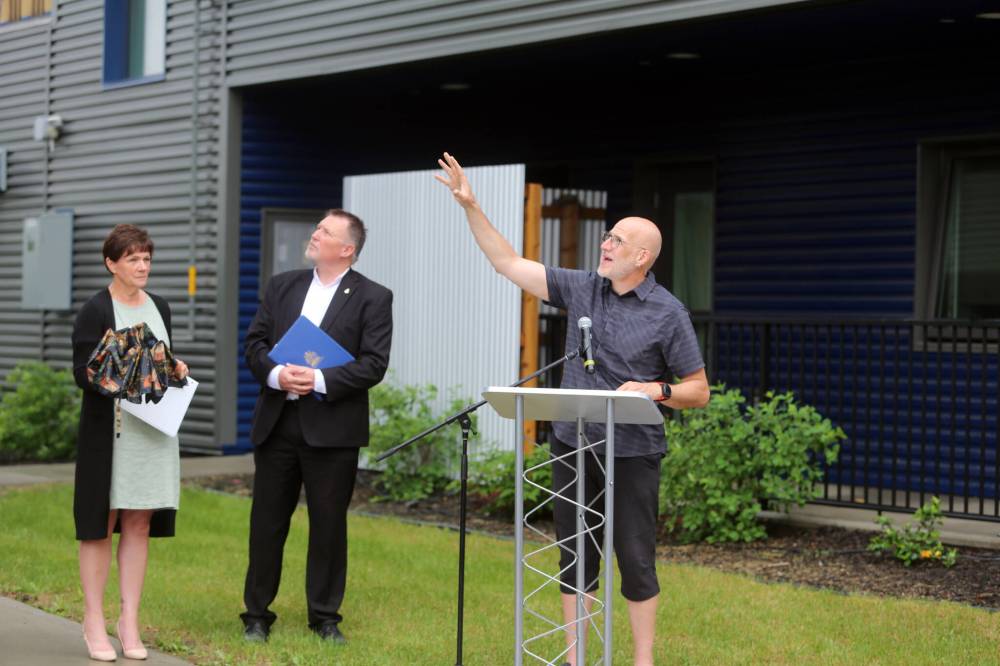
Westman Youth for Christ is receiving funding as well from that pool to transform the second floor of one of the buildings at its Lorne Avenue Blue Lions complex into non-medical supportive housing specifically aimed at young mothers and their children.
On top of that, the province announced it will provide ongoing annual support worth $600,000 for previously existing non-medical withdrawal management beds run by the Community Health and Housing Association.
It also announced approximately $800,000 to create a Flexible Assertive Community Treatment team based out of Brandon, which will be able to support up to 360 patients a year with serious mental health disorders and associated conditions.
Making the announcement outside of the Blue Lions complex Thursday morning was MentalHealth and Community Wellness Minister Janice Morley-Lecomte. She was joined by Mayor Jeff Fawcett, Coun. Greg Hildebrand (Ward 5), Brandon East Progressive Conservative MLA Len Isleifson and Brandon West Progressive Conservative MLA Reg Helwer.
The minister thanked community agencies for helping Manitobans through recovery.
“Increasing access to mental health and addiction supports and services are a priority,” Morley-Lecomte said. “As we move forward, we recognize the importance of ensuring this help is available to Manitobans when and where they need it.”
Representing Westman Youth for Christ, executive director Dwayne Dyck said the funding will allow his organization to serve a segment of people that need support.
“We’ve seen a gap in our community where we have young moms who have wanted to come into recovery and we’ve had to turn them away because the apartments we have now are all small, they’re made for … single young people who are in recovery,” Dyck said.
“This funding will allow us to increase our programming to care for young moms and their children.”
Dyck said the floor in question currently has tenants who moved in with the knowledge that their apartment would eventually be used for recovery programming. Youth for Christ is working with those tenants and other local agencies to find new homes for them before they’re adapted for their new purpose.
Representing Prairie Mountain Health at the event was its director of mental health services, Chris Bromley, who said the new programming would have a “real impact” on communities.
“Not only do these new investments increase the available spaces, they also provide choices and varied options to meet the needs of individuals,” he said.
“The addition of mobile withdrawal management will allow individuals to access support and services to help them safely withdraw from substances within their home or at a safe location arranged by our team.”
Once the new programming is in place, Bromley said, the health region would have three levels of withdrawal management services available to offer people depending on their stage of recovery and needs.
He said it would also allow the region to offer better services to people in rural communities.
The chair of Brandon and Area Overdose Awareness, Antoinette Gravel-Ouelette, said in a phone interview that Thursday’s announcement represents a step in the right direction and addresses a gap in services available for families and mothers.
“I’m very, very pleased to see that the province is supporting these initiatives and that they’re taking a lead on some of these things,” she said. “It needs to be a public health issue, not a justice issue. Our chief of police … even said we’re not going to police our way out of these issues.”
However, she noted that the announcement only represents part of the support needed for people dealing with addiction issues.
“When we’re dealing with substance use, we’re looking at a continuum of care,” she said. “This is for people wanting treatment. Treatment is not the whole thing. It’s definitely a piece of the pie, but it’s not the whole pie.”
Support also needs to be offered, she said, to people before they receive treatment to make sure they survive until they get the medical assistance they needed. They also need support during and after their treatment to ensure success.
Gravel-Ouelette said that Manitoba continues to lag other provinces in terms of reporting annual deaths relating to overdoses.
In a statement, Manitoba NDP mental health and addictions critic Bernadette Smith criticized previous premier Brian Pallister and current Premier Heather Stefanson for ignoring the addictions crisis while thousands of people lost their lives.
“Preliminary data shows that 418 Manitobans died of an overdose in 2022, but Premier Stefanson continues to hide those numbers from the public,” Smith said.
“While front-line organizations are doing everything they can to save lives, Premier Stefanson tried to pass a bill that would shut down their work. And recently the PCs downplayed community concerns regarding a shortage of provincially supplied naloxone kits. Today’s announcement doesn’t come close to addressing the increasing demand for treatment and health care for Manitobans struggling with addiction.”
» cslark@brandonsun.com
» Twitter: @ColinSlark