
Lamont sees ‘huge opportunity’
» Q&A with Liberal Leader Dougald Lamont
Advertisement
Read this article for free:
or
Already have an account? Log in here »
We need your support!
Local journalism needs your support!
As we navigate through unprecedented times, our journalists are working harder than ever to bring you the latest local updates to keep you safe and informed.
Now, more than ever, we need your support.
Starting at $15.99 plus taxes every four weeks you can access your Brandon Sun online and full access to all content as it appears on our website.
Subscribe Nowor call circulation directly at (204) 727-0527.
Your pledge helps to ensure we provide the news that matters most to your community!
To continue reading, please subscribe:
Add Brandon Sun access to your Free Press subscription for only an additional
$1 for the first 4 weeks*
- Enjoy unlimited reading on brandonsun.com
- Read the Brandon Sun E-Edition, our digital replica newspaper
*Your next Free Press subscription payment will increase by $1.00 and you will be charged $20.95 plus GST for four weeks. After four weeks, your payment will increase to $24.95 plus GST every four weeks.
Read unlimited articles for free today:
or
Already have an account? Log in here »
Hey there, time traveller!
This article was published 14/06/2023 (1204 days ago), so information in it may no longer be current.
During a visit to Brandon this week, Manitoba Liberal Leader Dougald Lamont took time on Tuesday afternoon to sit down with Brandon Sun editor Matt Goerzen. The following Q&A reflects part of their conversation. It has been edited for clarity and length.
Matt Goerzen — So I’ll start by asking you just out of the gate. Why are you in Brandon today?
Dougald Lamont — Well, it’s been two days. So yesterday, we were meeting with sort of the southwestern caucus of the RMs. Folks from Wawanesa, Sifton, Pipestone, talking about challenges facing RMs, which was a great discussion. There are lots of challenges — everything from water to infrastructure to health. This morning, I met with the president of Brandon University to discuss, you know, challenges and opportunities around BU and then met with Mayor Fawcett, did a luncheon learn with Brandon Pride and then today, we’re nominating Trenton Zazalak as a candidate for Brandon East. (NOTE: Zazalak was a former Liberal candidate for Spruce Woods in 2011.)
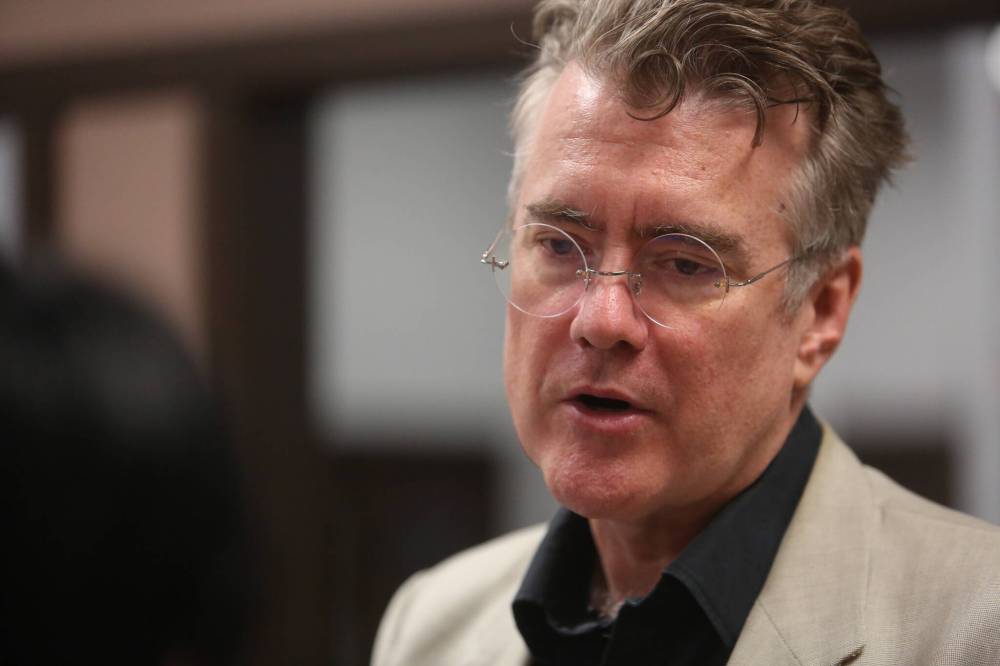
Provincial Liberal Leader Dougald Lamont stopped by the Brandon Sun offices on Tuesday during a visit to the Wheat City. (Matt Goerzen/The Brandon Sun)
MG — So any hope of a Brandon West candidate coming up anytime soon?
DL — Oh, no. It’s in the offing. But it’s in the hopper. Right. We have a whole bunch more candidates. We’re about to nominate shortly. And then we have other people to get through the application process. But yeah, we’re hoping to get everybody nominated well in advance of the writ.
MG — How do you as the Liberal Party leader look at say anything outside of Winnipeg? Because I know your stronghold is Winnipeg. How do you build that party base?
DL — Some of it is that it has to be done locally, right. So part of it is in nominating, strong candidates like Michelle (Budiwski) and Trenton. They have a base here, they’re committed here. And so rather than us having to do the heavy lifting from Winnipeg, is to say, look, here are the tools you need to go out to make sure that you’re supported as a candidate, in terms of communications. And we will not organize for them, but we will tell them how to organize. That’s the key thing. And in, the better they can do at it, the more resources we can also put towards them. But it’s, it’s always a challenge … there are Liberals here. It’s just a question of getting them involved. And sometimes actually pulling people from other parties who felt disengaged or disenchanted.
MG — Are you seeing any of that at the moment?
DL — Among our candidates? Yeah, for sure. (laughs)
MG — I mean people who are disenchanted.
DL — Well, there’s a lot of what we’re hearing, is there a lot of people who aren’t particularly happy about either of their two main choices, right. So for us, that’s an opportunity. We were even just talking about, we were talking to (someone) in one of our stakeholder meetings, and we mentioned Trent and he said, well, that’s super interesting because that’s good. That means there are three strong candidates in Brandon East as far as they were concerned with this. It isn’t somebody being appointed, it isn’t somebody from the outside. These are three strong candidates. Trenton’s from Brandon East and Michelle lives in Rivers. These are local folks.
MG — So right now according to what I’m reading (on the 338Canada polling website), the Liberals were polling at around 12 per cent. You’ve got a popular vote projection of 42 per cent and 40 per cent for the NDP and PCs, respectively. What kind of opportunity is this present?
DL — Well, no, I do think it’s a huge opportunity, in part, because I don’t think the other two parties are offering much new. It’s clear to me that they’re much more focused on bashing one another. So part of this for us, it’s … we have to put forward a vision of the province that’s uniting. And I do think that people are tired of that level of fighting, but we have to — we still have to be loud enough to be heard over the screaming. I would say actually, that’s, I realized, that’s one of our biggest challenges as a provincial party is having our ideas, and even our accomplishments heard over the sometimes — they’re really quite bitter — disputes that have happened. And when you actually talk to most people, they’re not that engaged in the partisan aspect of it. So many people just want the road fixed, they want to get health care. And they want to figure out how they’re gonna be able to pay their bills.
MG — I feel that there is an unspoken (political) centre that no one is trying to ply. So when you look at voters who are maybe thinking of themselves as centres, they don’t think of themselves as particularly partisan. How do you prompt them to get off their seat and fill out a ballot?
DL — Part of it is, I think, is that we have to recognize that it is a problem that the extremes are like trying to grab for the centre, the extremes are trying to seize the centre. And for us to say, because people have ideas about what a Liberal Party (is), but fundamentally, we want to be progressive and we want to be centralist. People think well, does that mean you’re half NDP or half PC? It actually just means that you recognize the business as a right to make a business and the unions have rights. And that there are a whole bunch of people out there who need to be taken care of. And you have to govern for everybody like that. As the two parties pull apart, the stakes get higher and higher for each of them. But you’re right, lots of people find that nobody’s speaking for them at all. So for us, it’s to say … yes I am partisan and progressive, but we will work with the other parties. And we have worked with the other two parties. We have. We’ve passed bills, and we’ve passed resolutions unanimously in the house. And you don’t get that done. Unless you’re working with the other parties.
MG — There has been talk on the on the NDP side that there is a need for safe injection sites. The PCs, of course, have gone the complete opposite direction and say we don’t need it. What we need is more access to services to help them get off drugs in the first place. Where do you fall on this issue?
DL — So I think the PCs have made a mistake because they’re talking about recovery, at which point somebody’s already in trouble. We absolutely support overdose prevention centres because that’s really what these places are. Making sure that people aren’t being poisoned, meet, making sure that people aren’t getting sick. And making sure people are getting access to the treatment that they need. The one thing about them is they I do think that they’re a they’re kind of treatment of last resort. Like that’s the one thing about it is that we need to be acting way before that. So we were talking with some folks just about the issue around mental health and addiction. And there are no spaces. But even if you go to a place where people might get addictions, treatment, they have no mental health supports. So we have a big push on mental health and making sure that people can get access to mental health care as a preventive (measure). I don’t have a problem with overdose prevention centres. I do see that they’re critical. But we need to be doing a lot more before that, which hasn’t been done.
MG — Our mayor, Jeff Fawcett, as part of his election platform last year, was talking about how Brandon needs to grow into its role as the second city … and have a greater voice in the governance of the province. How do you see your Liberal government helping him do that?
DL — I think there are some really important investments we can and must be making in Brandon. Both in education and in training for sure. I mean, Brandon University is part of it. Certainly (Assiniboine Community College). We need a counterweight because Manitoba is unique in that we’re the only province that has this 800-pound gorilla, where there’s one city that dominates. It’s not like Saskatoon and Regina, Calgary and Edmonton are all these other pairings. It’s just a question of equity … to recognize it doesn’t actually work for the province to put everything in Winnipeg. So part of this is making sure that the services and other things are available, but also having an equity formula that basically says look, if you’re going to be living in rural and northern areas, you’ll get a bit of a bonus pay, bonus for say whether it’s health care or education to make sure that you can attract and maintain people.
MG — When the NDP were in power, they were having trouble watching rural emergency rooms close, and the PCs are having similar problems. And they’re trying to retain nurses and recruit them — a problem shared right across the country. What can the Liberal Party do that they can’t?
DL — One of the reasons why we’re seeing yours close across rural Manitoba isn’t always doctors and nurses — it’s because they don’t have a lab tech. You need a lab tech to run work in an ER, and none of them have had a raise since 2017. So some of this is directly the result of the PCs, refusing to settle a contract for five or six years. So people are being hired elsewhere.
What we’ve proposed specifically for attraction and retention of folks in health care is it’s different than the PCs. We just (promised) a $10,000 bonus for nurses just as a thank you. This is similar to what the Nova Scotia government has proposed — $10,000. Thank you for working in the system, and we hope you’ll stay, with $5,000 for other health-care workers who deal with patients. And it will be prorated.
If we can find ways to retain people in the system, stop the bleeding and bring more people back with these bonuses, that is key to us. And then stepping up with credential recognition because there are people in Manitoba who could be working as doctors and nurses right now aren’t able to. And then the third is expanding training positions at universities and colleges to make sure that we’re increasing capacity here in Manitoba.
MG — On that one aspect, you know, offering nurses a retention bonus. Do you think that is enough for nurses who are looking at private agency nursing positions?
DL — Well, I think the $10,000 per day that a nurse was one of our candidates, Rhonda Nichols said she’d go back for that. So, like, it was a focus group of one.
But in her discussions with other folks, that was the case. The other thing is providing nurses with that greater degree of freedom, so that it is restoring freedom over their schedule.
That’s one of the reasons why people leave to work for agencies is because they can’t be mandated. And we may have to look at whether we have to restrict the use of agency nurses in the medium term, not the short term. But we want to make sure that people are properly paid, get the proper benefits, are being cared for and have some work-life balance back in the public system. Because ultimately, if we don’t, if the public system is falling apart, that’s the place where the vast majority of Manitobans can ever go, can ever actually afford to get treatment.