
Wild Westman weather worries producers
Advertisement
Read this article for free:
or
Already have an account? Log in here »
We need your support!
Local journalism needs your support!
As we navigate through unprecedented times, our journalists are working harder than ever to bring you the latest local updates to keep you safe and informed.
Now, more than ever, we need your support.
Starting at $15.99 plus taxes every four weeks you can access your Brandon Sun online and full access to all content as it appears on our website.
Subscribe Nowor call circulation directly at (204) 727-0527.
Your pledge helps to ensure we provide the news that matters most to your community!
To continue reading, please subscribe:
Add Brandon Sun access to your Free Press subscription for only an additional
$1 for the first 4 weeks*
- Enjoy unlimited reading on brandonsun.com
- Read the Brandon Sun E-Edition, our digital replica newspaper
*Your next Free Press subscription payment will increase by $1.00 and you will be charged $20.95 plus GST for four weeks. After four weeks, your payment will increase to $24.95 plus GST every four weeks.
Read unlimited articles for free today:
or
Already have an account? Log in here »
Hey there, time traveller!
This article was published 30/06/2023 (1174 days ago), so information in it may no longer be current.
The wild weather Westman has been experiencing lately — from downpours of rain to thunderstorms producing hail to tornado warnings — has some farmers concerned about their crops.
Water ponding — when a deluge of rain oversaturates the ground and causes standing water — is very bad news for canola crops, said Chuck Fossay, president of Manitoba Canola Growers.
“When you have water for two, three or four days at a time, it will kill the plant,” he told the Sun. “The roots die off and then the plant just rolls up and disappears, so you’ll see a lot of big bare spots in fields where water is damp.”
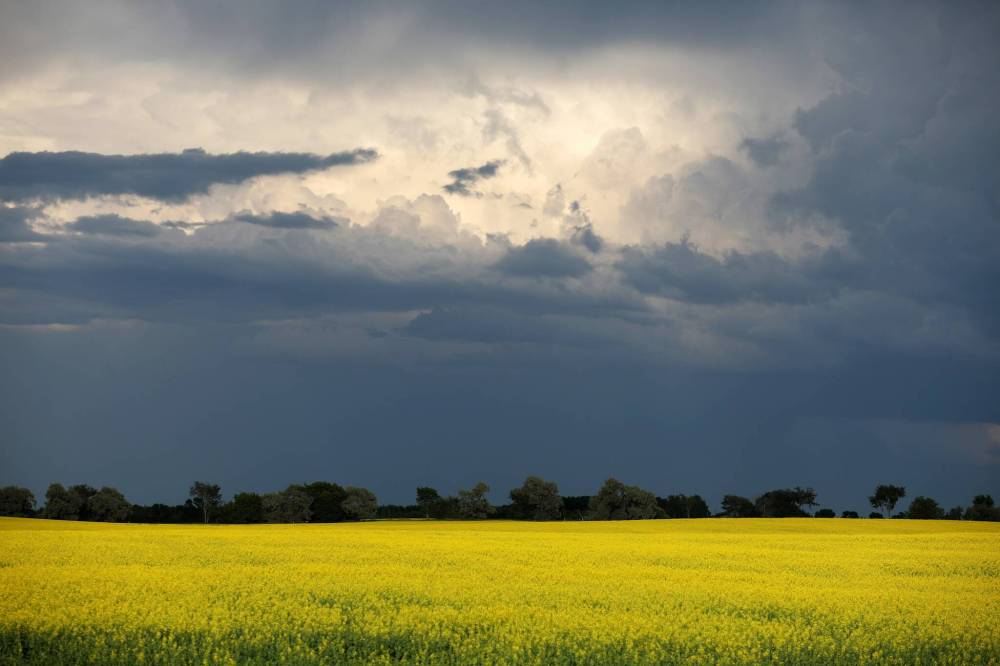
Storm clouds move east over a field of canola south of Brandon. (File)
As the Sun previously reported, a thunderstorm swept through Brandon late Tuesday afternoon, temporarily flooding streets and causing a power outage. On Wednesday, much of southern Manitoba and the Interlake — including Brandon, Neepawa, Melita, Killarney and Boissevain — was placed under tornado watches and warnings.
Environment and Climate Change Canada confirmed one tornado touched down near Arden, west of Gladstone, on Tuesday.
The latest crop report from the province of Manitoba stated that storms brought 134 millimetres of rain to parts of southwestern Manitoba and the Interlake in just one day.
Hail is another risk that producers on all types of farms are hoping won’t affect them this summer. On June 9, hail ranging in size from ping pong balls to softballs fell in Rivers and Oak River. And while hail can occur anywhere across North America, it most often happens in the central United States and the Canadian Prairies. Reports were also received of golf ball-sized hail in Neepawa, MacGregor and near Fork River this week.
Depending on how mature a crop of canola is, hail can have devastating effects, Fossay said. Although hail is never what any producer would hope for, if it has to happen, the earlier into the growing season, the better.
“If you get the hail when the plant is flowering, especially near the end of the flowering period, then you have really impacted its yield capability,” Fossay said.
Cattle producers are always on guard against inclement weather, said Melissa Atchison, a rancher and research and extension specialist with Manitoba Beef Producers.
Hail damage on silage crops — crops such as corn, legumes and grasses that are used for animal feed — can have an impact on beef producers. Rain on hay, which needs dry, sunny conditions to properly aerate — can negatively affect its quality.
“Rain on hay bales definitely degrades that hay crop and [it starts to] leak out water-soluble nutrients,” Atchison said.
Wind can also blow swaths of hay away, and lightning strikes are a very real danger for cattle, which often stand together in groups during storms. In July of last year, a family from Saskatchewan lost 28 cattle to a lightning strike.
Cows don’t understand that they need to move to lower ground, so they have no way of protecting themselves when a thunderstorm rolls in. Producers are unable to do much either, owing to how fast storms appear in Manitoba, Atchison said.
“Although lightning strikes are rare, it is common enough over the course of the season that you’ll know a couple of people who have lost an animal to lightning.”
In a perfect world, both Atchison and Fossay say the ideal summer for Manitoba would be made up of warm sunny days that cool down in the evening and rain showers that are regular but not too close together or heavy.
“That’s asking a lot but you know, that’s what we all hope for,” Atchison said.
Stephen Berg, a meteorologist with Environment and Climate Change Canada’s Winnipeg office, told the Sun earlier this month that Manitobans can expect above-normal temperatures for the duration of the summer.
» mleybourne@brandonsun.com, with files from Colin Slark
» Twitter: @miraleybourne