
Archeologists return to Westman dig site
Advertisement
Read this article for free:
or
Already have an account? Log in here »
We need your support!
Local journalism needs your support!
As we navigate through unprecedented times, our journalists are working harder than ever to bring you the latest local updates to keep you safe and informed.
Now, more than ever, we need your support.
Starting at $15.99 plus taxes every four weeks you can access your Brandon Sun online and full access to all content as it appears on our website.
Subscribe Nowor call circulation directly at (204) 727-0527.
Your pledge helps to ensure we provide the news that matters most to your community!
To continue reading, please subscribe:
Add Brandon Sun access to your Free Press subscription for only an additional
$1 for the first 4 weeks*
- Enjoy unlimited reading on brandonsun.com
- Read the Brandon Sun E-Edition, our digital replica newspaper
*Your next Free Press subscription payment will increase by $1.00 and you will be charged $20.95 plus GST for four weeks. After four weeks, your payment will increase to $24.95 plus GST every four weeks.
Read unlimited articles for free today:
or
Already have an account? Log in here »
Hey there, time traveller!
This article was published 10/07/2023 (1202 days ago), so information in it may no longer be current.
TWO BORDERS — Researchers from Brandon University and the Manitoba Archaeological Society arrived back at the Gainsborough Creek Valley dig site early last week, eager to work on a massive historical puzzle they began assembling five years ago.
This site, situated roughly 15 kilometres south of Melita, is one of only two locations that contain evidence of pre-contact Indigenous farming in Manitoba, which challenges the long-held belief that Indigenous people were strictly hunter-gatherers.
The whole operation kicked off in 2018 when nature enthusiast Eric Olson, who was visiting the area from Winnipeg, discovered farming hoes made of bison bone near Gainsborough Creek.

Manitoba Archaeological Society president Alicia Gooden walks visitors through the proper method of excavating a dig site during a Saturday morning tour of Brandon University’s current operation in the Pierson Wildlife Management Area. This site is one of only two locations that contain evidence of pre-contact Indigenous farming in Manitoba. (Kyle Darbyson/The Brandon Sun)
Since first investigating the site in 2019, BU anthropolgy professor Mary Malainey and her team have returned every July to expand the search for more historical artefacts, hoping to get a better idea of how these Indigenous groups lived off the land before the arrival of European settlers.
Malainey invited members of the public to view her team’s progress over the weekend, highlighting the two major dig areas that they’re currently excavating right next to the creek and on the grasslands just west of Highway 83.
During Saturday’s tour, Malainey, MAS president Alicia Gooden, University of Manitoba anthropology instructor Sara Halwas and several BU anthropology students told visitors that these two areas were used as a hearth or fire pit by the land’s inhabitants hundreds of years ago.
The hearth located uphill was most likely situated in a residential area, while the one located by the creek was primarily used as a space to butcher bison, given the sheer amount of animal bones they’ve discovered in the vicinity.
Even though the artefacts at these specific sites can be traced back to as far as the late 1400s or early 1500s, Malainey told the Sun that Westman residents have presented them with relics that suggest occupants dating back over a thousand years, which is why these kinds of archeological operations are so important.
“Essentially, we don’t know what we’re going to find … but every little bit of information we’re going to find makes the picture clearer,” the BU professor said.
“It’s like you have a puzzle that’s 10,000 pieces and those pieces are buried in the ground and you have to dig them up.”

Brandon University student Arynn Woytkiw shows some local visitors the proper method of sifting through dirt to find historical artifacts during Saturday morning's tour of a dig site located 15 kilometres south of Melita. (Kyle Darbyson/The Brandon Sun)
Outside of this Melita-area site, the only other evidence of pre-contact Indigenous farming in Manitoba can be found in the small community of Lockport, situated along the Red River north of Winnipeg.
Using the scientific method of radiocarbon dating, archaeologists determined that farmers arrived to cultivate this land around 1250 and abandoned the area roughly two centuries later.
Compared to Lockport, Malainey believes that this dig site in the Pierson Wildlife Management Area holds even more potential for future findings, since the land remained largely untouched before they started digging.
“It’s never been cultivated because the land owner that originally got this as homestead land determined that it wasn’t suitable because of all the steep cliffs. So he donated it to the province,” she said.
“Everything else around here has been cultivated by Europeans, by settlers. But here it hasn’t been. It’s been preserved and because it’s been preserved we have the opportunity to learn things we can’t learn elsewhere.”
Aside from the research grants they’ve received from the province, Malainey revealed that surrounding residents have been tremendously supportive of this project over the past half decade, especially the local First Nations communities who gave them permission to excavate these ancestral Treaty 2 lands in the first place.
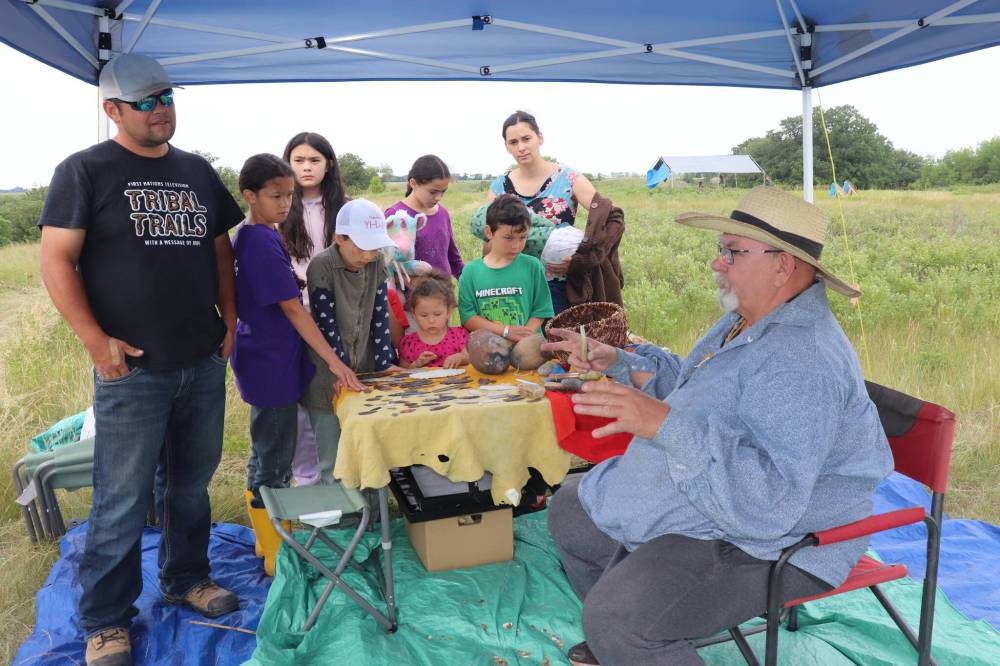
Gary Wowchuk demonstrates the proper way to manufacture stone tools in front of a family that's dropped by to tour an archeological dig site that was first established south of Melita in 2019. (Kyle Darbyson/The Brandon Sun)
Knowledge keepers like Greg Chatkana, from nearby Canupawakpa Dakota Nation, have also been a pivotal part of the team by offering guidance on how to approach this project in a culturally respectful manner.
For example, the dig team called Chatkana last week when they uncovered a fragment of a ceremonial pipe and sought the proper protocols for handling such a sacred object.
“So we are learning, and what we learn we’re sharing back with them,” Malainey said.
Moving forward, Malainey is confident that archaeologists will be returning to the Gainsborough Creek Valley for many years to come.
Given the sheer number of relics they’ve already uncovered, she believes this small slice of rural Westman holds the key to discovering the full scope of pre-contact Indigenous life in southwestern Manitoba, including its precise population and migratory patterns.
For anyone who wants to see the excavation site in action, Malainey encourages the public to come out and view it for themselves during the second round of tours that are taking place July 22-23 (starting at 10 a.m. and 12 p.m.).
“Some people think we don’t have archeology in Manitoba because we don’t have pyramids and stuff like that,” she said.

Brandon University student Charlotte Stein helps excavate an archeological dig site located right next to Gainsborough Creek on Saturday morning. (Kyle Darbyson/The Brandon Sun)
“But … this is our province’s history and pre-history here and it’s unique to Manitoba. It’s not something that happened on the other side of the world. This is what happened here.”
» kdarbyson@brandonsun.com
» Twitter: @KyleDarbyson