
Community standards bylaw passes
Advertisement
Read this article for free:
or
Already have an account? Log in here »
We need your support!
Local journalism needs your support!
As we navigate through unprecedented times, our journalists are working harder than ever to bring you the latest local updates to keep you safe and informed.
Now, more than ever, we need your support.
Starting at $15.99 plus taxes every four weeks you can access your Brandon Sun online and full access to all content as it appears on our website.
Subscribe Nowor call circulation directly at (204) 727-0527.
Your pledge helps to ensure we provide the news that matters most to your community!
To continue reading, please subscribe:
Add Brandon Sun access to your Free Press subscription for only an additional
$1 for the first 4 weeks*
- Enjoy unlimited reading on brandonsun.com
- Read the Brandon Sun E-Edition, our digital replica newspaper
*Your next Free Press subscription payment will increase by $1.00 and you will be charged $20.95 plus GST for four weeks. After four weeks, your payment will increase to $24.95 plus GST every four weeks.
Read unlimited articles for free today:
or
Already have an account? Log in here »
Hey there, time traveller!
This article was published 19/07/2023 (1148 days ago), so information in it may no longer be current.
A new bylaw that increases property upkeep standards and adds new definitions for ticketable offences including loitering, panhandling and graffiti is set to take effect after being passed by city council.
Concerns expressed by residents at Monday’s council meeting weren’t enough to scuttle the bylaw, though several amendments were made before the final vote was held.
All members of council voted in favour of the bylaw except Coun. Heather Karrouze (Ward 1). Coun. Kris Desjarlais (Ward 2) was not present at the meeting.
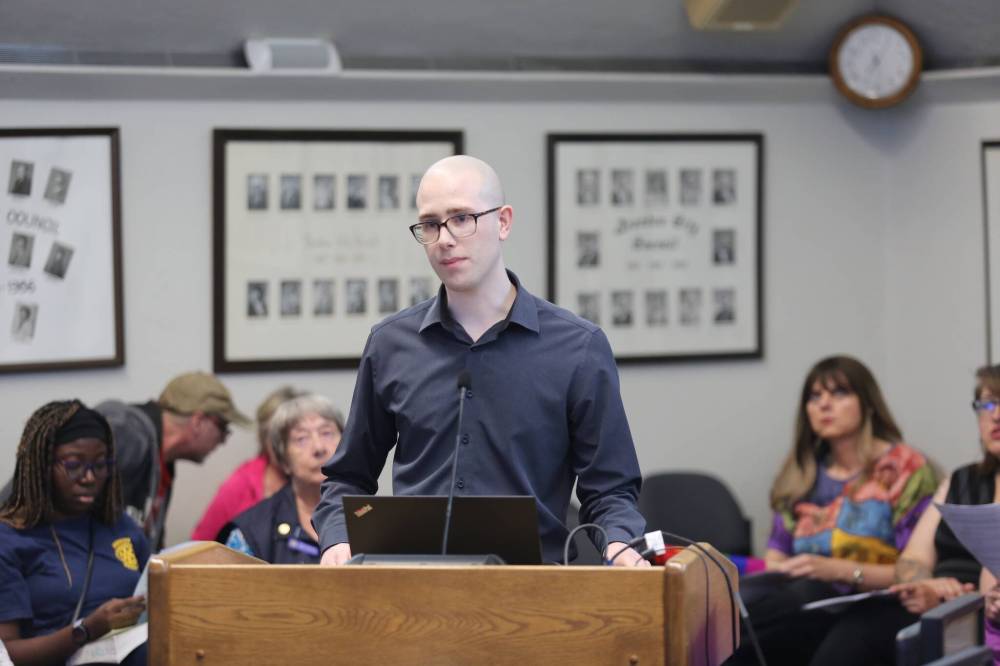
Resident James Epp expressed several concerns with the city’s new community standards bylaws in a presentation to Brandon City Council on Monday. Despite Epp’s concerns, city council approved the bylaw by a margin of 9-1. (Colin Slark/The Brandon Sun)
Brandon City Council has been discussing revisions to the bylaw since last year, though changes have been under consideration for multiple years.
When it was given second reading last December, wording was added to add snow-clearing requirements to the property standards section of the legislation.
It came up for third reading last month, but passage was delayed after some councillors expressed concern that the city would be unable to live up to the standards being set when it came to its own snow-clearing responsibilities.
Acting Brandon Police Service Chief Randy Lewis said at the meeting that the effort to revise the bylaws comes from a desire to consolidate and revise existing legislation.
Coming into Monday’s meeting, several amendments were proposed by city administration, but were ultimately defeated.
They would have required property owners to spread anti-slip material on their sidewalks if they are still slippery after being cleared of snow and more clearly defined the time period in which they are required to clear sidewalks after precipitation falls.
The city’s walking and biking paths would also have been exempted from the standards through an amendment. Coun. Shawn Berry (Ward 7) said he was uncomfortable that the city was requiring that residents had to clear paths in a certain time frame but it did not have to do the same.
“I think we should all follow the same rules regardless of who’s doing it,” Berry said.
Berry also said that putting stricter rules in place could deter citizens from voluntarily clearing their walkways. Coun. Glen Parker (Ward 9) countered that argument, saying that police need something in place so they can act in a worst-case scenario.
Another concern came from Coun. Barry Cullen (Ward 3), who said he knows of seniors who wouldn’t be able to clear snow themselves and would need to pay someone to do it for them.
However, Coun. Shaun Cameron (Ward 4) rebutted by saying that, having a standard in place helps guarantee that people with mobility issues won’t be forced to walk in the streets if sidewalks aren’t properly cleared of snow.
The proposed amendments ended up being quashed by a motion from Coun. Bruce Luebke (Ward 6), who said he wasn’t comfortable with putting a time frame in place.
The passed language on snow clearing ended up being: “Every owner and/or occupant of a property shall clear away and remove, or cause to be cleared away and removed, any and all snow or ice from sidewalks adjacent to their property to a condition to provide safe passage by pedestrians.”
Luebke also successfully passed a motion changing the proposed definition of loitering under the bylaw from one that included a mention of moving “slowly about” to one that said “wait around idly.”
There was an attempt by Karrouze to remove the sections of the bylaw dealing with panhandling and loitering, expressing fear that the legislation could have the effect of criminalizing poverty.
“My concern is that we’re offering at best a band-aid fix which does not address the underlying factors that result in loitering and panhandling such as homelessness, poverty, addiction,” Karrouze said.
Her amendment was defeated after only Karrouze voted in favour of it.
Not having those offences on the books and allowing people to be disrupted as they try to go about their lives without any enforcement tools would be a “big mistake,” Luebke argued.
Coun. Tyson Tame (Ward 10) wanted to know if the new bylaw would allow police to tackle people panhandling in and around the Corral Centre, since it prohibits panhandling in multiple circumstances, including toward people occupying motor vehicles.
Lewis said in order to enforce that provision, a person would have to be actively asking for money. That would include holding a sign asking for money.
It would not include people who stand at intersections but are not actively asking for money.
His co-presenter, Sgt. Jeff Hoad — who helped write the revised bylaws — said that prior to the new bylaws dealing with panhandlers on road medians, the only recourse the city had to deal with that situation was to charge them for stepping off of a median through a provision in provincial traffic laws.
Last week, the Sun published a story in which Toronto-based civil litigator Stephany Mandin expressed concern that the bylaw could open the city up to challenges under the Charter of Rights and Freedoms as municipalities in Ontario have experienced after passing similar legislation.
Brandon University sociology professor Christopher Schneider said in the same article that he was worried the bylaw would give police too much discretionary power because of the broad language used.
At Monday’s meeting, resident James Epp told councillors that his concerns included the bylaw’s compatibility with the charter. He said his complaints were with the standard bylaw itself and not the compliance bylaw that defines penalties for violating the standards, which he said he had not studied to the same extent.
He said some of the offences added in the bylaw are already listed under the Criminal Code, meaning officers should already have the discretion to enforce them.
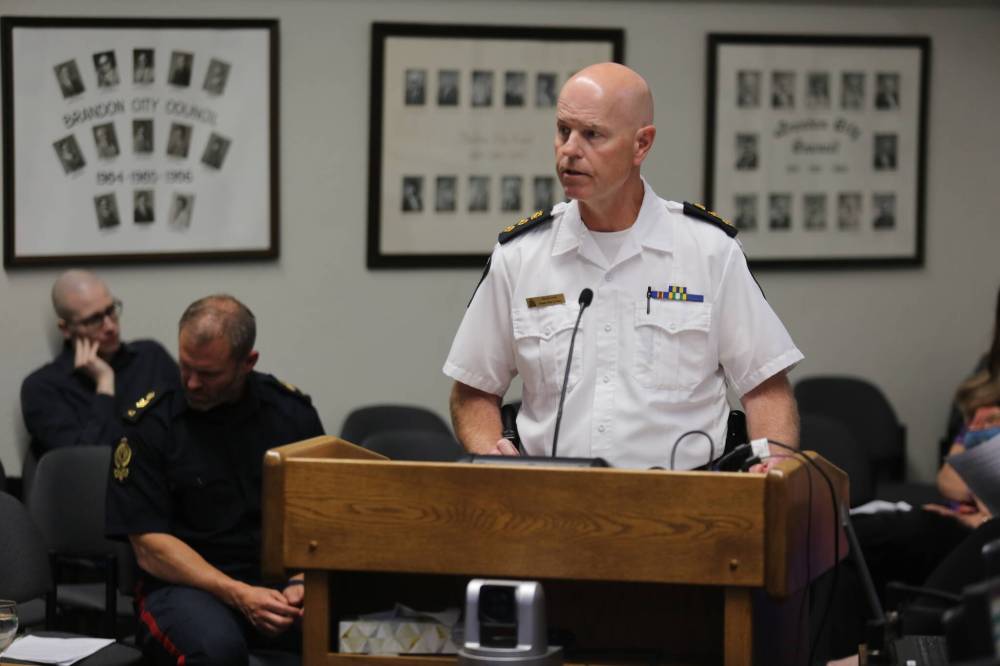
Acting Police Chief Randy Lewis answers questions about Brandon’s new community standards bylaw at Monday’s Brandon City Council meeting. (Colin Slark/The Brandon Sun)
Tackling that question, Hoad said that having offences covered under city bylaws allows for officers to tackle issues that don’t meet the threshold of being a criminal offence.
That would also mean the penalties are less stringent than if they were considered criminal acts. Hoad confirmed that the city’s legal department was consulted during the creation of the new bylaws.
Epp recommended the city consider some kind of appeal process where a figure like the chief of police can consider residents’ applications for exemptions to the bylaw.
On the provisions concerning graffiti, Epp pointed out that they discuss art works “of an inappropriate nature,” but asked who gets to decide what art is appropriate.
When it comes to loitering, the Criminal Code states that someone has to be both loitering and obstructing a public place. Epp said the city’s version states “no person shall loiter and/or obstruct” which is a lower standard.
One of the justifications surrounding the new bylaw is that adding more offences give police the ability to better connect people with services they might need.
“You don’t need a bylaw to do that,” Epp said. “You can just go up to someone who’s in need and say ‘hey, what do you need, can I help you?’”
Elliott Oleson, the runner-up in last year’s mayoral race and a Sun columnist, also voiced concerns regarding the bylaw’s interactions with the charter.
“I want to draw your attention to charter section seven: ‘no one will be deprived of life, liberty or security of person except in consistency with the fundamental principles of justice,’” Oleson said.
“This bylaw serves to criminalize the singular existence of the homeless. They have literally no place to go. Under this bylaw, if they did not have 24 hours a day, seven days a week scheduled out, they could be rounded up, searched, questioned for nothing more than moving.”
Mayor Jeff Fawcett pointed out that loitering has been listed as an offence in city bylaw since at least 1991.
Lewis said he’d done some research and found that loitering provisions haven’t been enforced since 2017, and the goal is to get residents to comply with the rules without having to enforce them.
“That bylaw has been useful in being able to work with our citizens and have guidelines as to what is acceptable behaviour and what is not,” Lewis said. “Enforcement is not our first priority with these … that would certainly go on with the panhandling bylaw as well.”
Two women speaking about the bylaw expressed worry that some people would be unable to fulfil the snow-clearing conditions in the bylaw.
“I do have concerns for Brandonites who are elderly, disabled, single-income family being able to have the time to maintain the sidewalk and do all the shoveling,” one of the women said.
“And the cost of being fined when they’re not able to do it because they don’t have time when they’re working two or three jobs.”
A final amendment by Coun. Shawn Berry (Ward 7) that changed the definition of properties affected by the new standards to explicitly include land that does not have buildings on it as well as land under every type of zoning designation was passed.
“They’re not set in stone, we will review these,” Fawcett said.
“This is the reason we’re doing this because there’s been a review and we thought we need to put some of these things together. There’s some redundancy with building bylaws. I don’t know if we can ask or look at going through a season, let’s go through a winter, let’s review it next summer and see if there are any little changes we need to make to a bylaw.”
The next step for the city will be to update its compliance bylaw to establish penalties for new offences added to the community standards bylaw.
» cslark@brandonsun.com
» Twitter: @ColinSlark