
Suggestions made in wake of cyclist collision
Advertisement
Read this article for free:
or
Already have an account? Log in here »
We need your support!
Local journalism needs your support!
As we navigate through unprecedented times, our journalists are working harder than ever to bring you the latest local updates to keep you safe and informed.
Now, more than ever, we need your support.
Starting at $15.99 plus taxes every four weeks you can access your Brandon Sun online and full access to all content as it appears on our website.
Subscribe Nowor call circulation directly at (204) 727-0527.
Your pledge helps to ensure we provide the news that matters most to your community!
To continue reading, please subscribe:
Add Brandon Sun access to your Free Press subscription for only an additional
$1 for the first 4 weeks*
- Enjoy unlimited reading on brandonsun.com
- Read the Brandon Sun E-Edition, our digital replica newspaper
*Your next Free Press subscription payment will increase by $1.00 and you will be charged $20.95 plus GST for four weeks. After four weeks, your payment will increase to $24.95 plus GST every four weeks.
Read unlimited articles for free today:
or
Already have an account? Log in here »
Hey there, time traveller!
This article was published 22/07/2023 (1222 days ago), so information in it may no longer be current.
Stop signs, roundabouts and pothole repairs were among the suggestions made Friday by experts who analyzed a 2022 accident in which a Brandon cyclist lost a finger.
While cycling with his wife near Rideau Park in June 2022, Grant Hamilton was struck by a vehicle and incurred several injuries.
Earlier this year, Hamilton pitched his accident to U.S.-based civic advocacy group Strong Towns as a possible subject for one of its crash analysis sessions.
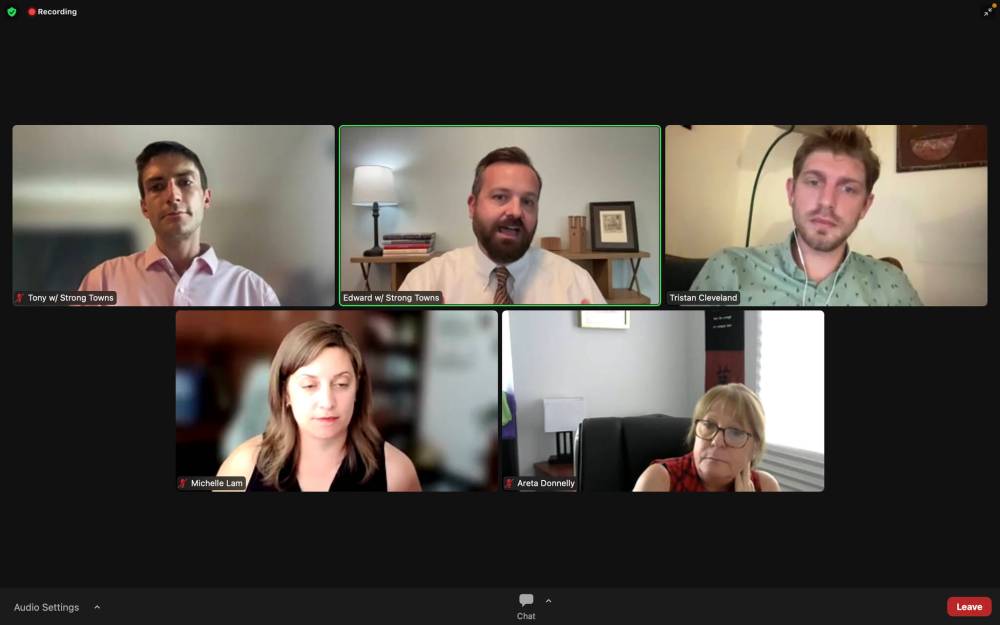
Panellists for a crash analysis studio held on Friday by non-profit Strong Towns analyzed and proposed solutions relating to Grant Hamilton's 2022 collision. Hamilton was struck by a vehicle while cycling on Park Street, causing him to suffer several injuries, including losing a finger. (Screenshot)
In these sessions, Strong Towns gathers experts to take deep dives into traffic collisions to figure out what caused them and how further incidents can be prevented.
The panel they assembled for Friday’s crash analysis studio brought together Brandon University professor Michelle Lam, United Way of Brandon & District campaign manager and member of Brandon’s Vision Zero task force Areta Donnelly, Dalhousie University city planning instructor Tristan Cleveland and Strong Towns’ director of community Edward Erfurt to discuss the situation.
Last week, Strong Towns’ communications manager Lauren Ronnander told the Sun that while her organization has done work in both the U.S. and Canada before, this was the first of their crash analysis studios focusing on an event in Canada.
On top of that, it’s also the first studio not to focus on a fatality, which made Hamilton the first participant to be able to speak about their own accident.
The facts of the incident as relayed by host Tony Harris was that on June 27, 2022, Hamilton and his wife were cycling along Park Street when a motorist turned onto the road from Lorne Avenue East and struck him, flipping him over the vehicle’s hood.
According to research done by Strong Towns, most vehicular accidents are caused by road design and not driver error.
Hamilton sustained injuries including the missing finger, a torn meniscus and a separated shoulder that required him to be transported to Winnipeg’s Health Sciences Centre for treatment and surgery.
Though it was getting dark at the time, Cleveland said he wouldn’t put too much weight on that argument as the cause of the collision.
Lam, who lives near the crash site, said there are significant potholes on the stretch of road in question, which can sometimes prevent cyclists from riding on bike lanes along Lorne Avenue East.
Donnelly also lives near the crash site, just a half-block away. She said she was in a traffic collision herself after another motorist didn’t follow a yield sign.
She said Brandon City Council’s decision to lower the speed limit of the roads surrounding Rideau Park earlier this summer to 30 kilometres an hour was helpful, but warned that people get complacent. A lot of motorists, she said, still travel in that area at 40 to 50 km/h.
An informal speed study performed by Hamilton over a three-hour period found that 18.5 per cent of motorists at the crash site were going faster than the speed limit. Now that the speed limit has been lowered, that number would have gone up to 88 per cent.
“I think the city needs to take a look at controlling some of those intersections a little bit better,” she said.
One way of doing that, she recommended, was for the installation of four-way stops at the intersection, add more stop signs in the area in general and replace some yield signs with stop signs.
The presence of yield signs, not stop signs at the intersection in question was intriguing to Erfurt. He said in his community, stop signs are generally seen by residents as being in place for visitors more than locals.
Because the street is very wide but frequently empty of cars, Erfurt said that could sometimes lead to motorists not paying as much attention as they would if there was more traffic.
He pointed out that cyclists have to be more careful about potholes than motorists because the impact of hitting one is greater when riding a bike.
According to Cleveland, urban planners need to keep an eye on how much street parking is expected to be used when designing streets because a lot of areas don’t have enough cars parked along them to act as traffic calming.
One possible solution is the introductions of small-scale roundabouts like those used more frequently in Europe.
If a roundabout had been present at the accident site, the motorist would have had to slow down and not turn immediately onto the other road where they collided with Hamilton.
If the city were to consider installing bump-out medians to create protected bike paths, Cleveland warned that some implementations have actually made cyclists feel less safe.
In the short term, Lam said parking should be limited on one side of Lorne using traffic cones to create a dedicated cycling path. The traffic cones could be replaced in the long-term with more permanent measures.
“The only thing that was mentioned that would take more than a few hours to do would be to turn one of the lanes to a dedicated bike lane,” Erfurt said.
Now that the analysis has been completed and suggestions made, Strong Towns will prepare a report for the City of Brandon to consider.
» cslark@brandonsun.com
» Twitter: @ColinSlark