
Adding AI to the curriculum
How Brandon educators plan to co-exist with artificial intelligence
Advertisement
Read this article for free:
or
Already have an account? Log in here »
We need your support!
Local journalism needs your support!
As we navigate through unprecedented times, our journalists are working harder than ever to bring you the latest local updates to keep you safe and informed.
Now, more than ever, we need your support.
Starting at $15.99 plus taxes every four weeks you can access your Brandon Sun online and full access to all content as it appears on our website.
Subscribe Nowor call circulation directly at (204) 727-0527.
Your pledge helps to ensure we provide the news that matters most to your community!
To continue reading, please subscribe:
Add Brandon Sun access to your Free Press subscription for only an additional
$1 for the first 4 weeks*
- Enjoy unlimited reading on brandonsun.com
- Read the Brandon Sun E-Edition, our digital replica newspaper
*Your next Free Press subscription payment will increase by $1.00 and you will be charged $20.95 plus GST for four weeks. After four weeks, your payment will increase to $24.95 plus GST every four weeks.
Read unlimited articles for free today:
or
Already have an account? Log in here »
Hey there, time traveller!
This article was published 26/08/2023 (1122 days ago), so information in it may no longer be current.
Generative artificial intelligence (AI) will inevitably play a role in the upcoming school year, but local education officials don’t think that’s necessarily a bad thing.
Rather than ban AI outright, instructors at the high school and post-secondary level are drawing up clear-cut rules on how these digital tools can and cannot be used in the classroom, with the hope of not being caught flat-footed like last year.
On Nov. 30, 2022, the American research laboratory OpenAI officially launched ChatGPT, showing the broader public how this revolutionary AI chatbot can generate complex text using data harvested from the internet.
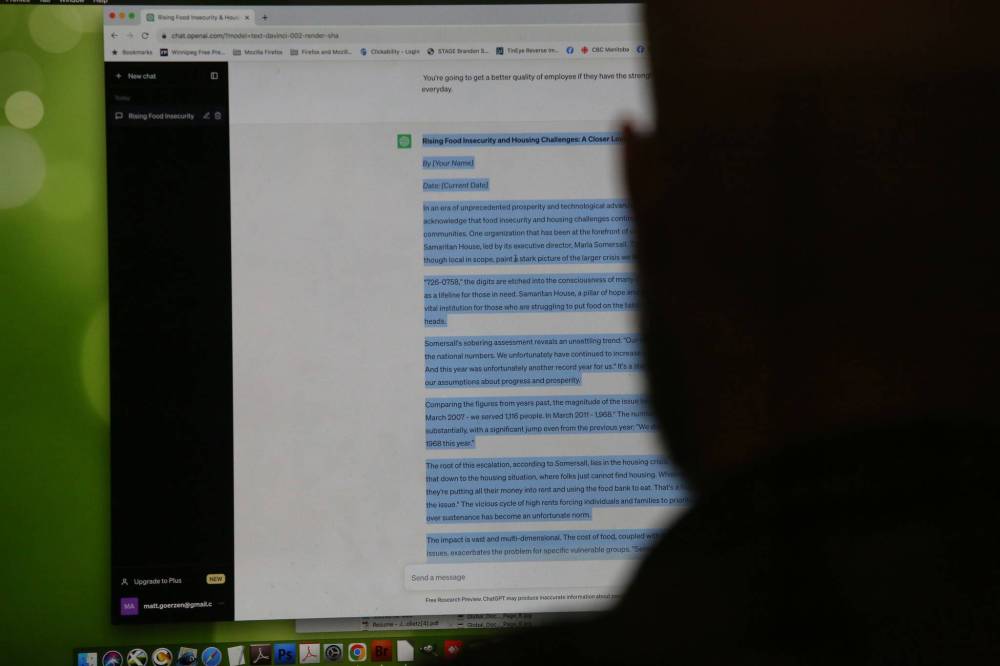
“About two weeks later, the first of many professors contacted me and asked ‘what’s this thing?’” recalls Curt Shoultz, the director of Brandon University’s Centre for Teaching, Learning and Technology.
“And then I started doing some research and reading on it, because obviously we were going to need a response to it as a university.”
The advanced language processing of ChatGPT helped it take the world by storm throughout the next couple of months, with the AI tool tallying 100 million active users by January and becoming the fastest-growing consumer application in history.
However, educators at BU and beyond continued to raise alarm bells about how this new technology could lead to a rise in plagiarism and academic dishonesty.
After all, ChatGPT has the ability to generate essays and other creative projects (poems, short stories, etc.) in mere seconds based on a couple of written prompts, giving students an easy way to complete assignments without putting in any hard work.
Sure enough, this very phenomenon started popping up at BU during the early stages of its recent winter term, with faculty members telling Shoultz that they started flagging work that appeared to be AI-generated.
This forced a lot of BU instructors to change their syllabi for the following spring and summer semester, carving out strict parameters on how AI tools can be used (if at all) depending on the course.
“And we hope that by the time classes begin in September every class has a course outline that has an expression of how each professor sees it being done,” Shoultz said.
Bryce Ridgen experienced a similar series of events last year as the principal at Vincent Massey High School.
Following the release of ChatGPT in November, Vincent Massey staff started to raise concerns about students using the AI chatbot around March, with dozens of pupils being caught red-handed throughout the remainder of the school year.
“Once we started hearing about it, it snowballed quickly, as most social media type things do,” Ridgen said. “When one student finds out one thing, or a shortcut or another option, you see it becoming more and more prevalent.”
Heading into the new school year as the principal of Crocus Plains Regional Secondary School, Ridgen is tasking his teachers with establishing AI guardrails in their course outlines to help guide students through this evolving digital landscape.
“Last year, at this time, no teacher would have had anything ChatGPT or AI-related [in their outline],” he said. “And this year, when teachers submit their course outlines, that’ll be a topic that will be included in all of them.”
Staff at Assiniboine Community College were also quick to respond to the emergence of this new technology, modifying their Policy on Academic Integrity in March to add “artificial intelligence” to a list of study aids that could be considered cheating.
While BU and the Brandon School Division haven’t adopted an overarching standard like ACC, all three organizations are united in terms of their basic approach to AI in the classroom.
Even though tools like ChatGPT are being strictly forbidden in certain circumstances — such as assignments that require students to compose essays and more traditional written work — local educators are being given enough wiggle room to incorporate AI into the curriculum if they so desire.
To Ridgen, generative AI could serve as an asset for teachers who want to help their students think outside the box, where they’re asked to break down a complex concept or idea and contrast their analysis with whatever ChatGPT is able to spit out.
“That’s a lot higher-level thinking than you would get from just a read-and-response [exercise],” he said.
Shoultz believes that AI programs have also shown a lot of potential for computer science courses, particularly for students who want to learn how to code.
ACC Library Services manager Josh Seeland is of a similar mind, believing that AI isn’t this looming destructive threat to academic integrity that some are making it out to be.

Seeland compares generative AI to older study aids like calculators, which are also included in ACC’s Policy on Academic Integrity as a potential form of cheating.
“If the point is to learn how to do math manually, then I can see a calculator not being a good idea,” he said. “But if the point of, say, a program is to just do research broadly, maybe to do some critical thinking, well maybe a generative artificial intelligence tool will be something you could use, right?”
To help ACC staff and students figure out whether AI is appropriate for their specific course, Seeland and his team have been busy putting together a bunch of resources to properly showcase the ins and outs of how these tools work.
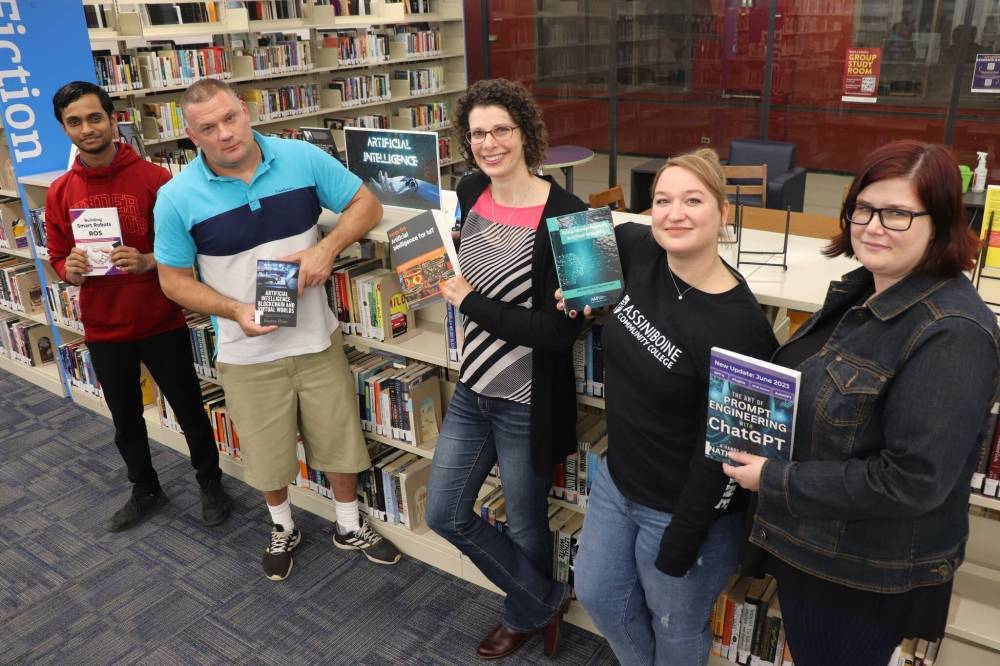
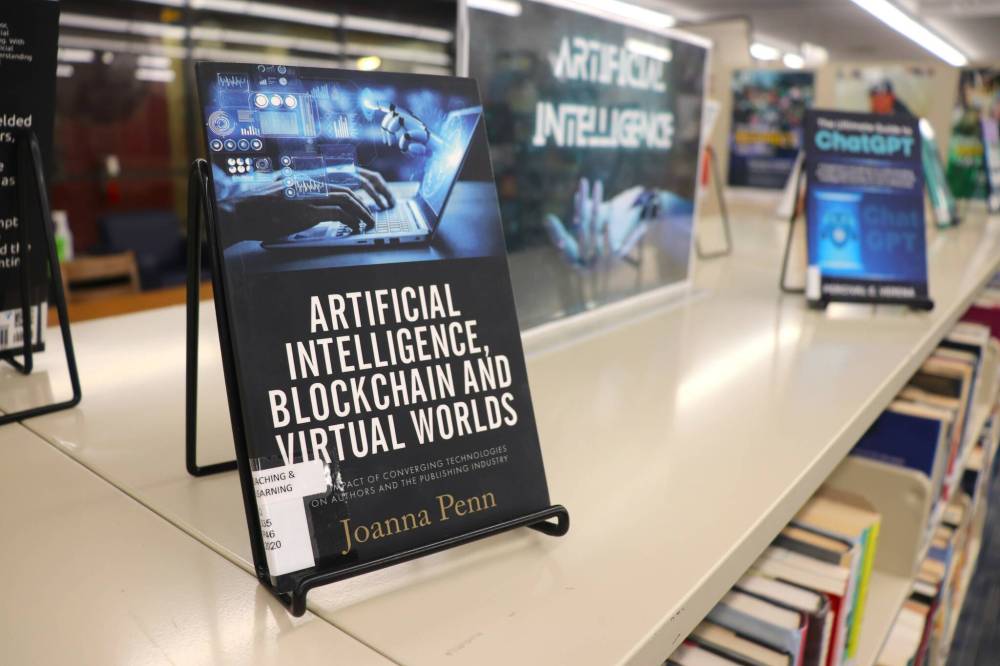
Outside of hosting speaking events and cultivating a dedicated artificial intelligence section at the library, Seeland’s team have been consulting with the college to modify certain introductory courses so that freshman students know about these new standards right away.
“Our first-year students take a course called College Foundations, which is kind of an introduction to college life here at ACC,” he said. “And the module that tackles digital information literacy has been updated to have generative AI in it, just to get that conversation going.”
BU and ACC aren’t the only post-secondary schools in Canada to take this open-minded approach towards AI.
Institutions like the University of Saskatchewan, the University of British Columbia and the University of Windsor are all giving students the green light to use AI tools under certain circumstances, with the promise of enforcing punitive action for those who cross the line.
Over at BU, Shoultz said that students who violate the AI guidelines written in their professors’ syllabi will also be subject to a range of academic punishment, from a zero on their assignment to outright expulsion.
“So the bottom line is: if you didn’t do the work, you didn’t do the learning. And if you’re trying to pass off someone else’s work — even if it’s a computer’s work — as your own, that is academic dishonesty,” he said.
Admittedly, getting all BU, ACC and Crocus Plains staff on the same page for this major shift in instructional practices will be a challenge, especially since there’s no universal way to spot an AI-generated work beyond simply knowing what to look for.
Luckily, Ridgen believes that his teachers are up to the task of changing along with the times, having made a similarly drastic pivot to online learning at the beginning of the COVID-19 pandemic.
“We had no choice but to adapt, and I think this is another opportunity where teachers are going to have no choice but to adapt to how they’re doing their instruction and assessment,” he said. “It’s definitely going to force some change quicker than it would have happened otherwise.”
For Seeland, introducing AI into the curriculum is a necessity and perfectly lines up with the goal of ACC and other post-secondary schools, which is to properly prepare students for a working world constantly in flux.
One in five Canadians already use generative AI tools to help them at work or school, according to a KPMG study that was published in June.
And given the sheer glut of generative AI tools that have flooded the marketplace since the debut of ChatGPT, with U of S professor Paula MacDowell placing that number at more than 3,000, there’s no way this genie is being put back in the bottle.
“CoPilot is going to be in Microsoft. Bing is already in Microsoft Edge … so be part of the solution, learn how to use them and decide what the narrative around them will be,” Seeland said.
» kdarbyson@brandonsun.com