
Public welcome for BU agriculture talk
Advertisement
Read this article for free:
or
Already have an account? Log in here »
We need your support!
Local journalism needs your support!
As we navigate through unprecedented times, our journalists are working harder than ever to bring you the latest local updates to keep you safe and informed.
Now, more than ever, we need your support.
Starting at $15.99 plus taxes every four weeks you can access your Brandon Sun online and full access to all content as it appears on our website.
Subscribe Nowor call circulation directly at (204) 727-0527.
Your pledge helps to ensure we provide the news that matters most to your community!
To continue reading, please subscribe:
Add Brandon Sun access to your Free Press subscription for only an additional
$1 for the first 4 weeks*
- Enjoy unlimited reading on brandonsun.com
- Read the Brandon Sun E-Edition, our digital replica newspaper
*Your next Free Press subscription payment will increase by $1.00 and you will be charged $20.95 plus GST for four weeks. After four weeks, your payment will increase to $24.95 plus GST every four weeks.
Read unlimited articles for free today:
or
Already have an account? Log in here »
Hey there, time traveller!
This article was published 16/09/2023 (1098 days ago), so information in it may no longer be current.
Renowned agricultural expert Robert Saik will be speaking about the threat futuristic technology could pose for the agriculture industry and global food security at the Lorne Watson Recital hall at Brandon University today as part of the university’s inaugural JRC Evans Public Lectureship.
Crises like the COVID-19 pandemic and the Russian invasion of Ukraine hint at ongoing global supply chain issues that places like western Manitoba must constantly adapt to, says Saik, who was recognized as one of Canada’s Top 50 Most Influential Agriculture Leaders and was named one of the country’s Top 10 Ag Mentors in 2021.
“A core group of farmers will be called on to grow the vast majority of the world’s staple food supply, and while mighty in their ability, they need support from the general public,” Saik said.
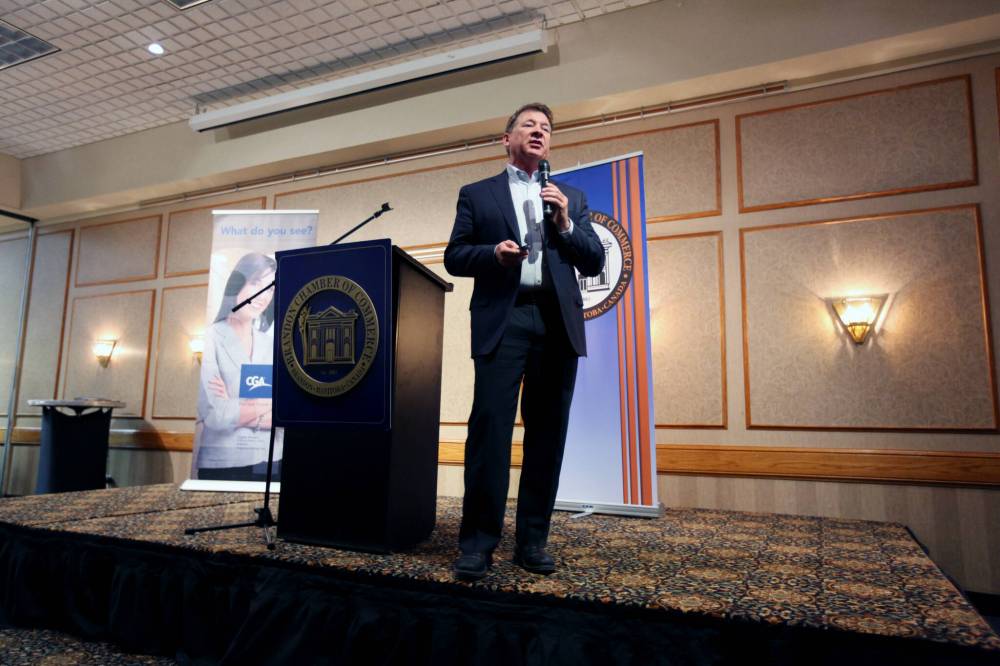
Robert Saik, who has 40 years of experience as a professional agrologist, will give a talk on technology and agriculture at Brandon University today. (File)
Demographic trends foresee a world population nearing 10 billion people by 2050, which Saik says implies that agriculture must increase production by 60 to 70 per cent, while also becoming infinitely sustainable. Living standards are getting better globally, which plays into the demand for a wider, more diverse diet, Saik said.
“There are also higher levels of meat consumption, particularly in developing nations, and this puts pressure on increased production,” he said.
Canada, Saik said, is one of the nations racing to keep up with global demand — a task that hasn’t been made easy with the country’s strict environmental policies and the federal government’s carbon tax program. Producers are being asked to produce more food, reduce their environmental footprint, protect the environment and, in some cases, restore habitat at the same time.
“Technology is a way that this can be alleviated a little bit, no doubt about it,” Saik said.
On the other hand, citing a movement away from globalization and toward more “nationalistic” policies, Saik says many countries are striving to become more independent when it comes to their food supplies.
“For example, Pakistan is trying to concentrate and grow more food on its own. Even places like United Arab Emirates are devoting a lot of money to try to produce more agricultural products in their own nation,” he said.
In Canada, the biggest constraint felt in agriculture is a labour shortage, which the COVID-19 pandemic exacerbated, Saik said. There’s more pressure now on labour in agriculture than ever before, and this, in turn, has furthered the push toward more and more automation in the industry.
“We’re continually, in agriculture, looking to the equipment side of technology, to do more, faster and with less labour,” he said, adding this can be seen in greenhouses, on vegetable farms, and in some cases on large-scale crop operations.
“We know that these challenges bring enormous opportunities for Westman, and we know that Brandon University researchers, alumni and partners can play a big role,” said Carla Eisler, BU’s director of advancement and alumni affairs.
Saik’s talk builds on his Amazon best-selling book, “Food 5.0: How We Feed the Future.” He’ll briefly discuss the history of agriculture and then turn to how technology is disrupting the industry, pointing to drones, 3D printing and artificial intelligence that is transforming the world’s food production.
Changes from technology are coming sooner than anyone expects, Saik said, and knowing how it will change producers’ ability to provide food to the world is worth pondering.
“This is essential knowledge for communities here in Westman, whether you’re directly involved in ag production, whether you work somewhere that does business with ag and really, for anyone who eats,” Saik said.
Saik’s book was written before the COVID-19 pandemic hit, and asked people how often they think about a plague, about famine and about war. In the years since it was published in 2019, all of those things have occurred — some on a global scale and some, like the pandemic, closer to home.
“Most of those are geopolitical issues,” Saik said. “These things disrupt agriculture and also create opportunity for agriculture.”
Saik hopes that not just people from the agriculture industry will attend his talk, as ag is something that affects every citizen of Canada, and of the world.
“I would really welcome the broader public to come. They’re going to learn about agriculture and where we’re going, and it’s very exciting,” Saik said. “It’s moving much faster than people realize, and it’s much more innovative than people realize.”
» mleybourne@brandonsun.com
» X: @miraleybourne