
Experts clash over food price fixes
Advertisement
Read this article for free:
or
Already have an account? Log in here »
We need your support!
Local journalism needs your support!
As we navigate through unprecedented times, our journalists are working harder than ever to bring you the latest local updates to keep you safe and informed.
Now, more than ever, we need your support.
Starting at $15.99 plus taxes every four weeks you can access your Brandon Sun online and full access to all content as it appears on our website.
Subscribe Nowor call circulation directly at (204) 727-0527.
Your pledge helps to ensure we provide the news that matters most to your community!
To continue reading, please subscribe:
Add Brandon Sun access to your Free Press subscription for only an additional
$1 for the first 4 weeks*
- Enjoy unlimited reading on brandonsun.com
- Read the Brandon Sun E-Edition, our digital replica newspaper
*Your next Free Press subscription payment will increase by $1.00 and you will be charged $20.95 plus GST for four weeks. After four weeks, your payment will increase to $24.95 plus GST every four weeks.
Read unlimited articles for free today:
or
Already have an account? Log in here »
Hey there, time traveller!
This article was published 19/09/2023 (1090 days ago), so information in it may no longer be current.
The possible imposition of new federal taxes on major grocery chains to curb rising food prices has sparked a contentious debate among political and economic experts, as they offer contrasting views.
“It’s crucial to strike a balance between addressing rising food prices and ensuring consumers have access to affordable and nutritious food,” Dalhousie University food distribution and policy professor Sylvain Charlebois told the Sun. “The impact on the industry needs to be carefully assessed, as increased taxes could affect the competitiveness and profitability of grocery chains, potentially impacting employment and supply chain dynamics.”
Charlebois said there is a need for a comprehensive cost-benefit analysis.
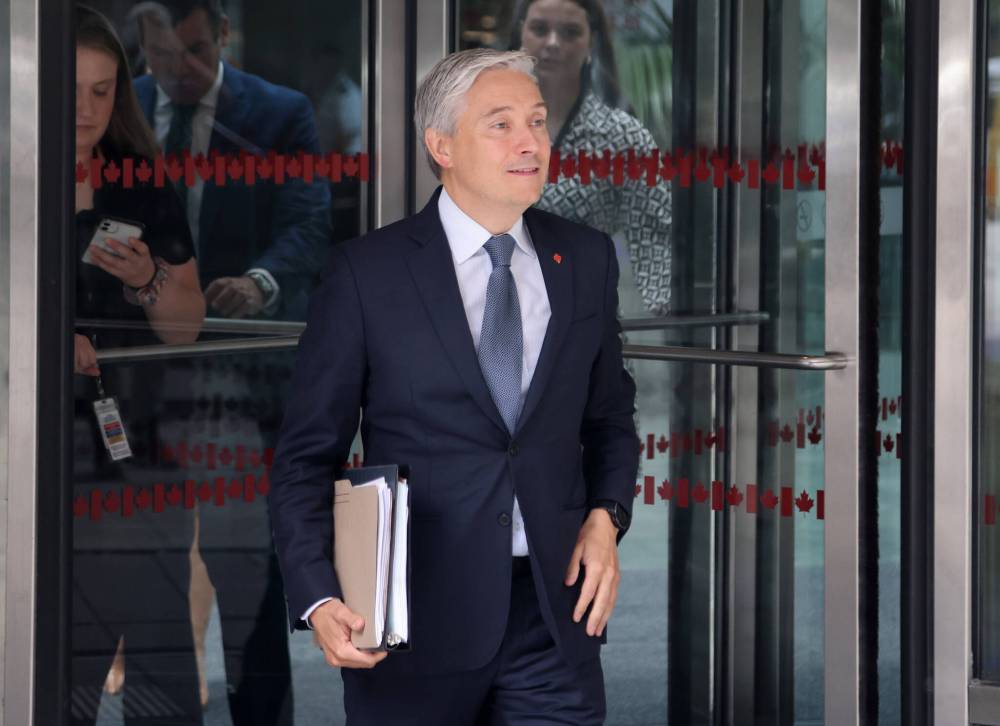
Industry Minister Francois-Philippe Champagne leaves a meeting on the growing cost of food in Ottawa on Monday. Champagne and Finance Minister Chrystia Freeland met with executives from Loblaw, Metro, Empire, Walmart and Costco. (The Canadian Press)
“To assess the economic feasibility, it’s important to conduct a comprehensive cost-benefit analysis that takes into account the potential revenue generated by the tax and its impact on food affordability,” he said.
Prime Minister Justin Trudeau announced during a press conference last Thursday his intention to hold the heads of large grocers accountable for addressing the escalating cost of food in Canada. He set an Oct. 9 deadline for the submission of their plans to stabilize prices and hinted at the potential use of tax measures if the proposed solutions did not provide significant relief to Canadians.
“[We] will be calling on the heads of large grocers to come to Ottawa with a plan to address the rising cost of food,” Trudeau said.
“Let me be very clear: if their plan doesn’t provide real relief for the middle class and people working hard to join it, then we will take further action, and we are not ruling anything out, including tax measures.”
Imposing additional taxes on grocers could indeed lead to higher prices for consumers, which would disproportionately affect low-income households, Charlebois said.
To Charlebois, the factors contributing to the increase in food prices in Canada are climate change, supply chain disruptions, global market dynamics and rising input costs.
The Canadian Taxpayers Federation also echoed Charlebois’ sentiments, urging Prime Minister Justin Trudeau to change course on the proposed tax and focus on eliminating the carbon tax instead.
“Another tax won’t make groceries more affordable; it’ll make them more expensive,” CTF federal director Franco Terrazzano stated.
Brandon-Souris Conservative MP Larry Maguire also shared that view.
“If you’re going to tax the major grocery stores because you think that they are causing high prices on groceries, then they’re just going to pass that on to the consumer, and the groceries will cause even more down the road,” Maguire told the Sun.
Maguire alleged that the existing carbon tax is a significant factor contributing to high food prices and tasked Trudeau to reconsider this policy.
“The better way for the prime minister to go would be to eliminate the carbon tax and allow these businesses to be able to operate on their own accord,” he said.
But Centre for Future Work director Jim Stanford disagrees with Charlebois and Maguire, saying the proposed tax measure would be an excess profits tax paid by companies — like one that is already in place for banks and insurance companies in Canada.
“The best alternative to this is for supermarkets themselves to show more restraint in raising their prices, and to be sure to quickly and fully pass on the lower costs that are already visible for most inputs in the food supply chain,” Stanford told the Sun.
Stanford argued that the recent surge in food prices cannot be attributed to the carbon tax, which has been in place since 2019, adding that such a claim is statistically unsupported and logically inconceivable. The professor of economics explained that energy costs, including those for food production, have played a significant role in inflation but are driven by global factors, not carbon pricing.
“The carbon price does not explain the gigantic ups, downs, and ups again of energy prices. That is all due to OPEC, Russia, and the oil and gas industry, which has profited enormously from higher oil prices, even though the cost of producing energy in Canada hasn’t changed,” he said.
Stanford added that Canada, unlike many other countries, exempts many groceries entirely from sales taxes, and this makes it more far-fetched for Conservative politicians to try to blame governments for the consequences of profit-seeking corporations.
“The direct impact of the carbon tax on prices, even for fossil fuel products, is minimal. For instance, a $15 annual carbon tax increase translates into a mere 0.08 per cent increase in overall consumer prices for gasoline, the most substantial direct fossil fuel component in the Consumer Price Index,” Stanford said.
He added that food retail profits sector-wide have doubled since COVID, and the profit margin (as a percentage of revenues) has also grown by about three-quarters.
Stanford argued that the core objective of the carbon tax is to stimulate economic adjustments for energy conservation and investments in cleaner energy sources. He said that the adjustments can lead to reduced prices for various products, such as electric vehicles and electricity sourced from renewables.
According to Stanford, most carbon pricing revenues are either rebated to Canadian households or allocated to public services, adding that this redistribution does not influence inflation rates but helps mitigate the impacts of inflation, particularly for lower-income Canadians.
Though the economist agreed that there could be some political undertone to meeting with the big grocery firms, he argued that anger over the companies’ behaviour can be justified.
“Despite the obvious politics tied to the meeting, anger over supermarket behaviour is legitimate and statistically verified. And the combination of public scrutiny with the threat of further action, following the Commons hearings earlier this year, could make a difference.”
Industry Minister François-Philippe Champagne and Finance Minister Chrystia Freeland met with executives from Loblaw, Metro, Empire, Walmart and Costco on Monday morning.
“They have agreed to support the government of Canada in our efforts to stabilize food prices in Canada,” Champagne told reporters after the meeting.
Calling the meetings historic and constructive, the industry minister said he told the grocery CEOs “in no uncertain terms” that Canadians expect them to take action.
Speaking to reporters Monday afternoon, Trudeau reiterated the federal government is going to make sure the major grocers have a plan.
“Food is too expensive for too many families and (grocers are) making record profits,” Trudeau said.
However, the Liberals haven’t indicated what they would like to see the grocers do or how these chains could bring stability to grocery prices.
Instead, Champagne said that he wants the grocers to come up with their own individual plans, so as to protect competition.
Champagne is expected to meet with other segments of the food industry as well to talk about rapidly rising prices.
» aodutola@brandonsun.com, with files from The Canadian Press
» X: @AbiolaOdutola