
AMM revisits election priorities
Advertisement
Read this article for free:
or
Already have an account? Log in here »
We need your support!
Local journalism needs your support!
As we navigate through unprecedented times, our journalists are working harder than ever to bring you the latest local updates to keep you safe and informed.
Now, more than ever, we need your support.
Starting at $15.99 plus taxes every four weeks you can access your Brandon Sun online and full access to all content as it appears on our website.
Subscribe Nowor call circulation directly at (204) 727-0527.
Your pledge helps to ensure we provide the news that matters most to your community!
To continue reading, please subscribe:
Add Brandon Sun access to your Free Press subscription for only an additional
$1 for the first 4 weeks*
*Your next subscription payment will increase by $1.00 and you will be charged $20.00 plus GST for four weeks. After four weeks, your payment will increase to $24.00 plus GST every four weeks.
Read unlimited articles for free today:
or
Already have an account? Log in here »
Hey there, time traveller!
This article was published 21/09/2023 (926 days ago), so information in it may no longer be current.
The mayors of some of Manitoba’s largest municipalities gathered at the Keystone Centre on Wednesday to reiterate their priorities for next month’s provincial election and list what the province’s three major parties have promised.
On May 5, the AMM released a list of four major priorities it wanted the Manitoba Liberals, Manitoba NDP and the Progressive Conservative Party of Manitoba to focus on during the campaign.
Those were the establishment of a fair, predictable funding model for municipalities, investments in infrastructure, investments to social infrastructure — health care and social service workers — and improvements to public safety.
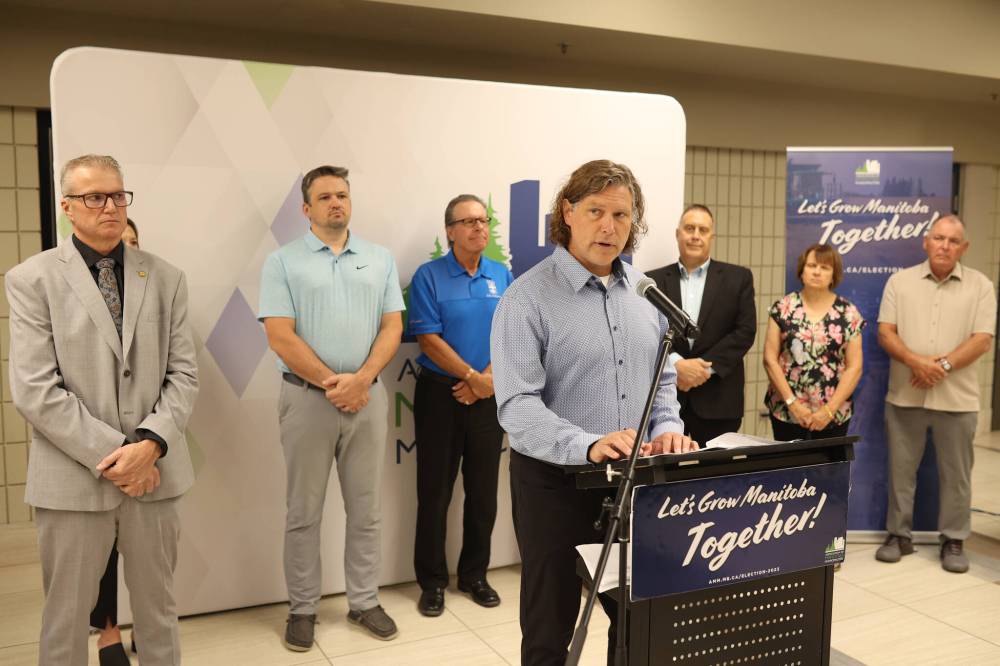
Brandon Mayor Jeff Fawcett speaks during an Association of Manitoba Municipalities press conference about provincial party election promises at the Keystone Centre on Wednesday. (Tim Smith/The Brandon Sun)
Meeting in Brandon for the AMM’s annual Cities Caucus fall gathering, AMM president Kam Blight said the purpose of Wednesday’s conference was not to give a report card to the parties, but to name what they have offered thus far and suggest what else should be discussed before election day.
“This is a highlight reel,” Blight said. “This is what we have heard so far.”
Winnipeg Mayor Scott Gillingham said the government of PC Leader Heather Stefanson increasing municipal funding earlier this year after a six-year freeze was “real progress,” but that municipalities are looking to the future.
“We’ve called for a new funding formula to service all through the 2020s and beyond, with new mechanisms to make sure that transfers grow automatically to reflect inflation, population growth and economic growth,” Gillingham said.
So far, he said the Tories have pledged to reduce municipalities’ tax burdens by eliminating the payroll tax and that Stefanson has expressed an openness to working with municipalities to update the funding formula.
NDP Leader Wab Kinew has pledged to create a multi-year funding program and would consider adding an inflation escalator to the equation while working with municipalities on updating the formula.
Gillingham explained that Liberal Leader Dougald Lamont’s promises are much the same as Kinew, but Lamont would also consider further tools for municipalities to raise revenues or to raise the municipal share of PST revenues and land value taxes.
When asked if municipalities were looking for additional cash to make up for the years of frozen funding, Gillingham reiterated that the focus for municipalities is to create a partnership with the province to promote local economies and share in the growth that creates.
Brandon Mayor Jeff Fawcett turned the discussion to infrastructure and health care, remarking that the Cities Caucus is stronger when the mayor of Winnipeg is a willing participant.
Fawcett said Manitoba municipalities need assistance maintaining and upgrading infrastructure like water and wastewater facilities, as well as extending broadband internet and cellular service access to rural communities.
In this realm, the Liberals have promised to repair and upgrade roads and highways, bridges and intersections. They would also repeal Bill 37 — the Planning Act — in consultation with the AMM and work with communities to improve water infrastructure, internet and cell service and provide long-term funding for the Keystone Centre.
The NDP will incentivize new rental builds by cutting the PST on developments, create an agency to promote broadband improvements, increase road funding and improve snow clearing, gravel roads, ditches and culverts.
The Progressive Conservatives have pledged $2.5 billion for highway infrastructure, $74 million to expand rail lines to the Port of Churchill, $40 million to improve Centreport, a $39.9-million annual strategic infrastructure package for municipalities outside of Winnipeg, $44.5 million for critical projects that improve public safety and waste management, as well as promises to improve water infrastructure in Winnipeg, Portage la Prairie and the Pembina Valley.
“We have a growing shortage of health-care and skilled professionals across this province,” Fawcett said in his introduction to the section on personnel. “And, it’s getting worse. We have a shortage of local training opportunities in many certified professions. When students, doctors or tradespeople go elsewhere for education or training, they often stay there.”
Fawcett said the NDP have promised $500 million over five years to hire 300 nurses, 400 physicians, 200 paramedics and 100 home care workers. They’ve also pledged to bring in more educated health professionals from other countries and cutting red tape to speed up the accreditation for foreign nurses to get them working in rural and northern Manitoba.
They’re also committing to bringing in 10 additional doctor training seats for Westman students, 300 more seats for nursing students, bringing in more educators and building a new training facility for medical personnel.
The Liberals have said they will build a satellite campus of the University of Manitoba’s medical school in Brandon to teach rural and northern family medicine, expedite the accreditation of foreign doctors and nurses and shift the health-care system toward home care.
The governing Tories have said they will, if re-elected, introduce $400 million in incentives to hire 2,000 health-care providers as well as introduce incentives to certify trades professionals from foreign countries, establish a $120-million permanent health-care recruitment fund — of which $10 million will be dedicated to rural municipalities — and help bring in more internationally trained nurses.
Other PC pledges include a $16-million initiative for skills training to fill 100,000 jobs in labour gaps over five years, a $10-million labour market fund to add health-care seats at three post-secondary institutions, $2 million to Assiniboine Community College to train 70 practical nurses and expand the advanced care paramedic program.
Portage la Prairie Mayor Sharilyn Knox addressed public safety.
“Crime is going up, violent crime is going up,” Knox said. “Drug crime is going up. Rural crime is going up … the AMM commissioned a poll by Probe Research this summer, and a resounding number of Manitobans feel less safe in their communities.”
Knox said the Progressive Conservatives have committed to spend $1.5 million for operational expenses for police forces, a $52-million violent crime fund, 24 new officers for downtown Winnipeg, $2 million for a sobering centre in Brandon with $1.5 million in annual operating funding and $4 million for a connected transitional housing facility.
Additionally, the Tories have promised $800,000 per year to support a drug treatment court in Winnipeg, $2 million in community supports program funding in Winnipeg and pledged to press the federal government for bail reform.
The NDP have also promised to press for bail reform, as well as replace the closed Dauphin jail, hire 100 mental health workers to work alongside police, create a $2.5-million rebate program to help Manitobans install security measures and to hire more police officers.
Lamont and the Liberals have said they will create emergency shelters for women and children fleeing violence to expand the current capacity by 20 per cent, create new tools to fight human trafficking, organized crime and fraud, establish non-police mental health and addictions crisis teams and create programs to divert kids away from gangs.
Blight acknowledged that if asked whether the province has listened to municipalities enough, they would probably say no. But since the AMM laid out its priorities, key personnel from each party has made an effort to hear what municipalities have to say.
“We’re very pleased to see that we’ve been acknowledged in some cases, but there’s still a lot more work that can be done and we will continue to advocate for all municipalities across the province of Manitoba until this election is over and then after the election as well,” he said.
In response to AMM’s announcement, Progressive Conservative spokesperson Shannon Martin responded in an email, stating: “Our party has listened to municipalities, and we look forward to continuing our discussions with them in the future.”
An NDP spokesperson also commented in an email that its work with municipalities will continue.
“We were the first party to call for the lifting of the municipal funding freeze started by Brian Pallister and continued under Heather Stefanson,” they wrote. “We were happy to share our priorities with the AMM on the issues of municipal support, crime, infrastructure and health care. We will continue to work with all municipalities in our province to help fix health care and improve Manitoba for all of us.”
» cslark@brandonsun.com
» X: @ColinSlark