
Crash report recommends changes to East End road
Advertisement
Read this article for free:
or
Already have an account? Log in here »
We need your support!
Local journalism needs your support!
As we navigate through unprecedented times, our journalists are working harder than ever to bring you the latest local updates to keep you safe and informed.
Now, more than ever, we need your support.
Starting at $15.99 plus taxes every four weeks you can access your Brandon Sun online and full access to all content as it appears on our website.
Subscribe Nowor call circulation directly at (204) 727-0527.
Your pledge helps to ensure we provide the news that matters most to your community!
To continue reading, please subscribe:
Add Brandon Sun access to your Free Press subscription for only an additional
$1 for the first 4 weeks*
- Enjoy unlimited reading on brandonsun.com
- Read the Brandon Sun E-Edition, our digital replica newspaper
*Your next Free Press subscription payment will increase by $1.00 and you will be charged $20.95 plus GST for four weeks. After four weeks, your payment will increase to $24.95 plus GST every four weeks.
Read unlimited articles for free today:
or
Already have an account? Log in here »
Hey there, time traveller!
This article was published 24/10/2023 (1061 days ago), so information in it may no longer be current.
The 2022 crash that caused a cyclist to lose a finger was made possible by road design that prioritizes motorists, according to a panel that reviewed the incident.
On June 27, 2022, Grant Hamilton was cycling along Lorne Avenue East when he was struck by a car at the intersection with Park Street.
This July, U.S.-based non-profit Strong Towns chose Hamilton’s crash as the first Canadian entry in its crash analysis studio series, which gathers a panel of experts to examine a traffic crash and then suggest solutions on how to make the affected area safer in the future.
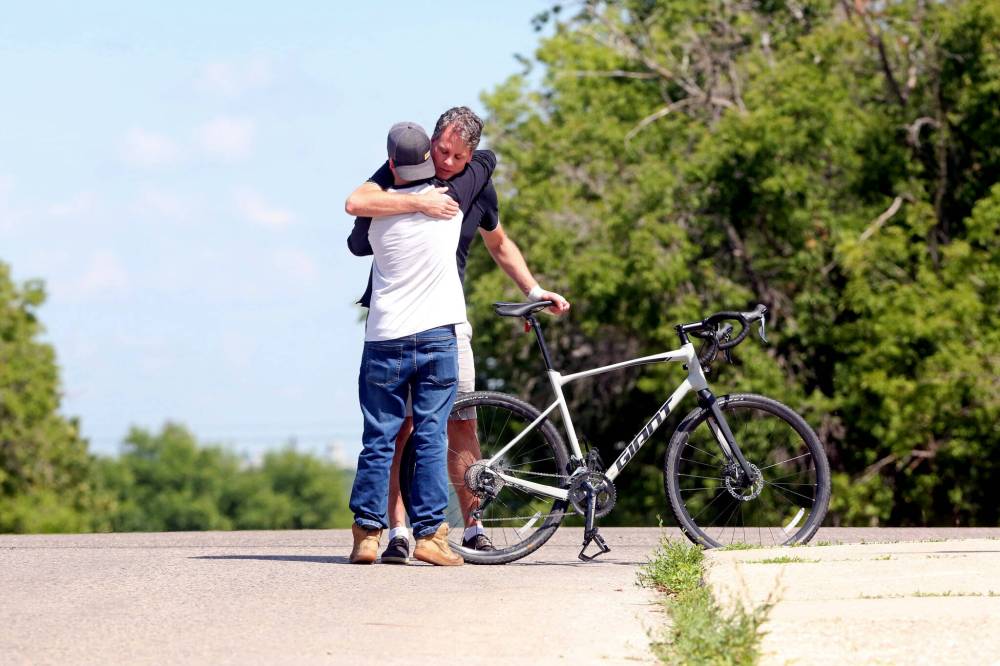
Last week, the panel released a report based on its analysis.
The five primary factors in the crash were determined to be caused by motorist-centric traffic design.
While on-street parking is allowed on Lorne Avenue East, it is inconsistently utilized and limited to only one side of the road, which the report says can give motorists a false sense of security.
The City of Brandon has since reduced the speed limit in the affected area — and all streets on the perimeter of Rideau Park — to 30 kilometres an hour as part of its Vision Zero efforts. The report said the previous 50 km/h prioritizes the speed of automobiles rather than cyclist of pedestrian safety.
Vision Zero is a philosophy that states that streets and roads should be designed to prevent all traffic-related deaths.
Tristan Cleveland, one of the panellists and an urban planner for a consulting firm called Happy Cities, said by phone from Halifax that a 30 km/h speed limit is much safer when it comes to collisions.
He said that at 50 km/h, a person struck by a vehicle has a 50 per cent chance of surviving. At 30 km/h, that survival rate climbs to 80 per cent. The change to the limit is a step in the right direction, he said, but it needs to be followed up with the street being redesigned.
“In the conversation, someone else pointed out that there’s like 20 intersections in a row with no stop sign,” Cleveland said. “That really encourages people to just put the pedal to the floor. They never have to pause at intersections to decide whether they can keep going.”
Signs on the road and at the intersection were judged by the panel to be insufficient, stating there are nearby yield signs instead of stop signs, that the crosswalks are unmarked and that there are no signal lights despite a proximity to the park and the East End Community Centre.
Maintenance on the road was said to be “neither thorough nor frequent enough to ensure cyclists can safely utilize the road way in its entirety.”
Potholes on the street limit the space cyclists can travel on, and navigating around parked cars and potholes can make cyclist behaviour harder for motorists to predict.
Though there are “share the road” signs and markings on the road that signal that cyclists and motorists need to share the roadway, the report states that such markings are no longer considered best practice and have been shown not to improve safety.
The final, secondary factor in the collision as determined by the panellists is that the shortcomings in the road design combined with darkness or insufficient street lighting reduces the visibility for everyone using the road.
In the short-term, the report recommends that all yield signs be converted to stop signs, that another speed study be performed to see if the reduced limit is having results, turning the affected intersection into a four-way stop, creating a protected bike lane on Lorne Avenue and using optical narrowing like paint and poles to make the street seem less wide to users.
Cleveland said this can be accomplished in several ways, like placing planters or concrete barriers along the curb.
“A lot of these interventions can be new for our communities,” he said. “And we should make it much easier for communities to experiment in this way. It would be very dangerous to put a flower box on a highway. It is the opposite of dangerous to put it on a local residential street.”
In the long-term, the report advises the city to study the impacts of any changes made, repeat any measures shown to be successful at other intersections, fix the damaged pavement on Lorne Avenue, review and change street signage as needed and create a multidisciplinary committee of city staff empowered to review and respond to crashes.
In a phone interview, Hamilton said he believes the design of the street needs to be changed to reflect the lower speed limit.
“It’s the design of the street that makes you feel like what you should be driving,” Hamilton said. “When I drive (there) it is very difficult for me to slow down, and I’m probably the most committed to slowing down around that part.”
The designs suggested by the panel, he said, are creative and seem like they might not cost the city too much to implement.
Over the winter, he said, he hopes the city will take a serious look at the suggestions and see what could be implemented in time for next spring. He added that he thought the suggestion of the city creating a crash response committee was a good idea.
“There was another crash recently and it was much sadder than the one I was involved in,” Hamilton said. “It just does go to show that it’s not something that is limited to one area of the city, it’s something that can happen to anyone at any time and the consequences can be devastating.”
Earlier this month, 15-year-old Antoine Sutherland was killed after being hit by a car while cycling through the intersection of Victoria Avenue and McDiarmid Drive.
A statement sent by email to the Sun about the report on behalf of Mark Allard, the city’s director of development services, said that while the city does not agree with all the identified contributing factors, the effort to identify safety improvement was “highly valued.”
“The City has recently developed a Vision Zero Task Force to address high risk issues regarding the on-street interactions of vehicles, cyclists and pedestrians,” Allard wrote. “Vulnerable users on the transportation networks should feel safe and protected when actively using the streets.
“This piece of road infrastructure was designed and built decades back when transportation design primarily focused on the efficient movement of vehicular traffic. Today there is an expectation to level the playing field, reducing the risk of serious injury to the vulnerable user. As there are many locations that don’t meet today’s expectations, the city must proceed to address these in a prioritized manner.”
According to Cleveland, where a lot of places in North America fall down on Vision Zero efforts is that people get too focused on education campaigns and not focused enough on design.
His recommendation is that Brandon pick some residential neighbourhoods to experiment with design in and limit institutional barriers to making changes. By widely implementing successful measures, he said, it could make a fundamental difference in the amount of traffic-related injuries and deaths.
» cslark@brandonsun.com
» X: @ColinSlark