
Canola growers welcome $9M boost from Ottawa
Advertisement
Read this article for free:
or
Already have an account? Log in here »
We need your support!
Local journalism needs your support!
As we navigate through unprecedented times, our journalists are working harder than ever to bring you the latest local updates to keep you safe and informed.
Now, more than ever, we need your support.
Starting at $15.99 plus taxes every four weeks you can access your Brandon Sun online and full access to all content as it appears on our website.
Subscribe Nowor call circulation directly at (204) 727-0527.
Your pledge helps to ensure we provide the news that matters most to your community!
To continue reading, please subscribe:
Add Brandon Sun access to your Free Press subscription for only an additional
$1 for the first 4 weeks*
- Enjoy unlimited reading on brandonsun.com
- Read the Brandon Sun E-Edition, our digital replica newspaper
*Your next Free Press subscription payment will increase by $1.00 and you will be charged $20.95 plus GST for four weeks. After four weeks, your payment will increase to $24.95 plus GST every four weeks.
Read unlimited articles for free today:
or
Already have an account? Log in here »
Hey there, time traveller!
This article was published 17/11/2023 (1031 days ago), so information in it may no longer be current.
A $9-million investment in Canada’s canola industry from the federal government will help to make the industry more sustainable, says Charles Fossay, the president of Manitoba Canola Growers.
“It’s very nice to hear that the government recognizes the value of the canola industry and is prepared to invest in it,” Fossay, a farmer from Starbuck told the Sun.
Federal Agriculture and Agri-Food Minister Lawrence MacAulay announced the funding Tuesday in Glenlea, Man.
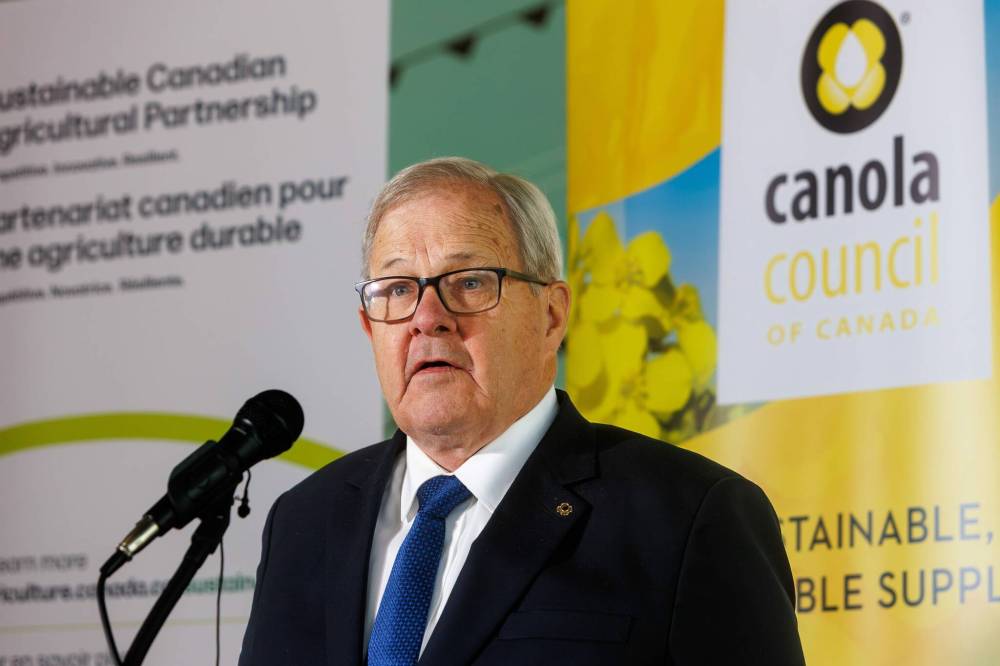
Lawrence MacAulay, federal minister of agriculture and agri-food, announces $9 million in funding to the Canola Council of Canada (CCC) through the AgriScience Program, while at the Bruce D. Campbell Farm and Food Discovery Centre in Glenlea, Man., on Tuesday morning. (Mike Deal/Winnipeg Free Press)
The global demand for Canadian canola seed, oil and meal is growing, MacAulay said.
“We’re committed to helping the sector meet these demands and establish new markets. This investment in research and innovation is vitally important to ensuring our Canadian canola farmers have a sustainable and profitable future.”
The funding will go directly to the Canola Council of Canada (CCC) through the AgriScience Program — Clusters Component, an initiative under the federal government’s Sustainable Canadian Agricultural Partnership.
The money is intended to sustainably increase Canada’s canola productivity and help the canola sector meet rising global demands and improve its global competitiveness. Activities under the funding will focus on three priority areas, including research on sustainable and reliable supply; increasing value; and increasing carbon sequestration, improving soil and water quality, and enhancing biodiversity.
The research that will come out of the funding will hopefully assist farmers in increasing their production and reducing greenhouse gas emissions while increasing the ability of canola to sequester carbon, Fossay said.
“The [federal] government wants to reduce greenhouse gas emissions by 30 per cent, and we feel that this can be achieved through improving canola varieties and also changing the methods of how we apply fertilizer and the types of fertilizer that we use in order to achieve better yields.”
It’s imperative that canola growers aren’t faced with any regulations that might impede the amount of fertilizer they use, but instead that focus on using better fertilizer at higher levels that will allow them to continue to produce high-yielding crops, he added.
Research partnerships like the one MacAulay announced are critical to unlocking canola’s continued innovation and success, said Chris Davison, president and chief executive officer of the CCC.
“This research will help the sector address new and evolving agronomic challenges, drive further resilience and growth, and build on canola’s strong contribution as a climate solutions provider,” he said.
Canola is Canada’s second-largest acreage crop, with approximately 20 million acres produced annually. It generated $13.7 billion in farm cash receipts last year, and the canola value chain generates $29.9 billion in economic activity and 207,000 Canadian jobs on an annual basis.
» mleybourne@brandonsun.com
» X: @miraleybourne