
Taking to the skies
Brandon Flight Centre helps locals earn their wings
Advertisement
Read this article for free:
or
Already have an account? Log in here »
We need your support!
Local journalism needs your support!
As we navigate through unprecedented times, our journalists are working harder than ever to bring you the latest local updates to keep you safe and informed.
Now, more than ever, we need your support.
Starting at $15.99 plus taxes every four weeks you can access your Brandon Sun online and full access to all content as it appears on our website.
Subscribe Nowor call circulation directly at (204) 727-0527.
Your pledge helps to ensure we provide the news that matters most to your community!
To continue reading, please subscribe:
Add Brandon Sun access to your Free Press subscription for only an additional
$1 for the first 4 weeks*
- Enjoy unlimited reading on brandonsun.com
- Read the Brandon Sun E-Edition, our digital replica newspaper
*Your next Free Press subscription payment will increase by $1.00 and you will be charged $20.95 plus GST for four weeks. After four weeks, your payment will increase to $24.95 plus GST every four weeks.
Read unlimited articles for free today:
or
Already have an account? Log in here »
Hey there, time traveller!
This article was published 08/12/2023 (1041 days ago), so information in it may no longer be current.
The sky’s the limit if you’ve always wanted to take off and arrive at your destination in half the time and use a different type of taxi. But it will require you to go back to school, says David Creighton, Brandon Flight Centre’s CEO.
“Once you have your private pilot’s license, then you can jump on a plane, take your friends up go flying around, and do whatever you want,” Creighton said.
Students learn to fly in any of the three different types of aircraft provided by the flight school located at Brandon’s Municipal Airport; a Cessna 172, a Piper Cherokee 140, or a multi-engine Piper Comanche, which are all quite common aircraft used by flight schools across the country.
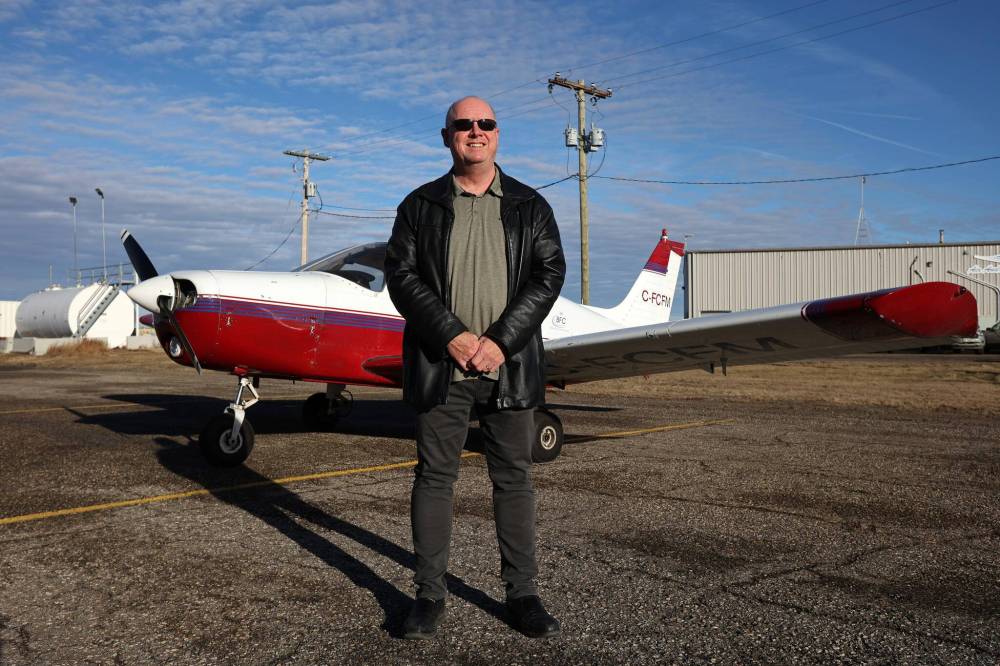
Brandon Flight Centre CEO David Creighton in front of a Piper Cherokee 140 outside the BFC hangar on Wednesday afternoon. (Photos by Tim Smith/The Brandon Sun)
There are about 80 students currently enrolled in flight school who are in varying stages of training, and various ages as well. Creighton said they’ve had trainees as young as 14 years old, and some who were well into their 70s.
All are taught by six instructors including Amelio Zugno, who achieved his private and commercial pilot’s license in Ontario and has been teaching in Brandon for the last two years.
“On average, most people usually get their private pilot’s license in six months to a year. It really does depend on the pace of the student. Some full-time students can do it in about six months, but some take longer. I just completed one student who finished his in two and a half years, so it depends,” Zugno said, who is also assistant chief flight instructor.
The journey to fly the friendly skies begins with ground school, which can take about three months. In Transport Canada jargon, that translates to 40 hours of instruction, but Creighton said they like to up their students’ game.
“The 40 hours of ground school is Transport Canada’s minimum, but we typically plan for about 60 hours. And the reason for that is, we want to make sure that the students have a really good in depth understanding of everything that’s being taught to them. We don’t want them to just learn enough to pass the test, we want them to understand the reason behind what they’re learning, so they can fully understand and appreciate the lesson,” Creighton said.
Courses include air law, navigation, instrumentation, general aeronautic knowledge, and a presentation by the flight centre’s director of maintenance who goes through the mechanics of the aircraft.
But one of the most important factors to understand when flying, said instructor Zugno — is clouds and weather.
“For most beginner pilots, we do what’s called visual flight rules or VFR. And that means you have to have open skies with clear visual reference around you and to the ground.
“Once you lose that sight of around you, you then get into what’s called instrument meteorological conditions or IMC, and that means you have to have other ratings to be able to fly through those.
“Different types of clouds mean different types of weather, and some are not that big of an issue, but some can be hiding thunderstorms and can be a big issue for us in aviation.
“So, we have to know how to read the different types of clouds to say, are these just normal ones we can work around, or is this one going to be a safety risk to the airplane and the people on board. We make sure we’re keeping everyone safe at the end of the day,” Zugno said.
Turbulence may be invisible, Zugno added, but its presence is well-known when an airplane and its passengers experience it.
Turbulence is a sudden shift in the regular flow of air. The air moves up or down or sideways, which causes the airplane to jostle and bump.
Mountains can cause turbulence by obstructing the airflow, thunderstorms create friction in the atmosphere, and clear air turbulence happens when an airplane moves in between air masses moving at different speeds or directions.
“I got into it once, a fairly rough one,” Zugno said. “But I just knew that ok, where I was, had better air than I was currently in, so, I knew I just had to turn away from it, get back into the smoother air and then make a decision from there what to do.”
Someone like Zugno who has a cool head, is the type of person who makes a good pilot, said Creighton, because there are many variables that change when you’re flying.
“There are a lot of things and they’re all happening at once, anything from weather to radio traffic. You have to be monitoring your aircraft and everything else at the same time. Lots of things are going on, especially during takeoff and landing.
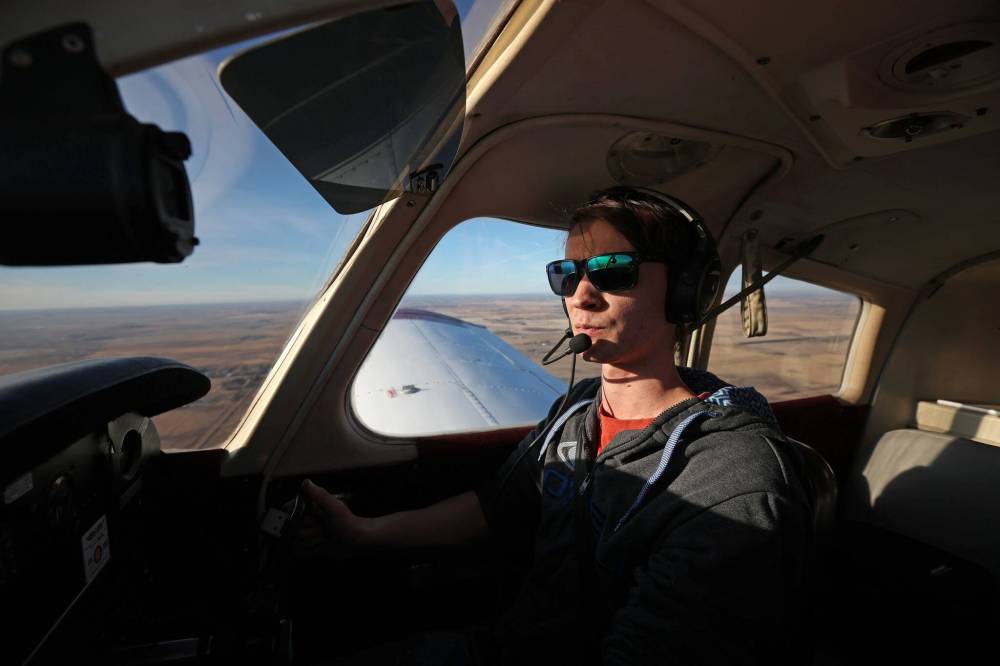
Brandon Flight Centre Assistant Chief Flight Instructor Amelio Zugno pilots a Piper Cherokee 140 over Westman on Wednesday afternoon.
“So, you have to have a very calm demeanor and not crack under pressure, basically,” Creighton said.
After completing ground school, the student-pilots take to the air with about 45 or 50 flights, or close to 60 hours before they’re ready to take their exam, and then the flight test, which consists of a ground portion where the students are quizzed on their knowledge of the airplane itself.
“And then once in the air, they go through a list of exercises that they have been taught and practiced throughout the training. They have to have those exercises completed within a marginable limit,” Zugro said.
The cost for a private pilot’s license ranges from $12,000 to $15,000, depending on how much time someone spends going through the entire course, said Creighton.
“If somebody’s able to dedicate a lot of time and is understanding the lessons and picking them up quite quickly, they’ll get it done sooner, therefore the cost will be lower.
“On the other hand, if someone is taking longer, whether it’s because of finances or other obligations and they’re not flying regularly, they tend to start to forget some of what they’ve learned, and they have to revisit that at their next lesson, so, it takes them longer to get their license, and the cost would go up a little bit.
“But we’ve tripled our fleet in the last three years to keep up with demand,” Creighton said.
For those who want to make a career out of being a pilot, the next step after a private license is to attain a commercial one.
Commercial pilots do crop dusting, which is common in the Westman area, as are air ambulance or medevac pilots. Those who fly charters, or have a goal to be an airline pilot, must also have a commercial license.
But there are those who prefer to keep their feet planted firmly on the ground and are just as happy to watch somebody else roll up to the runway and take the controls.
“It’s just something that is at every airport no matter how big or small. You’ll find people who will just sit and watch the planes coming and going, it’s quite the thing – it’s just the magic of flight that attracts people I guess,” said Creighton.
If you, or someone you know would like to be featured in our Rides section, send an email to mmcdougall@brandonsun.com
» X: @enviromichele