
Ten-year plan includes entire capital wish list
Advertisement
Read this article for free:
or
Already have an account? Log in here »
We need your support!
Local journalism needs your support!
As we navigate through unprecedented times, our journalists are working harder than ever to bring you the latest local updates to keep you safe and informed.
Now, more than ever, we need your support.
Starting at $15.99 plus taxes every four weeks you can access your Brandon Sun online and full access to all content as it appears on our website.
Subscribe Nowor call circulation directly at (204) 727-0527.
Your pledge helps to ensure we provide the news that matters most to your community!
To continue reading, please subscribe:
Add Brandon Sun access to your Free Press subscription for only an additional
$1 for the first 4 weeks*
*Your next subscription payment will increase by $1.00 and you will be charged $20.00 plus GST for four weeks. After four weeks, your payment will increase to $24.00 plus GST every four weeks.
Read unlimited articles for free today:
or
Already have an account? Log in here »
Hey there, time traveller!
This article was published 20/12/2023 (743 days ago), so information in it may no longer be current.
A 10-year financial sustainability plan developed for the City of Brandon calling for hefty tax increases accounts for everything on the city’s infrastructure wish list, a representative from accounting firm MNP told city council on Tuesday.
The report, which was released by city administration last week, recommends that Brandon increase taxes by around 13 per cent a year over the next four years and then by about three per cent a year for the six years after that in order to remain financially sustainable.
This would see an average Brandon home with an assessed value of $278,000 paying $2,783 in annual municipal costs in 2023, including taxes and utilities, pay $5,300 by 2033.
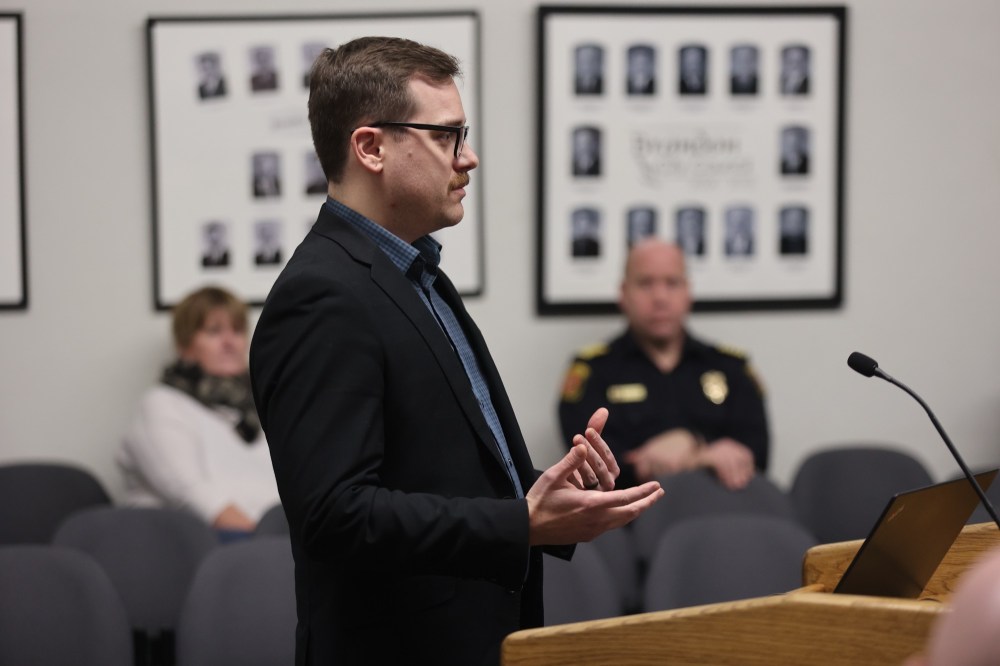
Matthew Exell of accounting firm MNP told Brandon City Council on Monday that the 10-year financial sustainability plan made for the City of Brandon incorporates everything on the city's capital planning wish list and could change depending on what items council decides to proceed with. (Colin Slark/The Brandon Sun)
Brandon City Council held its first public discussion on the report on Monday, with Matthew Exell of MNP explaining the report’s methodology and answering councillors’ questions about its findings.
Exell said the plan his firm developed accounted for a $680-million capital plan the city provided them with. Though the exact contents of that capital plan were not discussed, Exell said it includes everything on the city’s wish list.
Coun. Shawn Berry (Ward 7) said it will be important for the city to explain to residents exactly what the capital plan entails because it is not yet written in stone.
As an example, Berry said the report lists $146 million in capital spending in 2024, but he knows of at least two projects worth $35 million that will not come to fruition next year.
“As much as this report is very important going forward for us to understand what’s happening, there’s a lot of variables that will change and change this whole scenario and outlook,” Berry said.
“As we go forward, council and administration, we need to let people know what is in our 10-year capital plan. We can’t sit here and say to you we’re going to look at $680 million and not tell you what we’re doing — like if it’s for outdoor water parks, if it’s for new libraries, for roads and infrastructure, water treatment plants, whatever.”
Coun. Bruce Luebke (Ward 6) noted that when council approved a capital plan for 2024 through 2032, the estimated cost was in the neighbourhood of $420 million. He said he was curious as to what factors drove the MNP report to estimate costs north of $600 million.
“We know inflation and such has definitely been part of that and there have been some additions, but I don’t think there’s $280 million in additions,” Luebke said.
Because of the seven-year-long municipal funding freeze by the provincial government that ended earlier this year, Coun. Shaun Cameron (Ward 4) said Brandon is still catching up. He said having the numbers from the MNP report provides a solid foundation for talks with the province on instituting a new municipal funding formula.
“I’m back in Winnipeg this week with ministers with my begging and borrowing hat on,” Mayor Jeff Fawcett said. “They’ll be willing to work with us on this.” The Association of Manitoba Municipalities and Federation of Canadian Municipalities, he added, “are taking on the same situation that we’re in across the province and across the country.”
Of that $680 million, $536 million of it (79 per cent) is considered to be major infrastructure — projects that the provincial and federal governments are more likely to contribute to. This category includes water, sewer, streets, drainage and airport projects.
The remaining $144 million (21 per cent) is considered “city capital” and includes vehicles, equipment, recreation, municipal building improvements and land acquisition.
The report assumes that Brandon will receive 25 per cent of major infrastructure costs provided by the federal government, 30 per cent provided by the provincial government and will fund the remaining 45 per cent itself.
For city capital projects, the report assumes Brandon will pay for 77 per cent of the costs, the provincial government 10 per cent, the federal government 12.5 per cent and another 0.5 per cent from “other” unspecified sources.
The report compares Brandon’s taxation levels to several other communities in the country: Fredericton, N.B., Medicine Hat, Alta., Grande Prairie, Alta., Prince Albert, Sask., and North Bay, Ont.
Those communities were chosen, Exell said, because they are similar in population to Brandon.
As the Sun previously reported, Brandon has on average 47 per cent lower per capita tax revenues than those communities. Exell expounded further on Tuesday, saying that from 2018 to 2022, the other communities raised their property taxes by an average of 2.7 per cent a year whereas Brandon raised its taxes by 1.2 per cent on average over the same period.
According to Exell, the report is phase one of a three-phase plan. He said phase two will be city administration creating a sustainable operational services plan and phase three will be the creation of a sustainable critical infrastructure financial plan.
MNP’s report projects that Brandon will increase the amount of revenue it brings in from higher levels of government and to achieve that, it proposes that the city bring in a full-time grant writer.
“We found there was a need to improve financial reporting and communication,” Exell said.
“Several other cities we looked at won the Government Finance Officers Association Award in Excellence for Financial Reporting. Generally, we found in looking at reports from these cities that they had really a high level of reporting and information for stakeholders involved.”
Though Exell said Brandon had the highest percentage of revenue from higher levels of government of all the compared cities, Brandon was the only city in the comparison that does not currently employ a grant writer.
The report accounts for the approved utility rate increases the city is implementing between this year and 2026 and assumes increases at the rate of inflation from 2027 through 2033 as well as potential increases to development cost charges currently under discussion, the implementation of drainage fees on both residential and commercial properties and boosting revenues from the city’s sanitation department by selling compost and wood grinding.
Those drainage fees are estimated to cost the average household around $100 per year while the cost to a business will depend on the size of a property.
Increases to permit fees were deemed small enough to be immaterial to the study, but MNP encourages Brandon to review them annually.
Between 2024 and 2033, the model projects that Brandon’s population will grow to 57,860 and the total assessed value of properties within its boundaries will reach approximately $3.8 billion.
Brandon’s debt load is projected to peak at 61.5 per cent of its total capacity in 2033. In 2023, Brandon has around $38.8 million in debt. By 2033, if the 10-year plan is adopted, Brandon would have about $163.3 million in total debts.
The financial projections for 2024 are based on the city’s interim budget figures and its approved financial plan for 2023.
Risks to MNP’s proposal, Exell said, include pushback from taxpayers, increasing Brandon’s reliance on debt, potential increases to interest rates, inflationary increases to capital costs and low levels of funds in city reserves.
He said the phasing-in of tax rates as proposed in the plan could make it easier for households and businesses to plan for.
» cslark@brandonsun.com
» X: @ColinSlark