
Forage group promotes regeneration at Ag Days
Advertisement
Read this article for free:
or
Already have an account? Log in here »
We need your support!
Local journalism needs your support!
As we navigate through unprecedented times, our journalists are working harder than ever to bring you the latest local updates to keep you safe and informed.
Now, more than ever, we need your support.
Starting at $15.99 plus taxes every four weeks you can access your Brandon Sun online and full access to all content as it appears on our website.
Subscribe Nowor call circulation directly at (204) 727-0527.
Your pledge helps to ensure we provide the news that matters most to your community!
To continue reading, please subscribe:
Add Brandon Sun access to your Free Press subscription for only an additional
$1 for the first 4 weeks*
- Enjoy unlimited reading on brandonsun.com
- Read the Brandon Sun E-Edition, our digital replica newspaper
*Your next Free Press subscription payment will increase by $1.00 and you will be charged $20.95 plus GST for four weeks. After four weeks, your payment will increase to $24.95 plus GST every four weeks.
Read unlimited articles for free today:
or
Already have an account? Log in here »
Hey there, time traveller!
This article was published 18/01/2024 (1002 days ago), so information in it may no longer be current.
Attending Manitoba Ag Days was the perfect chance for representatives of the Manitoba Forage & Grassland Association to spread the word about regenerative agriculture and the benefits it has for not only the environment but for farmers as well, the group’s chairperson said.
Lawrence Knockaert was joined at the Manitoba Forage & Grassland Association’s (MFGA) booth at the Keystone Centre in Brandon by Jacques Saquet, a bison farmer from the Ste. Rose du Lac area, and Hans Rindlisbacher, one of MFGA’s grassland and forage specialists.
“I think it’s good to show the people that grassland is very important, and we’re showing the kids all the animals that eat grass that they might not know,” Knockaert said before a group of students came to the booth to learn more about regenerative agricultural practices and how they can have a positive impact on the environment.
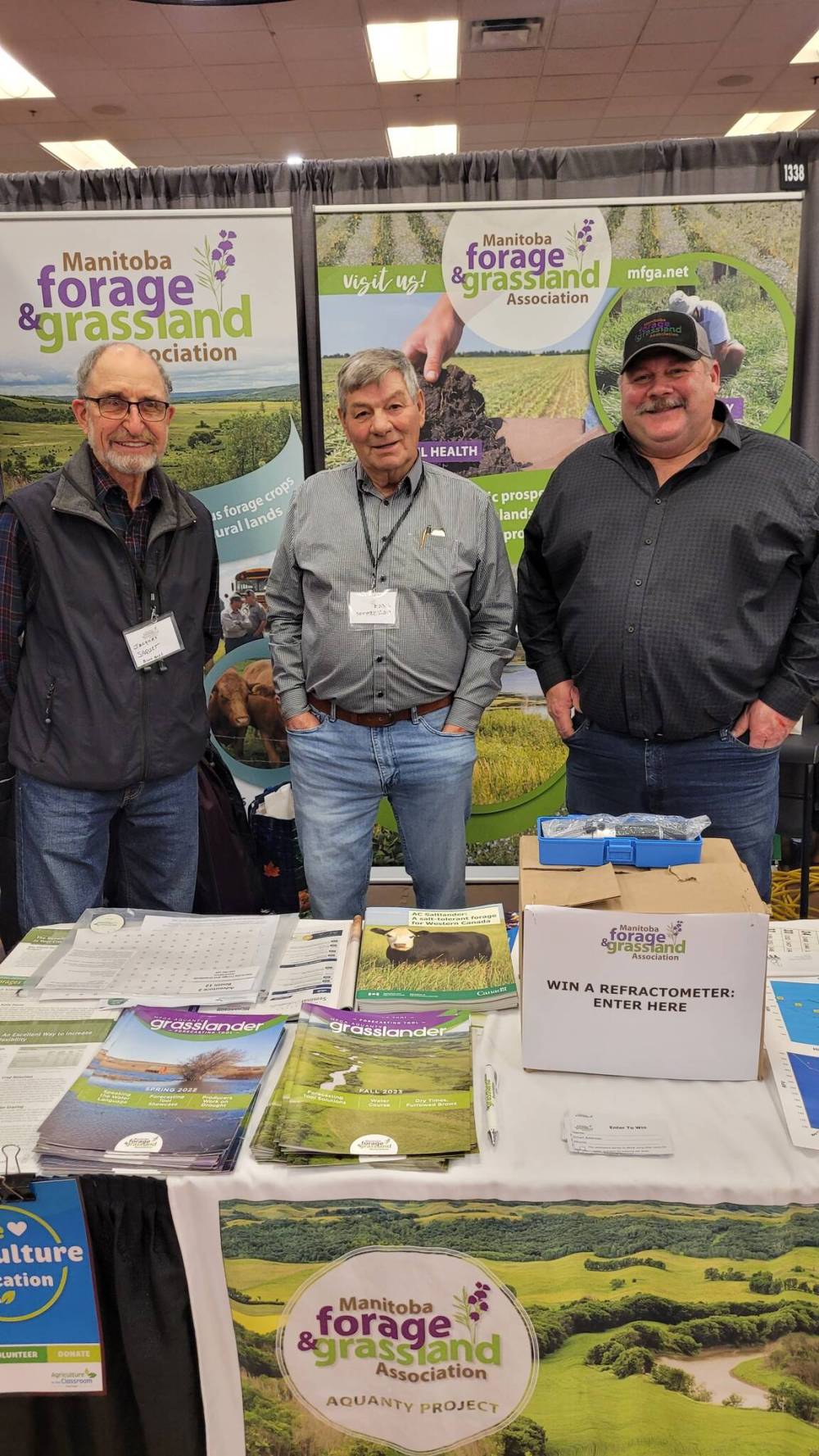
Jacques Saquet, a bison producer from the Ste. Rose du Lac area, Hans Rindlisbacher, a grassland and forage specialist, and Lawrence Knockaert, the chairperson of Manitoba Forage & Grassland Association, at the association's booth at Manitoba Ag Days at the Keystone Centre in Brandon on Wednesday, Jan. 17. (Miranda Leybourne/The Brandon Sun)
These practices include no-till and minimum tillage techniques, the use of cover crops, crop rotations, compost and animal manures, the inoculation of soils with composts or compost extracts to restore soil microbial activity, and managed grazing, the MFGA’s website states.
“Animals use the grass to make food for us. You can’t eat grass as a human, so they’re upcyclers. The good story is that grass is on the Prairies and helps with carbon sequestration,” Knockaert said.
Rindlisbacher said he was happy to be on hand to promote regenerative agriculture.
”We start talking to a producer and all kinds of things come up,” he said.
During his career with Manitoba Agriculture, Rindlisbacher spent his time teaching best practices to farmers. He remembers helping farmers transition fields that were full of stones or were not producing well into forage land, which not only provides grazing fields for beef herds, but supports biodiversity and provides ecological services such as air quality and flood and drought mitigation.
Saquet constantly strives to find the answers to improving the health of the soil and vegetation on his bison farm, he said. When he first started in the bison farming industry, he struggled with the salinity levels of his soil.
”My hay land where I made bales had lots of salinity, so I got to use the knowledge I gained from associations like the MFGA to find out what it was that could grow on those plots,” he said. “It was mostly wheat grasses and specialized annuals that can tolerate the salinity of the soil.”
Saquet recommends that any producer interested in regenerative agriculture and how it can help them stop by their booth at the Keystone Centre or visit mfga.net.
“You’ll find some answers there. Also, try to get in on our conferences that we have every fall … It’s held right here in Brandon,” he added.
» mleybourne@brandonsun.com
» X: @miraleybourne