
Lerner predicts warming trend after cold Jan.
Advertisement
Read this article for free:
or
Already have an account? Log in here »
We need your support!
Local journalism needs your support!
As we navigate through unprecedented times, our journalists are working harder than ever to bring you the latest local updates to keep you safe and informed.
Now, more than ever, we need your support.
Starting at $15.99 plus taxes every four weeks you can access your Brandon Sun online and full access to all content as it appears on our website.
Subscribe Nowor call circulation directly at (204) 727-0527.
Your pledge helps to ensure we provide the news that matters most to your community!
To continue reading, please subscribe:
Add Brandon Sun access to your Free Press subscription for only an additional
$1 for the first 4 weeks*
- Enjoy unlimited reading on brandonsun.com
- Read the Brandon Sun E-Edition, our digital replica newspaper
*Your next Free Press subscription payment will increase by $1.00 and you will be charged $20.95 plus GST for four weeks. After four weeks, your payment will increase to $24.95 plus GST every four weeks.
Read unlimited articles for free today:
or
Already have an account? Log in here »
Hey there, time traveller!
This article was published 18/01/2024 (984 days ago), so information in it may no longer be current.
World Weather Inc. president and meteorologist Drew Lerner says farmers should expect a warming trend after a colder-than-normal January.
During a session called “Weather 2024: More Extremes or Back to ‘Normal’” at Manitoba Ag Days on Wednesday, Lerner said he anticipated below-normal moisture levels, particularly in the north-central and northwestern Prairies.
“Temperatures have been colder than normal in January and we will get a warmup here next week,” he said. “But it won’t be enough to counter the anomalies that we experienced this past 10 days, and precipitation will be below low-normal to slightly near-normal.”
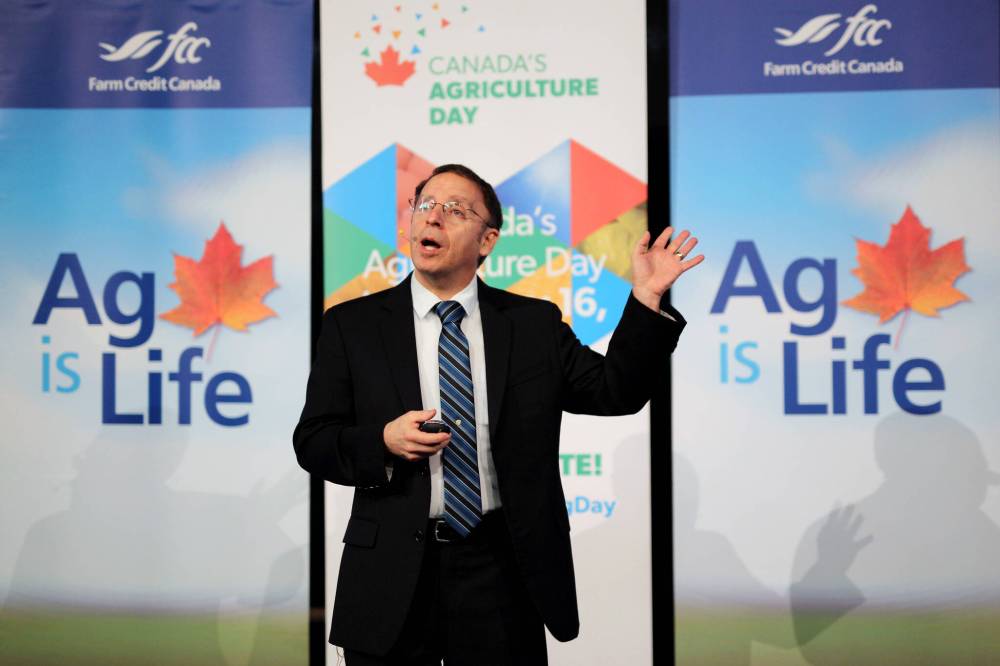
Drew Lerner, president and senior agricultural meteorologist of World Weather, Inc., delivered a talk titled "Weather 2024: More Extremes or Back to 'Normal'" at Manitoba Ag Days on Wednesday. (File)
Moving into February, Lerner forecast a potential warming trend, acknowledging that the warmth may be a bit overstated.
“My forecast for February may be a little bit too warm, but it is probably in the right,” he said. “It shows the right anomalies or the right direction for those precipitations in February is still going to be below normal.”
The discussion then delved into the spring months, with Lerner presenting 18-year cycle charts for March, April and May. He said drier tendencies will show up across areas that have experienced dry biases in recent months. “In April, there is a drier tendency that seems to be showing up.”
Lerner also discussed the impact of an underwater volcano eruption in 2022, emphasizing its significant warming effect on global temperatures. The lingering effects of the volcano could intensify a ridge, potentially causing issues with ongoing moisture deficits, particularly in Manitoba and eastern Saskatchewan.
The presentation extended to the summer and autumn forecasts, indicating a dominating persistent ridge of high pressure in the northern hemisphere during the summer. Lerner discussed the potential for below-normal precipitation biases in the U.S. plains and western Corn Belt, contrasting with above-normal precipitation biases in parts of Alberta and northwestern Saskatchewan.
He also explored different scenarios for autumn, considering various cycles and El Niño conditions. Lerner highlighted drier biases in the central U.S. and wetter biases in northern Alberta and northwestern Saskatchewan.
El Niño and La Niña are climate patterns in the Pacific Ocean that can affect weather worldwide.
On temperature anomalies for spring, summer and autumn, he showcased the differences under neutral conditions and El Niño to La Niña transition scenarios, emphasizing the potential impact of the El Niño to La Niña transition on temperatures, with a colder spring but warmer summer.
The meteorologist touched on global and regional precipitation forecasts, anticipating relatively normal to slightly warmer temperatures across the middle of the U.S. during spring and noted a potential drier tendency in precipitation during this period.
From chilling trends in January and February to potential warming in spring and summer, farmer Trevis Brooks from Hamiota said he gained valuable insights into what lies ahead.
As the agriculture community braces for the challenges and opportunities that 2024 may bring, Brooks told the Sun that Lerner’s expertise offers a vital guide for informed decision-making in the face of dynamic weather patterns.
“Lerner’s presentation is always very informative,” Brooks said. “Weather is always hard to predict, so it’s hard to know if the predictions will become true or not, but it gives us a bit of an indication of what to expect for the spring, summer and fall.”
He found the forecast intriguing, particularly given the region’s recent dry years.
“I don’t know if there’s anything on the farm we can do any differently based on a weather forecast in January,” he said. “I think we will do the same things we’ve always done, but it’s interesting to kind of know what his expectations are for the year.”
Sarah Leguee, a farmer from Weyburn, Sask., also shared her experiences and expectations, recalling the challenges faced during the drought.
“While we were in the drought, it was flooded until June,” Leguee said. “So seeding was miserable and then it never rained again until harvest, so we are really dry.”
Despite not feeling overly concerned now, she stressed the need for moisture.
“Some timely moisture would be nice,” she said. “We just need to make sure we can get some rain before we start seeding and then again when we’re done seeding and then again in the summertime. Like, we don’t ask for much.”
» aodutola@brandonsun.com
» X: @AbiolaOdutola