
NDP pledge $30M for school meal program
Advertisement
Read this article for free:
or
Already have an account? Log in here »
We need your support!
Local journalism needs your support!
As we navigate through unprecedented times, our journalists are working harder than ever to bring you the latest local updates to keep you safe and informed.
Now, more than ever, we need your support.
Starting at $15.99 plus taxes every four weeks you can access your Brandon Sun online and full access to all content as it appears on our website.
Subscribe Nowor call circulation directly at (204) 727-0527.
Your pledge helps to ensure we provide the news that matters most to your community!
To continue reading, please subscribe:
Add Brandon Sun access to your Free Press subscription for only an additional
$1 for the first 4 weeks*
- Enjoy unlimited reading on brandonsun.com
- Read the Brandon Sun E-Edition, our digital replica newspaper
*Your next Free Press subscription payment will increase by $1.00 and you will be charged $20.95 plus GST for four weeks. After four weeks, your payment will increase to $24.95 plus GST every four weeks.
Read unlimited articles for free today:
or
Already have an account? Log in here »
Hey there, time traveller!
This article was published 31/01/2024 (964 days ago), so information in it may no longer be current.
Katherine MacFarlane, the principal of Prairie Hope High School in the Brandon School Division, says she’s excited about new funding for school meal programs promised by Manitoba Premier Wab Kinew on Tuesday.
In a multimillion-dollar pledge to Manitoba’s schools, the province is investing $30 million to expand school lunch programs, along with additional funding for schools currently on a waiting list to receive other breakfast, lunch or snack programs.
MacFarlane, a teacher of 30 years, said to help children who are coming to school hungry is to provide them with nutrition “inside the walls of schools, so they feel safe, comfortable and ready to learn.”
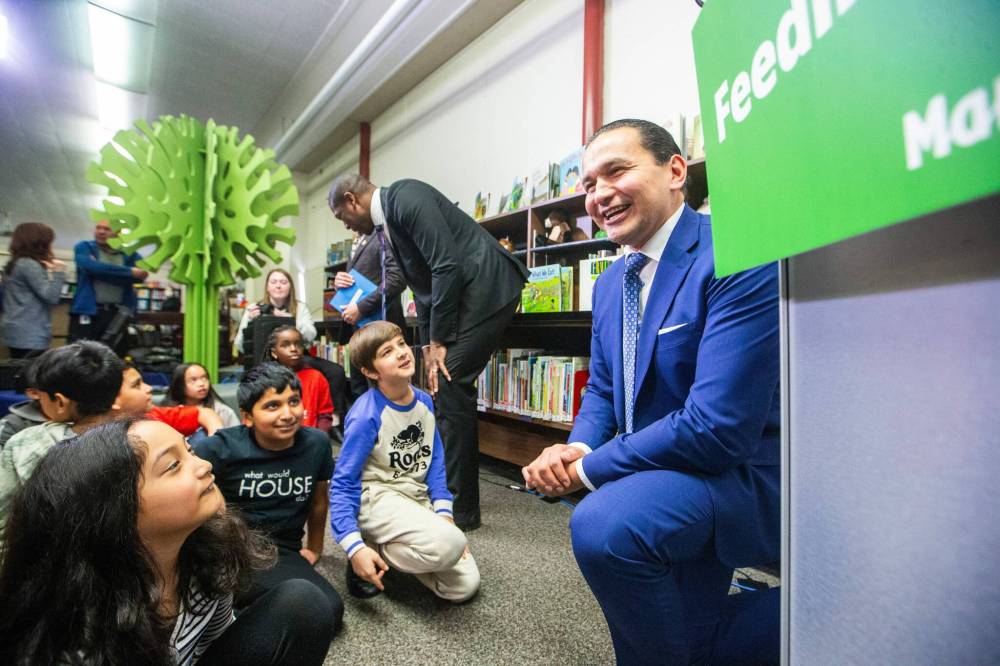
Premier Wab Kinew speaks to students after announcing a universally accessible school nutrition program at St. George School in Winnipeg on Tuesday. (Mikaela MacKenzie/Winnipeg Free Press)
“One of the things I appreciate is that the government is moving right within this school year to address the waitlist and sort out the shortages,” MacFarlane said. “And then they’ve made a significant commitment of funding for next school year. I think that’s going to make a difference for students.”
Kinew said the $30 million for the universal nutrition program, which he had promised ahead of last year’s election, will be available for the 2024-25 school year.
“This program is all about lifting up kids across Manitoba,” Kinew said during a news conference from the library of St. George’s elementary school in Winnipeg, surrounded by school children and teachers.
“And we’re here to do this press conference, to promise you that we’re going to make sure that we work together so that no kid goes to school hungry in Manitoba,” Kinew said.
While the $30 million in funding is expected to roll out for the next school year, the province has immediately boosted funding to the Child Nutrition Council of Manitoba (CNCM), a registered charity.
The CNC provides grants and guidelines to schools that apply to purchase nutritious food and small food prep items. The grants allow the schools to supplement funding with other community contributions to provide anything from breakfast and lunch to snack programs.
CNCM will receive an additional $1.37 million, an increase from $2.5 million to $3.87 million for this school year.
Two months ago, a community dietitian with CNCM said there were 59 Manitoba schools on the waitlist and it was the “highest it has ever been.”
The list has continued to grow, but the new funding will help to alleviate that, said Wendy Bloomfield, CNCM’s chair, alongside Kinew at the news conference.
“There are currently 300 schools involved that have varying degrees of programs,” Bloomfield said. “Some of them have snacks, some breakfast, some lunch, or a combination thereof. And we have almost another 70 schools on the waitlist that will be brought on with this new funding.”
The funding is allocated on a base rate per student, added Bloomfield. There’s a rate per student for kindergarten to Grade 6, and another rate for students from Grades 7 to 12, with the reason that as students age, they eat a lot more.
Schools that are in northern Manitoba, including The Pas, Flin Flon and Churchill, will receive more funds than cities and towns in the central or southern part of the province because food costs are higher.
Wayne Ewasko, former education minister under the Provincial Conservative government, told the Sun that while in power, his party more than doubled the funding to CNCM, which the NDP voted down.
Considering the $30 million, the 200 days of school and the number of students in Manitoba, Ewasko added, the cost per student doesn’t add up.
“No joking meant by this, but if the NDP can get such a fantastic deal on food to about 52 cents a meal, I think they should be sharing their shopping secrets with the rest of Manitoba,” said Ewasko, the PC party’s interim leader.
“As a teacher myself, I absolutely know how important it is (to) make sure that we’ve got healthy meals and proper nutrition and how it directs to student success, absolutely. And that’s why we were partnering not only with the CNCM when we were in government, but also community partners as well,” he said.
“And I don’t know how some of the conversations have gone within that NDP caucus, but I think there are a few holes in there in their math, and I guess time will tell.”
The $30 million which will begin to flow into Manitoba’s schools next school year will be divided up three ways, according to the province’s news release.
While $15 million will go toward school divisions for meal programs based on the number of students enrolled and socio-economic factors, $6 million will go to schools in areas with the highest socio-economic need.
The remaining $9 million will be for nutrition programs available on an application basis, including family outreach initiatives and support for after-school, summer and school break programs in schools that are eligible.
The after-school support stood out to principal MacFarlane, who said she’s excited about programming that will be available for school kids during summer break as well.
“As someone who’s been a teacher for 30 years, I know what it’s like to look at the faces of kiddos who are going to go out the door for a week for spring break, or two months for summer break, or two weeks at Christmas. And if you know for a fact that the family experiences food insecurity, we worry about those times. We worry about those kids during those periods when they’re not at school each day, accessing nutritious food,” she said.
“So, I’m excited that they’ve broken that $30 million down to allocate a portion that could impact families and children outside of those school hours when they’re not sitting within our safety net. I think that’s really important.”
» mmcdougall@brandonsun.com
» X: @enviromichele