
City plan development in home stretch
Advertisement
Read this article for free:
or
Already have an account? Log in here »
We need your support!
Local journalism needs your support!
As we navigate through unprecedented times, our journalists are working harder than ever to bring you the latest local updates to keep you safe and informed.
Now, more than ever, we need your support.
Starting at $15.99 plus taxes every four weeks you can access your Brandon Sun online and full access to all content as it appears on our website.
Subscribe Nowor call circulation directly at (204) 727-0527.
Your pledge helps to ensure we provide the news that matters most to your community!
To continue reading, please subscribe:
Add Brandon Sun access to your Free Press subscription for only an additional
$1 for the first 4 weeks*
- Enjoy unlimited reading on brandonsun.com
- Read the Brandon Sun E-Edition, our digital replica newspaper
*Your next Free Press subscription payment will increase by $1.00 and you will be charged $20.95 plus GST for four weeks. After four weeks, your payment will increase to $24.95 plus GST every four weeks.
Read unlimited articles for free today:
or
Already have an account? Log in here »
Hey there, time traveller!
This article was published 22/02/2024 (952 days ago), so information in it may no longer be current.
Brandon’s new city plan is expected to be approved by June, city council heard at a special meeting on Tuesday.
It was the first update on the development of a new city plan since last spring, when public consultation sessions went off track after some residents accused the city of trying to implement ideas connected to the concept of 15-minute cities.
Principal city planner Sonikile Tembo outlined how the plan would shape the future health, transportation options and growth of the city.
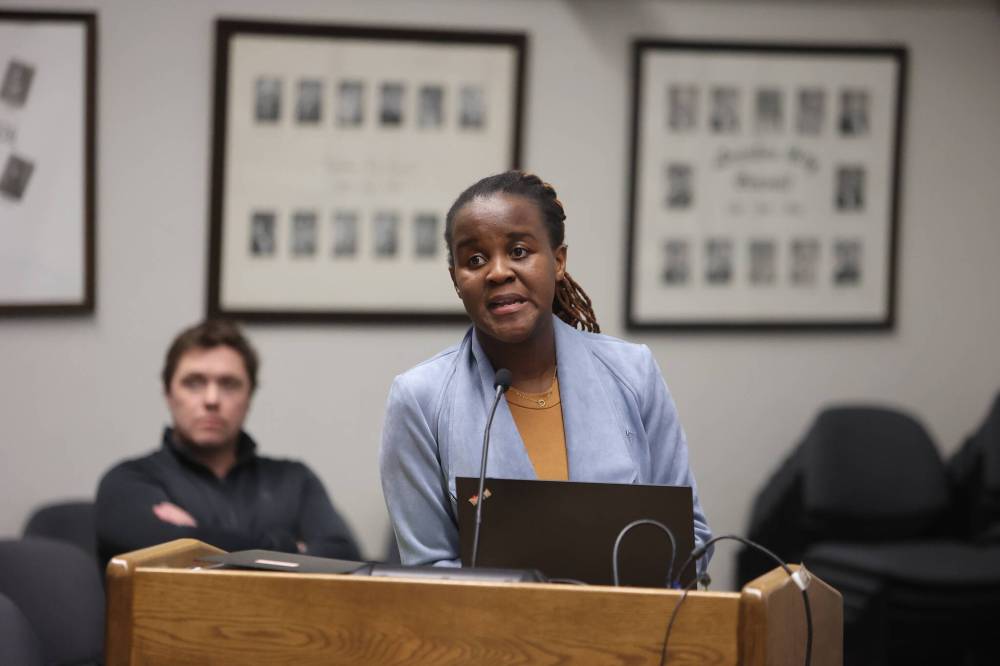
Brandon principal city planner Sonikile Tembo said at a Tuesday special meeting of city council that the new city plan is expected to be given final approval by June. (Colin Slark/The Brandon Sun)
“You can think about equity, reconciliation, immigration and so forth as several reasons that it’s vital we make some of these changes,” Tembo said.
“There are many things we can’t control: interest rates are going up, cost of construction is going up, we’ll soon be having discussions about our development charges, which are affecting our development industry … However, there are things that we do have control over such as our regulatory framework. There are tools that we have that can increase our housing supply.”
Tembo warned that from what she has heard from some residents, there will be opposition to some of the changes being proposed. The hope is to balance all kinds of different visions going forward, using the city plan as a template for how to do so.
She said that though the new city plan has yet to be approved, many initiatives already on the go align with the goals it sets out, including those aimed at accessing funding from the federal government’s Housing Accelerator Fund.
The John Howard Society of Brandon and Westman Youth for Christ’s joint transitional housing and sobering centre project earmarked for 353 16th St. North aligns with the city plan’s goal of making Brandon a healthier city.
This spring, the city is working to overhaul its general zoning bylaws. Next winter, the city is expected to establish a citywide program to incentivize the creation of affordable housing.
Some of the biggest changes on the housing front are expected to be the elimination of some kinds of exclusionary zoning and parking space minimums for developments, which the city must explore — but not necessarily implement — in order to receive funding from the Housing Accelerator Fund.
However, director of planning and building Ryan Nickel said at the meeting that city administration believes those changes are in Brandon’s best interest, especially so it can meet the housing targets that would be imposed through the Housing Accelerator Fund.
Representatives from the local development industry, Tembo said, have told the city their biggest concerns with building more residential units surround land use and parking.
“The argument is that perhaps the city’s role shouldn’t be to require parking because the expert in how much parking is required is the developer,” Tembo said. “This is something that we’re seeing nationwide. Several municipalities are removing that requirement for parking minimums. We understand where we are in terms of our culture in Brandon in that it is a very big shift.”
If the proposed changes are approved, no parking spaces would be required for downtown housing developments or affordable and transitional housing developments. Outside of those exemptions, half a parking space would be required for one-bedroom units of up to 600 square feet (one space for every two units) and one parking space per unit for all other housing developments.
Residential single-detached and residential low-density zoning would be merged into a single category in the proposed changes, with residential low-density areas modified to allow for the construction of fourplexes.
Tembo said more than 50 per cent of residential land in the city is currently zoned for single-detached housing, but there’s been a decrease in the demand for it and a spike in the demand for multi-unit housing.
Regina, Saskatoon, Winnipeg and Calgary were listed as some examples of cities considering similar housing and zoning changes.
Mayor Jeff Fawcett asked Tembo where she expects pushback when it comes to parking. She said people generally feel entitled to convenient parking.
“I think the pushback will come from residents within the vicinity of some of these larger developments where the streets are already flooded with street parking,” Tembo said.
In reducing parking requirements, Coun. Barry Cullen (Ward 4) asked if the city was shooting itself in the foot in cases where the city has snow to clear off of roads, but everyone is parking on streets. Developers being able to build more units because they have fewer parking spots to build will benefit, but Cullen wondered if it would benefit residents.
Nickel said Brandon needs to determine its priorities in growing the community and needs to weigh the potential benefits of more housing units versus maintaining current parking requirements.
“It’s not just benefiting the developers, it’s not why we’re doing this,” Nickel said. “It benefits our residents, because they have places to live.”
Other proposed initiatives to kickstart housing development in the city include the rezoning of major corridors so that homes are built closer to amenities and transit routes.
Administration is also considering a density incentive program for developers.
At the regular council meeting that followed Tuesday’s special meeting, councillors voted to approve the first reading of a bylaw that would establish a program aimed at incentivizing developers to build market-rate housing in downtown Brandon.
Addressing the “moving city” portion aimed at improving transportation options in Brandon, Tembo said a bike path on 26th Street is being developed in consultation with some city councillors.
She said the public’s perception of the city’s active transportation routes, like cycling and walking paths, is that they are primarily for leisure and not for important travel around the city like getting to work.
To help with that, the city is investigating filling in missing links in its active transportation network.
A city staff member presenting with Tembo said three options are being considered for the 26th Street bike path.
The first is unbuffered bike lanes where cyclists would be in a lane between a parking lane and the lane containing moving vehicles. The second is buffered and protected bike lanes where cyclists would travel directly beside the curb, with a buffer space between the bike lane and a parking lane, and active vehicles in a lane next to the centre of the road.
The final option is a raised cycle track that takes bikes off the road entirely onto a separate track up and off the curb
While that final option would provide the greatest safety for cyclists, it was said to be the most difficult to implement.
According to Tembo, residents in the areas getting new active transportation routes would be consulted in their creation. A public hearing on the 26th Street bike path is being scheduled for March.
The ongoing review of Brandon Transit services and routes, as well as vision zero traffic safety efforts, were said to be a key part of this element of the city plan. Public engagement on the transit review is supposed to be scheduled for April while vision zero public engagement sessions are expected to take place this month and next.
Addressing some residents’ concerns from last year’s public consultation that the city was trying to remove their ability to drive vehicles, Tembo said the city knows it will not be able to eliminate vehicle use and the goal is to provide residents with greater options.
Further public engagement sessions on the final draft of the plan are supposed to take place this month and next, wrapping up by March 20. Council is set to hold a first reading of a bylaw implementing the new plan in April.
On May 21, an open house is being scheduled to take place at city hall before that day’s regular council meeting. Then, in June, the plan will be up for second and third readings.
» cslark@brandonsun.com
» X: @ColinSlark