
Drainage levy could hit all property owners
Advertisement
Read this article for free:
or
Already have an account? Log in here »
We need your support!
Local journalism needs your support!
As we navigate through unprecedented times, our journalists are working harder than ever to bring you the latest local updates to keep you safe and informed.
Now, more than ever, we need your support.
Starting at $15.99 plus taxes every four weeks you can access your Brandon Sun online and full access to all content as it appears on our website.
Subscribe Nowor call circulation directly at (204) 727-0527.
Your pledge helps to ensure we provide the news that matters most to your community!
To continue reading, please subscribe:
Add Brandon Sun access to your Free Press subscription for only an additional
$1 for the first 4 weeks*
*Your next subscription payment will increase by $1.00 and you will be charged $20.00 plus GST for four weeks. After four weeks, your payment will increase to $24.00 plus GST every four weeks.
Read unlimited articles for free today:
or
Already have an account? Log in here »
Hey there, time traveller!
This article was published 06/03/2024 (673 days ago), so information in it may no longer be current.
A new proposed drainage levy in the City of Brandon would base its charges on the amount of terrain on each property that water cannot drain into, Brandon City Council heard at its Monday meeting.
For the average property owner, that could mean an additional tax of $140 a year.
A financial sustainability report issued by accounting firm MNP in December 2023 had stated city administration was considering a drainage levy as a new revenue stream as Brandon looked for ways to pay for a 10-year capital plan.
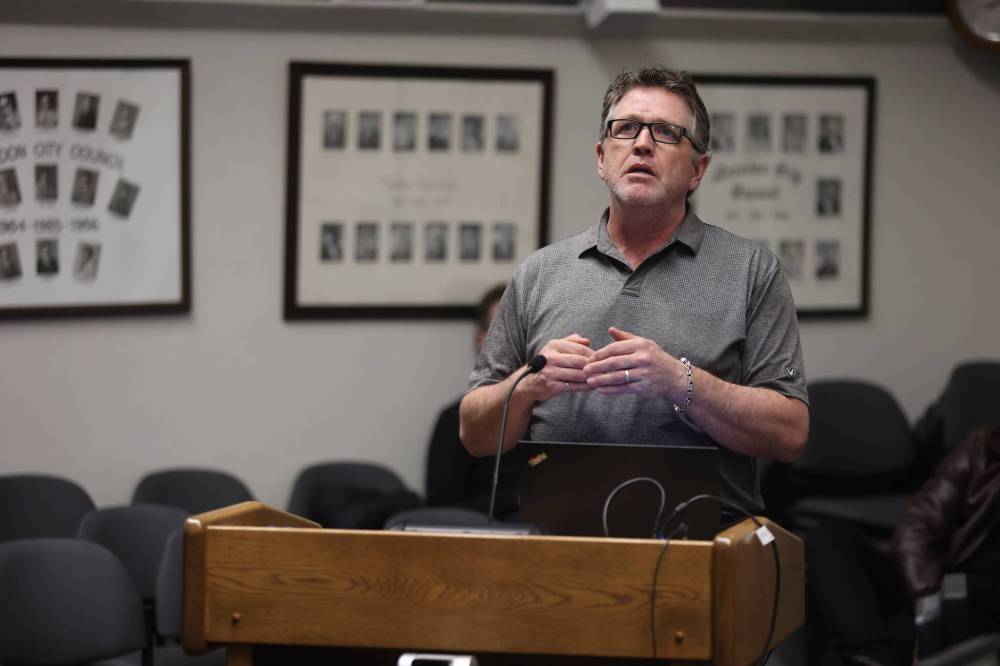
General manager of development services Mark Allard said upgrades to Brandon’s land drainage system are needed due to the growth of the city, increased flooding from weather events in recent years and the age of much of the current infrastructure.
Some parts of the drainage system are more than 100 years old, with the entire system covering about 170,000 metres of piping, 155,000 metres of ditches, 1,281 culverts, 2,947 catch basins, 1,705 manholes, and 40 retention and storage ponds.
The proposed levy would be charged to property owners on an annual basis to fund both the operation and capital improvements to the drainage system. The funds collected from the levy would be spent directly on the drainage system.
However, Allard said growth of the system would be funding through other means.
Currently, the city is working on drainage improvements in southeast Brandon that the city has borrowed $30 million for but could cost up to $58 million in the city’s worst-case scenario.
Other improvements need to be made in the downtown core, the North Hill, the Flats, on 34th Street, 24th Street North and Second Street.
While some cities like Calgary assess a flat rate for their drainage levies and Chilliwack, B.C., based its levy on assessed property values, Allard said Brandon would base its ratepayers’ levies on the size of impervious surfaces on their properties — surfaces that do not allow water to drain through them like roofs and roads.
That approach is the same one taken by Saskatoon.
Each property in the city would be assigned an equivalent runoff unit (ERU) based on aerial photography taken last year. The city’s median property has a footprint of 186 square metres, so that would be considered a single ERU.
Buildings 10 square metres in size or smaller will not be considered in the city’s calculation.
As an example, Allard provided some calculations based on the city needing to raise $20 million for capital projects for its land drainage system over the next 10 years.
That’s not the final figure the city’s capital plan calls for, but Allard said it was close. Another $600,000 per year may need to be added to cover operating costs.
There are 23,008 ERU in Brandon. If the city needs to raise $2 million per year, it would divide that amount by the number of ERU for a cost of $86.92 per unit.
Under those figures, the average property owner would pay $140 a year in drainage levies, though Allard said a few larger properties would pay more than $20,000 per year.
However, there are other factors to consider, like whether commercial, industrial and residential lands would all pay the same rate.
In commercial areas, impervious parking surfaces might be bigger than the buildings on a given property. For industrial areas, there are a lot of open ditches and surfaces that will absorb water.
According to Allard, the city is not currently looking at charging for parking areas because it doesn’t have measurements for them, but those could be developed and accounted for in the future.
One proposal is to treat the city’s drainage system as a utility for a few years and to see how that works.
Allard pitched a levy as a sustainable model for funding Brandon’s drainage infrastructure, one that is equitable for ratepayers and transparent in what it charges residents.
He said the city has authority to impose the levy under the Municipal Act, which allows for the implementation of “special service or local improvement” levies.
To implement the levy, the city would need to create a capital and operational plan, calculate how much residents would be expected to pay, draft a bylaw implementing it, hold a public hearing, have it reviewed by the municipal board and then finally pass the bylaw.
Manitoba’s Municipal Act states that residents subject to a new local improvement levy can oppose its creation by filing a notice of objection with a municipality’s chief administrative officer — in this case, city manager Ron Bowles — either by mail or in person ahead of the public hearing.
If two-thirds or more of those subject to the levy object under those guidelines, the proposal cannot be passed and council cannot consider a similar proposal for two years. Coun. Shawn Berry (Ward 7) wondered whether a plebiscite could be used to gauge residents’ views on the proposal.
After that public hearing, the city is required to send notice to everyone who objected to the proposal when it intends on holding a third and final reading for the bylaw approving the levy.
Residents have 30 days after those notices are sent to file notices of objection with the Municipal Board. Then, if either 25 notices or a number equivalent to 10 per cent of those subject to the proposal are sent to the Municipal Board, the board must hold its own public hearing before making its decision.
Coun. Kris Desjarlais (Ward 2) said his message to ratepayers is that these improvements have to be paid for in one shape or another.
“We have a drainage plan, we’re borrowing $30 million,” he said. “We’re either going to pay it through our property taxes or we’re going to develop this levy, which is a little more equitable than getting everybody to pay for it up front … We’re going to ensure that those doing the most harm to our drainage system are going to pay the most.”
The timing is terrible, Coun. Barry Cullen (Ward 3) said, with the city asking residents for more after city council approved a budget with a 9.4 per cent tax increase last month.
He said consideration would have to be made for residents with rain gardens, water features or other measures benefiting the city’s drainage capacity.
“Taxation without credit for doing it properly doesn’t work for me,” Cullen said.
While there have been discussions about credits, Allard said the city isn’t ready to implement them. That’s partially because the city would need a way to figure out whether features improving drainage are being kept in good condition and are serving their intended purpose.
Reached by phone Tuesday afternoon, Brandon Chamber of Commerce president Lois Ruston concurred with Cullen’s remark, adding that the city is also working on increasing development cost charges for developers.
“Businesses are just looking at a perfect storm right now with a 9.4 per cent property tax increase, many of them have to repay CEBA loans, interest rates are higher than we’ve seen in many years and a lot of businesses are carrying significant debt,” Ruston said.
“That impacts them as they are trying to recover and rebuild out of the pandemic … I know that they’re looking at not rolling this out until 2025, but we can look ahead and see that the impacts of all of these increases will be felt for many years within our business community.”
While the levy is still in the development phase, Ruston said she hopes the city is transparent about how it will be spending the extra funds it is generating through these extra taxes and fees. She encouraged chamber members with concerns over the levy to reach out and express their opinions so they can be passed on to the city.
» cslark@brandonsun.com
» X: @ColinSlark