
Pet charities seek $2.5M to curb dog crisis
Advertisement
Read this article for free:
or
Already have an account? Log in here »
We need your support!
Local journalism needs your support!
As we navigate through unprecedented times, our journalists are working harder than ever to bring you the latest local updates to keep you safe and informed.
Now, more than ever, we need your support.
Starting at $15.99 plus taxes every four weeks you can access your Brandon Sun online and full access to all content as it appears on our website.
Subscribe Nowor call circulation directly at (204) 727-0527.
Your pledge helps to ensure we provide the news that matters most to your community!
To continue reading, please subscribe:
Add Brandon Sun access to your Free Press subscription for only an additional
$1 for the first 4 weeks*
*Your next subscription payment will increase by $1.00 and you will be charged $20.00 plus GST for four weeks. After four weeks, your payment will increase to $24.00 plus GST every four weeks.
Read unlimited articles for free today:
or
Already have an account? Log in here »
Hey there, time traveller!
This article was published 14/03/2024 (751 days ago), so information in it may no longer be current.
A state of emergency has been declared by a Manitoba organization that raises money for stray cats and dogs, with a plea to the provincial government for $2.5 million to pay for a spay-and-neuter program.
Kareena Grywinski, founding director Winnipeg-based Feed the Furbabies Canada, said the province is “drowning in overpopulation of dogs,” adding that it has led to an increase in dog attacks and risks of rabies.
“We believe it’s a safety and health issue and that’s the government. Everybody sees what’s happening on a weekly and daily basis with horrible images of children being mauled, or culls happening in communities,” said Grywinski.
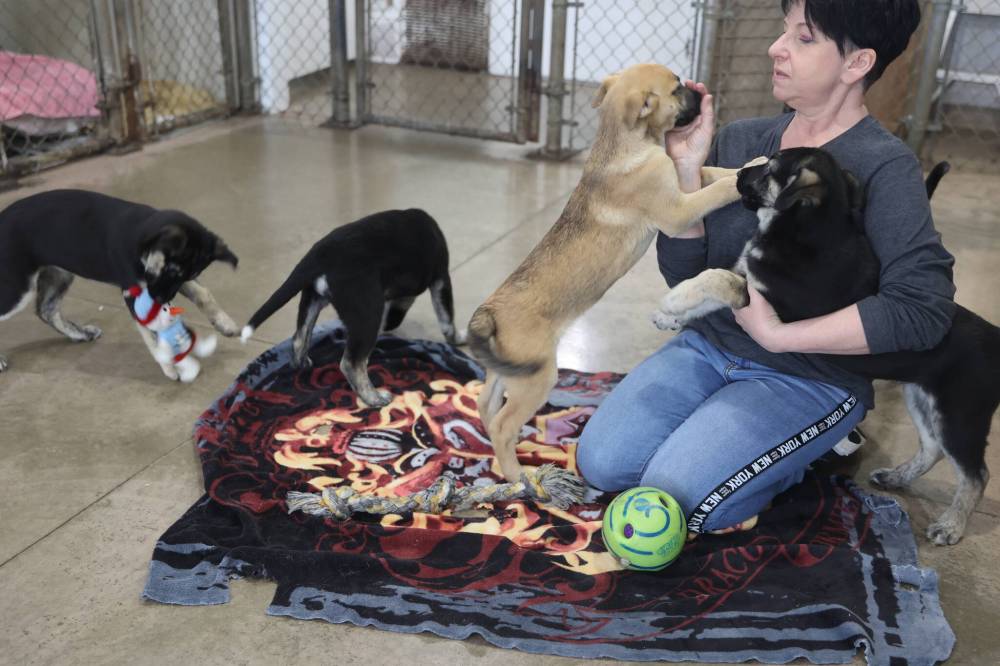
Kathy Smith, staff member at Brandon Humane Society, socializes with shepherd-husky-cross puppies on Wednesday afternoon. They were brought in from a community east of Winnipeg in January. (Michele McDougall/The Brandon Sun)
“In fact, the day we released the state of emergency on social media, another child was mauled, so we finally said, ‘You know what? We have to have our voices heard.’”
Just two weeks ago, a 22-year-old woman was attacked by a group of dogs in Waywayseecappo First Nation, about 150 kilometres northwest of Brandon.
The woman’s clothing was ripped away and she received numerous dog bites. Waywayseecappo First Nation safety officers and Manitoba First Nations Police Service went to a residence where three of the dogs responsible for the attack were located. Two dogs were seized and one was put down.
On Monday, Grywinski sent a letter to Manitoba Premier Wab Kinew, Agriculture Minister Ron Kostyshyn, Indigenous Economic Development Minister Ian Bushie and Dr. Brent Roussin, the chief provincial public health officer, calling for action and asking for funding.
The request of $2.5 million a year, Grywinski said, will be used to create an awareness campaign to stop backyard breeding and cover the costs to send pet food and supplies to remote communities and curb the pet population.
“We want the funding for a mobile spay-and-neuter clinic to be able to travel to communities and for food to be brought in,” Grywinski said.
When Grywinski sent the letter, she said she had the support of 45 other animal welfare groups from across Canada. But in the last two days, the list of organizations is “well over 65 and growing.”
The organization that Grywinski founded in 2015 — Feed the Furbabies — is not an animal shelter. Volunteers raise money, collect food and either drive the supplies to rural and remote communities or have them shipped them by air.
“We’ve seen a 25-pound bag of dog food on the shelf in a northern community that sells for $125 or $140, so that’s where a lot of our costs come from. If I’m going to ship 700 pounds into a fly-in community, which is probably about 35 bags of food, it costs us well over $1,000 to ship that,” Grywinski said.
At Brandon’s Humane Society, shelter manager Tracy Munn said while she admires Grywinski’s passion, caring and calls for action, having the dogs spayed and neutered is not the only solution.
They usually have about 38 dogs and 40 cats that have either been surrendered or found, and brought in to their facility.
“We all know the problem. I think the government knows the problem, I think on First Nation reserves, they know the problem — everybody does. Now, what we need is a solution,” Munn said.
“I do know that bylaws have to change. There has to be some kind of bylaw like in Brandon, that you can only have, say, two animals. And spaying and neutering is one thing, but if you’re not going to enforce that and see that every animal is done, it’s not going to change. There should be rules for everybody.”
Funds for Furry Friends is a national registered charity based in Brandon, with between 30 and 40 foster families who look after dogs or cats until they are adopted.
In 2022, almost 200 pets were matched with permanent families, said board member and adoption coordinator Theresa vanHoof. But these days, she added, they have more requests coming in than dogs going out.
“There are too many puppies being born is the bottom line, and it’s not pretty,” vanHoof said. “They’re freezing outdoors and we get multiple requests a day to take a mom and puppies or a pregnant mother or puppies that are living outside. And then there’s people who are surrendering their dog for whatever their personal reason might be.”
vanHoof said said she never had the opportunity to sign the letter that was sent to government officials, but she supports Grywinski’s efforts.
“If there could be a budget for mobile clinics that could go out to where they are, that would be great,” she said. “I don’t really see a downside to asking, I’m just not super hopeful.”
Kostyshyn told the Sun he received and read the letter. He is also responsible for veterinary services, and said no matter where you live in Manitoba, there are “way too many animals that have been somewhat neglected and we’re now faced with the consequences.”
Kostyshyn cited the provincial deficit of $1.6 billion when asked if writing a cheque for $2.5 million to the animal welfare groups was possible.
“I think we need to talk about it. We need to design a blueprint to address the problem we are faced with today, and that means the whole province of Manitoba,” Kostyshyn said. “This is a community-based opportunity, and those organizations — besides trying to find some super amount of dollars — they have come forward with some solutions.
“We need to get together at the roundtable and have some discussion moving forward and solve this problem in the long run,” he said.
» mmcdougall@brandonsun.com
» X: @enviromichele