
Dozens protest carbon tax at Sask. border
Advertisement
Read this article for free:
or
Already have an account? Log in here »
We need your support!
Local journalism needs your support!
As we navigate through unprecedented times, our journalists are working harder than ever to bring you the latest local updates to keep you safe and informed.
Now, more than ever, we need your support.
Starting at $15.99 plus taxes every four weeks you can access your Brandon Sun online and full access to all content as it appears on our website.
Subscribe Nowor call circulation directly at (204) 727-0527.
Your pledge helps to ensure we provide the news that matters most to your community!
To continue reading, please subscribe:
Add Brandon Sun access to your Free Press subscription for only an additional
$1 for the first 4 weeks*
- Enjoy unlimited reading on brandonsun.com
- Read the Brandon Sun E-Edition, our digital replica newspaper
*Your next Free Press subscription payment will increase by $1.00 and you will be charged $20.95 plus GST for four weeks. After four weeks, your payment will increase to $24.95 plus GST every four weeks.
Read unlimited articles for free today:
or
Already have an account? Log in here »
Hey there, time traveller!
This article was published 02/04/2024 (938 days ago), so information in it may no longer be current.
KIRKELLA — Dozens of cars, trucks and even tractors lined the westbound lanes of the Trans-Canada Highway at the Manitoba-Saskatchewan border on Monday to protest the federal carbon tax.
Parked with two wheels on the paved shoulder and two wheels in the ditch, protesters either held signs and flags or had them affixed to their vehicles. Some protesters came alone, while others brought their kids and dogs with them.
There were about 80 vehicles present when the Sun left the scene around 1 p.m., not counting police vehicles from the RCMP and Saskatchewan Highway Patrol.
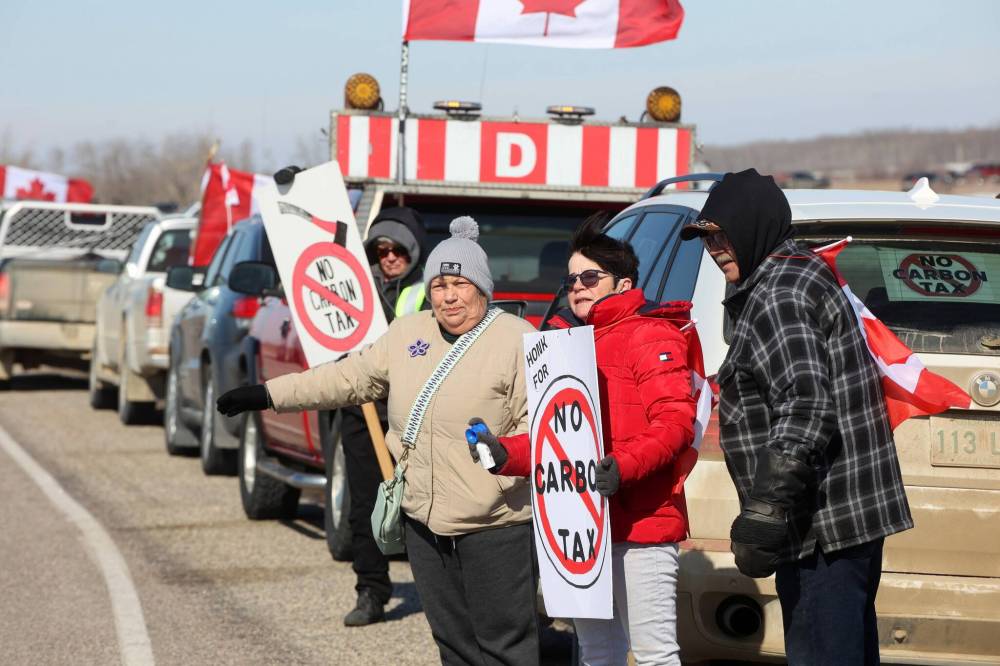
Protesters greet passing traffic while parked along the shoulder of the westbound lanes of the Trans-Canada Highway at the Manitoba-Saskatchewan border during nationwide protests against the federal carbon tax on Monday. (Tim Smith/The Brandon Sun)
Many of the signs referenced the 23 per cent increase in the carbon tax going into effect Monday, with several others referencing pay hikes for members of Parliament also being implemented that same day.
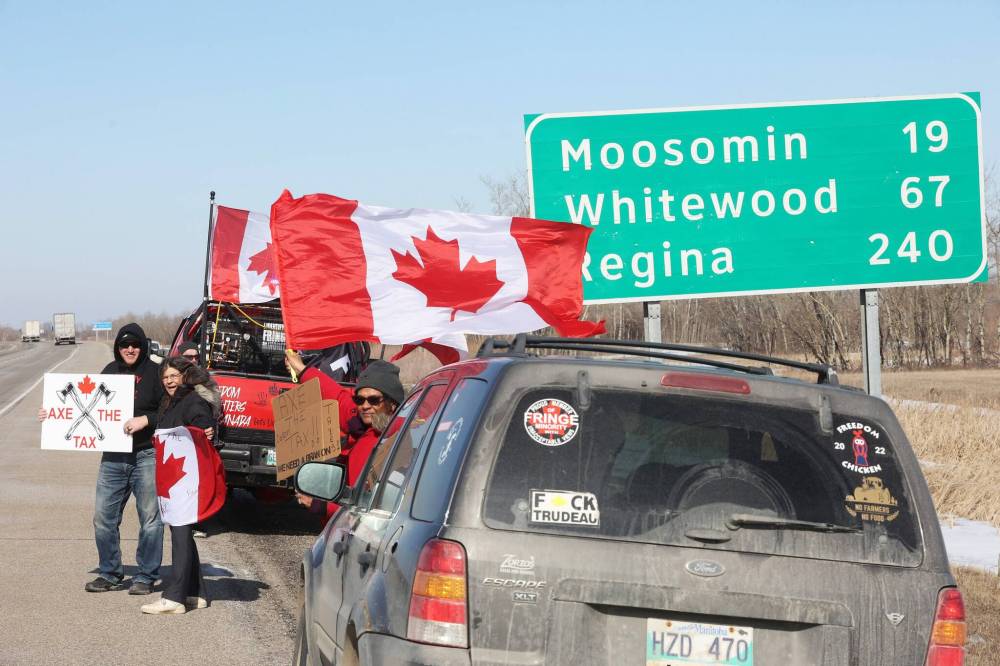
There were upside down flags, “F— Trudeau” flags, “Axe the Tax” signs, Freedom Convoy stickers, anti-COVID mandate messages and more, including “Save the Children” decals invoking a QAnon conspiracy theory.
Other protests were held across the country, including at the Manitoba-Ontario border.
When Sun reporters arrived at the border around 10 a.m., vehicles were lined up on a service road connecting to the rest area.
That rest area served as the base of operations and featured portable toilets, trailers, an ice-fishing shack and firewood to provide amenities to those present.
Organizers Dallon Leger and Tanner Milligan said they intend to have people manning the protest 24-7 until the federal government drops the carbon tax, even if some participants come and go.
“There will be a lot of come and go,” Leger said. “People still have full-time jobs. As we know, the economy is getting harder and harder to pay our mortgages and buy our groceries.”
Leger said he was one of those people, having to return to his farm in Yorkton, Sask., periodically.
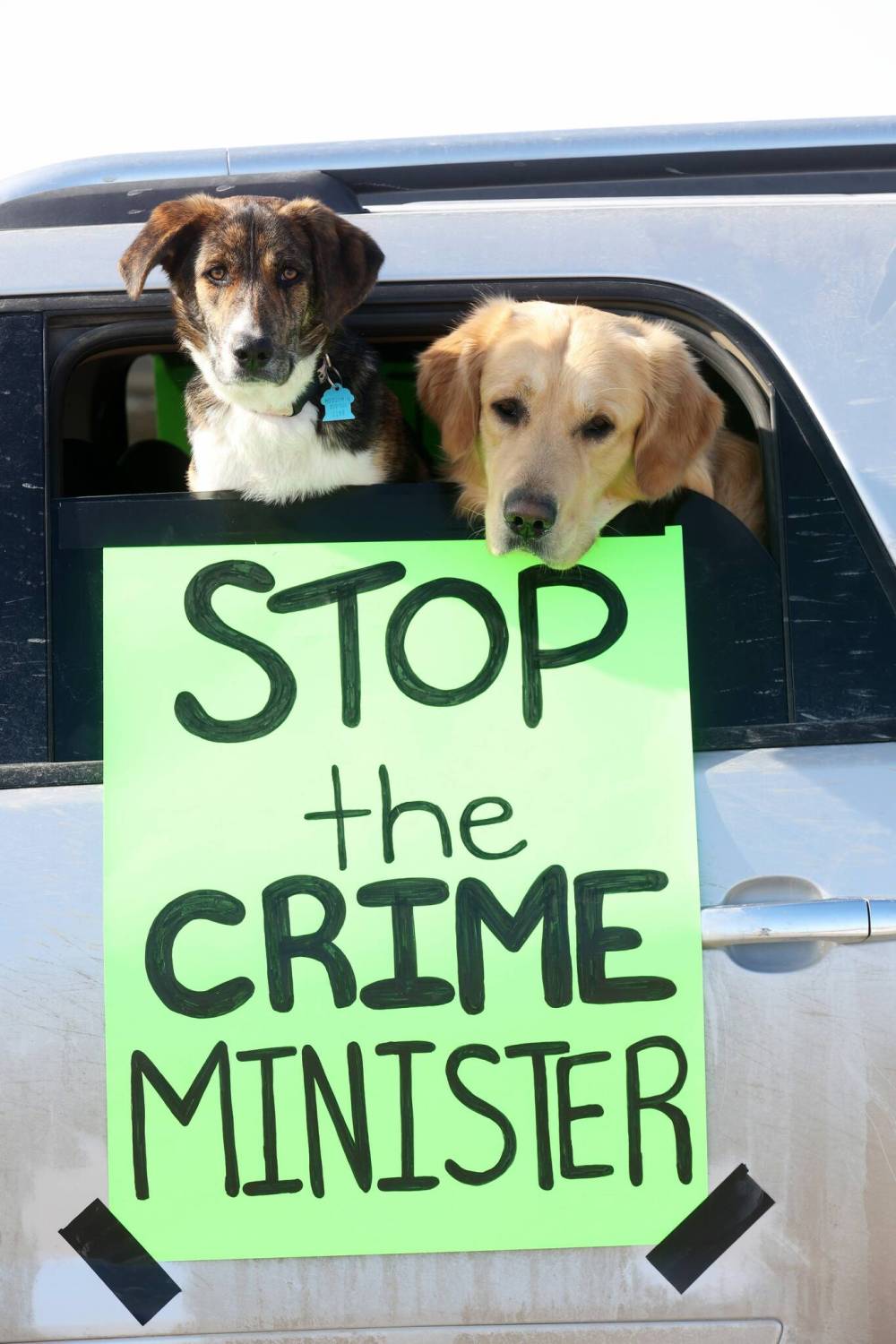
A pair of dogs in one of the protesters' vehicles frame the message on Monday. (Tim Smith/The Brandon Sun)
From a personal perspective, he said he was against the carbon tax because the costs it imposes are forcing him to choose between paying his heating bill and buying groceries.
He said the carbon tax makes farming activities like seeding, fertilizing, spraying and harvesting more expensive.
With Monday’s hike, he said he must fill up his truck with fuel every two days and it will cost him in the neighbourhood of $225 at the pump.
Canadians who live in provinces like Manitoba and Saskatchewan without their own carbon price are issued a rebate through the federal government.
For example, individuals in Manitoba are issued $150 through the Canada Carbon Rebate every quarter, with additional funds provided depending on how many dependents a person has, whether they are married and if they live in an area considered to be rural.
“So the rebate that they offer of a couple hundred dollars quarterly, that is a tank of fuel for me,” said Leger, who said he did not qualify for the rebate.
The federal government’s stated reason for implementing a price on carbon is to incentivize less polluting behaviour. By making activities that emit more carbon more expensive, it theoretically leads companies and individuals to choose more climate-friendly ways of doing things.
Leger said he believes that the world is subject to climate cycles, though he couldn’t say what he thinks is the cause.
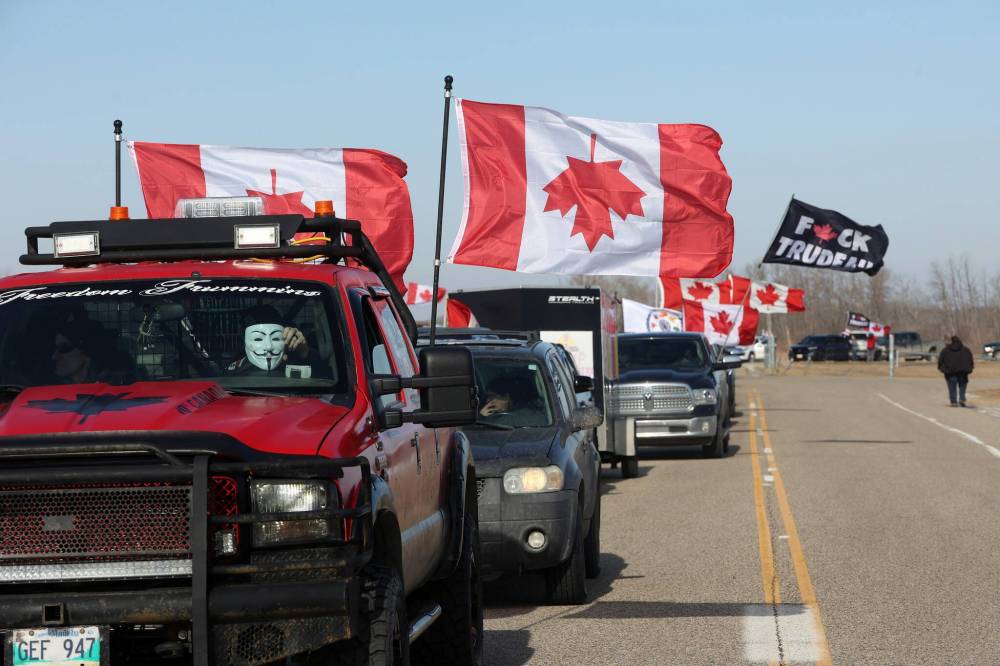
Protesters sit parked near the Trans-Canada Highway at the Manitoba-Saskatchewan border on Monday, including a vehicle with an upside-down Canadian flag. (Photos by Tim Smith/The Brandon Sun)
“It’s been going on for generations and generations and adding a tax to try to protect your climate isn’t going to get us the results that we desire.”
For Milligan’s part, he said he saw the carbon tax as something affecting all Canadians regardless of their political affiliation.
He said things like the carbon tax are ultimately shouldered by large corporations, which then pass down those extra costs to consumers.
“The little guy at the very end … he gets hit the hardest, unfortunately,” Milligan said.
Should the federal government change course and eliminate the carbon tax, he said he hoped big companies would “have the humanity and the decency” to turn around and pass the savings onto their consumers.
As for whether they’re hopeful for Trudeau to change his mind on the matter, Milligan said that with several premiers calling for the abolition of the tax combined with the protests, the federal government will decide to listen to those speaking up.
Unlike Leger, Milligan said he was going to stay on site, using the ice shack he towed in as his headquarters and residence. He said he hoped to use the structures brought in to provide places for protesters to warm up and to serve at least one meal a day to those present.
The organizers said they were in contact with police for the three weeks they were organizing their protest, claiming that Mounties initially granted permission for protesters to partially block the right-hand lane before changing their minds Monday morning and directing them to the shoulder instead.
Police on scene directed inquiries to the Manitoba RCMP’s media relations office.
By email, communications and media relations director Robert Cyrenne said Monday afternoon that 60 km/h speed zones had been put in place at the border.
“We ask motorists in the area to slow down, drive with caution, and follow any direction provided by officers at the scene,” Cyrenne wrote.
“There have been no issues and officers continue to work with the planners to assist them in exercising their right to protest in a safe way.”
However, he did not address protesters’ comments about where they were allowed to park.
While Leger and Milligan were willing to speak with reporters, others weren’t as forthcoming.
Some expressed distrust with the media as a reason for declining an interview while another group demanded to know which side the reporters were on before they would comment.
When told that reporters were trying to remain neutral, one man who had written an anti-tax message on the front blade of a parked farm implement said, “You picked the wrong place to be neutral.”
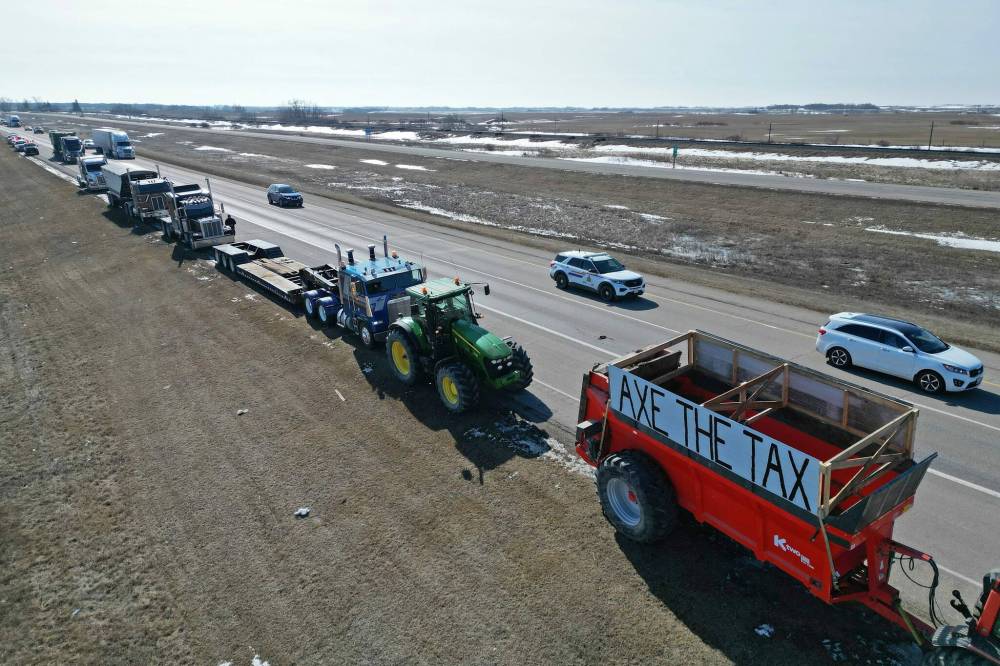
Vehicles sit parked along the shoulder of the westbound lanes of the Trans-Canada Highway at the Manitoba-Saskatchewan border on Monday. (Tim Smith/The Brandon Sun)
According to Milligan, the protesters are planning on only occupying the side of the highway between 8 a.m. and 8 p.m., leaving the road clear at night to address safety concerns.
“We’re out here working with the RCMP, they’re working with us the best they can to make sure that we co-ordinate. We make sure this is a family friendly, safe event,” he said.
» cslark@brandonsun.com
» X: @ColinSlark