
BU to offer viewing spot for eclipse
Advertisement
Read this article for free:
or
Already have an account? Log in here »
We need your support!
Local journalism needs your support!
As we navigate through unprecedented times, our journalists are working harder than ever to bring you the latest local updates to keep you safe and informed.
Now, more than ever, we need your support.
Starting at $15.99 plus taxes every four weeks you can access your Brandon Sun online and full access to all content as it appears on our website.
Subscribe Nowor call circulation directly at (204) 727-0527.
Your pledge helps to ensure we provide the news that matters most to your community!
To continue reading, please subscribe:
Add Brandon Sun access to your Free Press subscription for only an additional
$1 for the first 4 weeks*
- Enjoy unlimited reading on brandonsun.com
- Read the Brandon Sun E-Edition, our digital replica newspaper
*Your next Free Press subscription payment will increase by $1.00 and you will be charged $20.95 plus GST for four weeks. After four weeks, your payment will increase to $24.95 plus GST every four weeks.
Read unlimited articles for free today:
or
Already have an account? Log in here »
Hey there, time traveller!
This article was published 04/04/2024 (920 days ago), so information in it may no longer be current.
While Brandonites may be missing out on the total solar eclipse that folks in eastern parts of the country will see, Brandon University is offering up telescopes and glasses to view the part of the eclipse that can been seen in the Wheat City.
Tyler Foster and Austin Guilliver, astronomy professors in the Department of Physics and Astronomy at BU, will have a pair of portable telescopes with solar filters set up for anyone to drop by to view the celestial event.
A solar eclipse, where the moon passes between the Earth and the sun and obscures the view of the sun, will occur on Monday afternoon. Some parts of North America, including eastern parts of Canada, will experience a total eclipse. However, in Brandon, eclipse viewers will only see a partial eclipse.
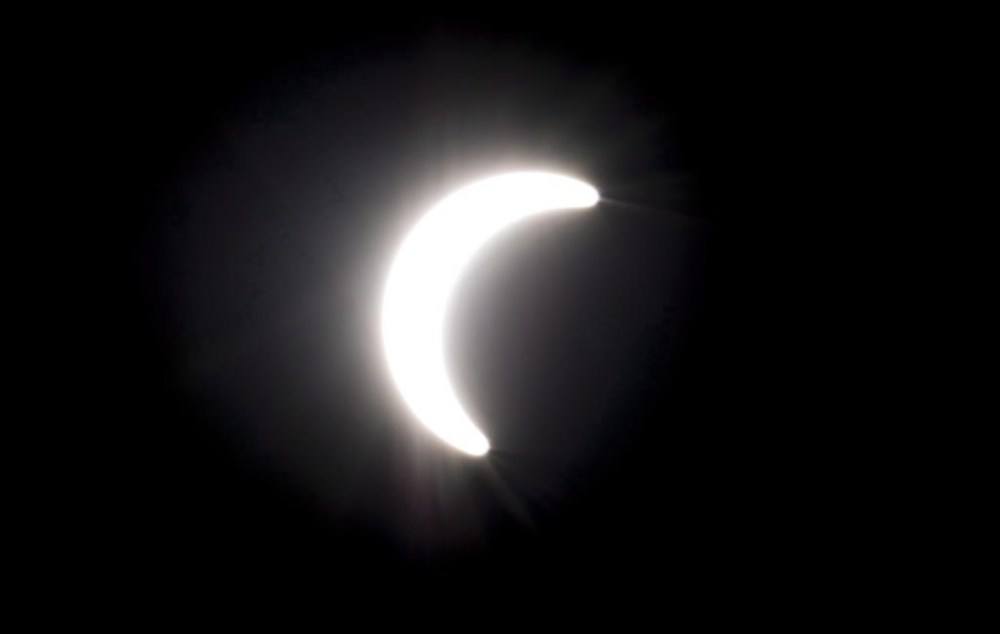
“You’ll see a big bite taken out of the sun, maybe 50 to 60 per cent of the sun will be missing,” Foster said. “At its peak depths, you won’t notice it by eye, there’ll be 50 to 60 per cent less light around you.”
But the astronomer said that unless people are looking at the eclipse (which should always be done with safe protective eyewear), it won’t perceptibly affect the level of daylight.
“The eye adapts pretty well and actually kind of fools you into thinking that nothing’s changed,” he said.
Foster said usually one or two solar eclipses happen each year, but because the blocking of the sun can only be seen on such a small spot on the Earth each time, people don’t get to experience them as often.
In Brandon, the last total solar eclipse was in 1979 and the last partial eclipse was in August 2017.
“The reason why (this one) is being hyped up is because this is the last total solar eclipse that will occur on North American soil for 20 years,” Foster said. “But we have a whole host of partial eclipses coming up.”
The astronomer said Brandonites can look forward to a more significant partial eclipse in January 2029.
“It’s going to be like 80 per cent or even more of the sun is going to be missing,” he said. “You might actually see a light drop because there’s so much of the sun that’s going to be missing.”
For Monday, Foster encourages safe viewing of the eclipse by wearing shade 14 welding glasses and advises against using any kind of unsafe home remedies. He said the glasses will be available for people to purchase for $1 on Monday on a first-come, first-serve basis.
The telescopes will be set up outside the Brodie building at the Louise Avenue entrance from 12:45 p.m. to 3 p.m. when the eclipse ends. Foster said the eclipse will be at its peak around 2 p.m.
Manitoba optometrists are also reminding residents about safe eclipse viewing, saying in a press release that it is never safe to look directly at the sun and to only look at the eclipse through solar eclipse glasses that meet the ISO 12312-2 international standard. Sunglasses, no matter what kind, do not protect eyes adequately when looking directly at the sun.
Staring at the sun without protection can cause solar retinopathy, the statement said, which is damage to the retina from the sun. Since there are no pain receptors in the retina, damage can occur without knowing it is happening.
The Brandon School Division said it will be keeping students inside during the eclipse.
» gmortfield@brandonsun.com
» X: @geena_mortfield