
Plans for McKenzie Seeds building hit snag
Advertisement
Read this article for free:
or
Already have an account? Log in here »
We need your support!
Local journalism needs your support!
As we navigate through unprecedented times, our journalists are working harder than ever to bring you the latest local updates to keep you safe and informed.
Now, more than ever, we need your support.
Starting at $15.99 plus taxes every four weeks you can access your Brandon Sun online and full access to all content as it appears on our website.
Subscribe Nowor call circulation directly at (204) 727-0527.
Your pledge helps to ensure we provide the news that matters most to your community!
To continue reading, please subscribe:
Add Brandon Sun access to your Free Press subscription for only an additional
$1 for the first 4 weeks*
*Your next subscription payment will increase by $1.00 and you will be charged $20.00 plus GST for four weeks. After four weeks, your payment will increase to $24.00 plus GST every four weeks.
Read unlimited articles for free today:
or
Already have an account? Log in here »
Hey there, time traveller!
This article was published 11/04/2024 (751 days ago), so information in it may no longer be current.
The ambitious plans of Brandon Fresh Farm (BFF) to transform the historic McKenzie Seeds building into a state-of-the-art indoor farming facility have hit a brick wall, as local investors remain hesitant to commit to the project.
After purchasing the building last November, BFF outlined a comprehensive approach to funding, intending to leverage various capital sources including grants, low-interest loans from government agencies like Farm Credit Canada and the Business Development Bank of Canada, as well as private investments.
Central to their financial strategy was an $18-million convertible debenture, which now appears to be elusive due to the lack of local investor participation.
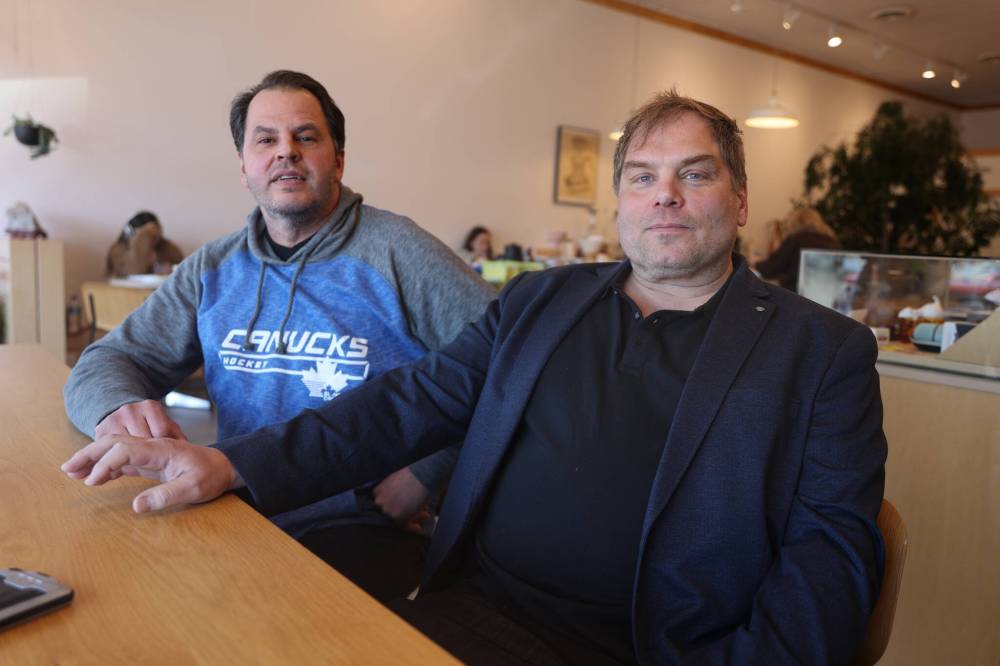
Brandon Fresh Farm vice-president Paul Souque (left) and president Adam Morand are looking beyond local investors to kickstart their operation in the historic McKenzie Seeds building. (Abiola Odutola/The Brandon Sun)
BFF president Adam Morand told the Sun despite initial enthusiasm, delays have hampered progress, prompting the company to seek funding from sources outside the local community.
“We’ve talked to hundreds of potential investors, and they seem to like the project, but it seems they don’t seem to understand the importance of indoor farming,” he said. “A lot of people here don’t understand food security and a lot of the problems of the world and how the water shortages in Mexico and … the U.S. affect us.”
Morand noted California’s agricultural output has plummeted to less than 30 per cent of its usual production levels, adding many Canadians are unaware of the significant quantities of produce we import solely from the U.S.
Canada, he said, imports 260 million metric tons of lettuce and 90 million metric tons of celery annually from the U.S. Basil, along with various other herbs and Asian greens, contribute to these imports, he said.
“There has been a noticeable decline in the quality of available food throughout 2023, prompting concerns about the systemic impacts on global food supplies,” he said. “Numerous countries are experiencing reduced agricultural yields due to widespread droughts, exacerbating the effects of climate change. These are reasons we encouraged people to invest in proactive measures like indoor farming.”
Despite extensive outreach efforts to provincial government agencies and private investors, the BFF president found little support within existing programs.
“The project’s scope and timeline were deemed incompatible with available resources, leaving the company with few alternatives but to seek funding elsewhere,” he said.
“We are now turning to investors from New York and Europe to bridge the financial gap.”
However, he said, the shift raises concerns about the long-term consequences for Brandon and Manitoba.
“The origin of funding is important, as it determines the direction of product distribution and ultimately influences the future of the project,” he said.
“We have several farms in Manitoba owned by foreign entities and a lot of that food goes elsewhere because whoever owns or influences the company determines its future.”
BFF vice-president Paul Souque acknowledged the ongoing challenges but remained optimistic about the project’s prospects.
“We understand vertical farming is new and a lot of money has gone into certain companies that have failed and that is one of the reasons some investors are indecisive,” Souque told the Sun. “But no matter what, BFF has come to stay.”
Despite the setbacks, he underscored the vital role of local support and highlighted initiatives such as the Manitoba investor tax credit, which offers significant incentives for potential investors.
“The tax credit is an amazing program and no one else in Canada has this program. A 45 per cent investor tax credit is huge,” he said.
» aodutola@brandonsun.com
» X: @AbiolaOdutola