
Retention called key to rebuilding health system
Advertisement
Read this article for free:
or
Already have an account? Log in here »
We need your support!
Local journalism needs your support!
As we navigate through unprecedented times, our journalists are working harder than ever to bring you the latest local updates to keep you safe and informed.
Now, more than ever, we need your support.
Starting at $15.99 plus taxes every four weeks you can access your Brandon Sun online and full access to all content as it appears on our website.
Subscribe Nowor call circulation directly at (204) 727-0527.
Your pledge helps to ensure we provide the news that matters most to your community!
To continue reading, please subscribe:
Add Brandon Sun access to your Free Press subscription for only an additional
$1 for the first 4 weeks*
- Enjoy unlimited reading on brandonsun.com
- Read the Brandon Sun E-Edition, our digital replica newspaper
*Your next Free Press subscription payment will increase by $1.00 and you will be charged $20.95 plus GST for four weeks. After four weeks, your payment will increase to $24.95 plus GST every four weeks.
Read unlimited articles for free today:
or
Already have an account? Log in here »
Hey there, time traveller!
This article was published 11/04/2024 (899 days ago), so information in it may no longer be current.
With almost a year under her belt as CEO of Manitoba’s Shared Health, Lanette Siragusa says now that the tough times of the COVID-19 pandemic are over, the health-care system is stabilizing and it’s time to start hiring new people and making sure they’re satisfied with their jobs.
“There is no one silver bullet” when it comes to building capacity and recruiting new health-care workers, Siragusa said.
“I think we work together well, across the province. And, if it can be a common vision that we rebuild this health system, I think we can get there. It will be a series of small steps and will be multiple people working in different ways, but I have hope,” she said.
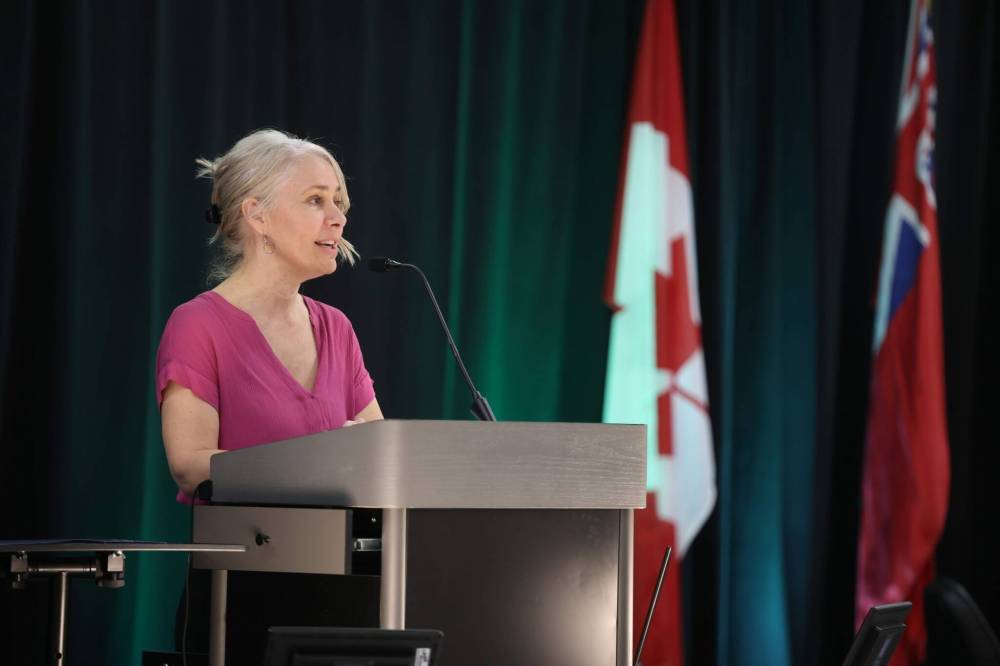
Lynette Siragusa, CEO of Shared Health, speaks to attendees at the 2024 Association of Manitoba Municipalities spring convention at the Keystone Centre in Brandon on Wednesday. (Tim Smith/The Brandon Sun)
Shared Health was established in 2018 by the Manitoba government as a legal entity. It is responsible for the co-ordination and oversight of health-care services in the province and is a central clinical and business service provider for regional health authorities.
Siragusa’s first day on the job was May 1, 2023. She is a registered nurse who previously held the position of chief nursing officer with Shared Health but left to take a position at the University of Manitoba, where she became vice-dean of education at the Rady Faculty of Health Sciences and associate director of Ongomiizwin Health Services.
On Wednesday, Siragusa addressed municipal leaders in Brandon during the Association of Manitoba Municipalities spring convention at the Keystone Centre.
The title of her presentation was “Manitoba is hiring: retention, training, and recruitment of the provincial health workforce.”
“How do we retain (health-care workers) once we have them?” Saragusa said in an interview before her presentation. “Being embraced by the community is what makes people stay. We can recruit them, but how they thrive once they get here is to be part of a community.
“So, there’s opportunity to bring people in, but there’s also opportunity to grow our own. Who’s in high school that maybe needs to meet a paramedic or meet someone from the lab? What opportunities can we introduce to really get people excited to work in health care, because it is a wonderful, wonderful career?” said Siragusa.
“The system is not perfect,” she added, and health regions can do their part by looking at flexible work schedules and career-laddering mentorship.
Four days into her new job as CEO of Prairie Mountain Health, Treena Slate said it’s important for rural communities to work with the health region to promote themselves.
“The communities are their best own salespeople around recruitment, and they know how to grow their own and they know how to keep people in their community, and they also know how to sell themselves,” Slate said.
“And so, we rely heavily on them to help guide us with recruitment efforts and we work collaboratively with them on a regular basis as well.”
When asked about the shortage of nurses in the province, Siragusa said a new system was recently given a trial run called a provincial nursing flow pool. It involved 125 nurses, some who came from private agencies.
Those front-line health-care workers identified what specialty they wanted to do and what part of the province they wanted to work in. Giving them a choice provided continuity to their employees and gave them a bit of control and flexibility, said Siragusa.
Darlene Jackson, president of the Manitoba Nurses Union, said she welcomes new ideas to hire more nurses and agreed that retention is key to solving the “critical nursing shortage.”
In Prairie Mountain Health, the shortage of nurses forced the region to hire private agency nurses, which cost the health region $41.5 million during the 2021-22 fiscal year.
For the 2023-24 budget, PMH is expecting a deficit of close to $30 million, with three-quarters of that cost going to overtime and agency nurses.
“These are public funds that should be poured back into our public health system,” Jackson said.
“I keep saying to the government, you have to focus on retention,” Jackson said. “When these new grads come out, there’s no one to support or mentor them. They’re leaving as fast as they’re coming out.
“I’m glad the government is opening educational seats so that there are more students, but we need to be able to keep them in this system. It’s great to recruit. But if you can’t retain, you’ve wasted your money,” Jackson said.
» mmcdougall@brandonsun.com
» X: @enviromichele