
Manitobans set record donating, receiving kidneys
Advertisement
Read this article for free:
or
Already have an account? Log in here »
We need your support!
Local journalism needs your support!
As we navigate through unprecedented times, our journalists are working harder than ever to bring you the latest local updates to keep you safe and informed.
Now, more than ever, we need your support.
Starting at $15.99 plus taxes every four weeks you can access your Brandon Sun online and full access to all content as it appears on our website.
Subscribe Nowor call circulation directly at (204) 727-0527.
Your pledge helps to ensure we provide the news that matters most to your community!
To continue reading, please subscribe:
Add Brandon Sun access to your Free Press subscription for only an additional
$1 for the first 4 weeks*
- Enjoy unlimited reading on brandonsun.com
- Read the Brandon Sun E-Edition, our digital replica newspaper
*Your next Free Press subscription payment will increase by $1.00 and you will be charged $20.95 plus GST for four weeks. After four weeks, your payment will increase to $24.95 plus GST every four weeks.
Read unlimited articles for free today:
or
Already have an account? Log in here »
Hey there, time traveller!
This article was published 23/04/2024 (888 days ago), so information in it may no longer be current.
A record number of Manitobans donated and received kidneys last year.
Eighty-three people received a kidney transplant at Winnipeg’s Health Sciences Centre in 2023, compared to a previous high of 77 people in one year, which was achieved in 2017.
Many reasons account for the increase, including the effects of the COVID-19 pandemic when no transplants were conducted at all.
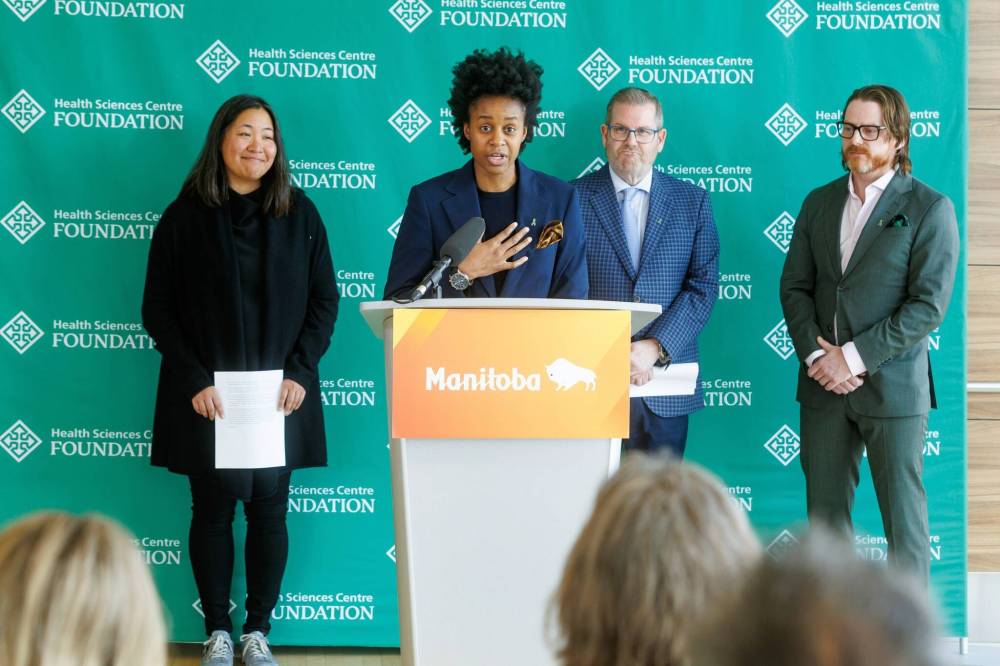
Additionally, the completion of a multimillion-dollar transplant wellness centre in Winnipeg in 2020 helped enhance care for living kidney donors, pre-transplant and post-transplant patients and recipients, according to Health Minister Uzoma Asagwara.
Donating an organ is one of the most selfless acts that can be done, Asagwara said, while acknowledging this is National Organ and Tissue Donation Awareness Week.
“Since Manitoba’s organ registry came online in 2012, more than 69,000 people have registered their intent to be an organ donor and tissue donor,” said Asagwara. “This includes 4,000 Manitobans in this past year alone, which is an incredible number signing up to donate.
“I’m inspired by the growing number of Manitobans who are willing to step up for their communities in this way,” Asagwara said during the live news conference from Health Sciences Centre in Winnipeg.
The main goal of Monday’s announcement was to thank Manitobans, but Asagwara added, “We’re also here to encourage people to sign up and to have those important conversations to make sure that your loved ones are well aware of your intent to donate.
“We do need more folks to sign up. We need folks to encourage one another to have these conversations,” said Asagwara.
Under the province’s current system, Manitobans may indicate their intent to become an organ or tissue donor when they register their consent online on the Sign Up For Life website.
Without expressing that consent, Manitobans will not become organ or tissue donors after death.
In 2021 on Canada’s East Coast, Nova Scotia became the first province to introduce presumed consent for organ and tissue donation, which means everyone is a donor unless they opt out.
When the Sun asked the health minister if their government was considering initiating presumed consent, they told the Sun it’s a possibility.
“I know that’s a conversation that’s been ongoing for quite some time,” Asagwara said.
“In my capacity as minister, I’ve also had the pleasure of sitting down with folks, experts, community advocates in this regard, and it’s certainly not off the table,” they said.
“But our priority is making sure that we’re supporting the good work that’s being done and to better understand what we can do as a government to support increased donation capacity here in our province.”
Also in attendance were representatives from the HSC Foundation, the Adult Kidney Transplant Program and the Gift of Life Program.
Gift of Life medical director Dr. Owen Mooney said that in 2023, a record 30 people donated organs posthumously. The previous record was 22, set in 2018.
“As a physician, I can tell you that it’s an incredible privilege to be right there with the families during this time of grief and loss and with the hope that something — comfort and meaning — can be found in what is ultimately a tragedy,” Mooney said.
“And our teams, our co-ordinators are specially trained to connect with families to share information to help them make the right decision at that time.”
When asked by the Sun how many kidney donors have come from western Manitoba, Mooney wasn’t able to say, but added the intensive care unit at the Brandon Regional Health Centre was included in the provincial picture.
“We have something that’s called routine notification, meaning that if you’re intubated and that the attending physician is having an end-of-life discussion with your family, our co-ordinators that I work with every day are notified,” Mooney said.
“That goes for Brandon, that goes for any hospital, any intensive care unit. It’s a rare event that a donation is possible. Three per cent of all in-hospital deaths are eligible for organ donation. So, we want to take every opportunity, and that includes patients that are in Brandon,” he said.
Manitoba is on par with the rest of the country when it comes to the number of kidney transplants per year, said Dr. Julie Ho, medical director of the Adult Kidney Transplant Program at HSC. But she added the goal is to be a leader across Canada when it comes to the number of transplants done on a per capita basis.
“And the reason that is such an important and overwhelming goal for us as a program is because Manitoba has one of the highest prevalence or highest rates of kidney failure in Canada,” said Ho.
“So, it’s not enough for us to do just as much as the rest of Canada — we want to be better than everyone else in Canada because we have to help our patients,” she said.
Several new programs have been initiated over the past few years, including an age-targeted program that matches older organ donors with older recipients to give them an opportunity for a transplant.
The Hepatitis C kidney transplant program that uses antiviral therapies enables HSC to do transplants from donors that would have previously been declined.
National Organ and Tissue Donation Awareness Week runs until April 27. For more information on Manitoba’s organ donor registry, visit https://www.signupforlife.ca/
» mmcdougall@brandonsun.com
» X: @enviromichele