
Westman woman spurs province to action on domestic violence
Advertisement
Read this article for free:
or
Already have an account? Log in here »
We need your support!
Local journalism needs your support!
As we navigate through unprecedented times, our journalists are working harder than ever to bring you the latest local updates to keep you safe and informed.
Now, more than ever, we need your support.
Starting at $15.99 plus taxes every four weeks you can access your Brandon Sun online and full access to all content as it appears on our website.
Subscribe Nowor call circulation directly at (204) 727-0527.
Your pledge helps to ensure we provide the news that matters most to your community!
To continue reading, please subscribe:
Add Brandon Sun access to your Free Press subscription for only an additional
$1 for the first 4 weeks*
- Enjoy unlimited reading on brandonsun.com
- Read the Brandon Sun E-Edition, our digital replica newspaper
*Your next Free Press subscription payment will increase by $1.00 and you will be charged $20.95 plus GST for four weeks. After four weeks, your payment will increase to $24.95 plus GST every four weeks.
Read unlimited articles for free today:
or
Already have an account? Log in here »
Hey there, time traveller!
This article was published 03/05/2024 (874 days ago), so information in it may no longer be current.
A Westman woman has helped to get a new provincial bill introduced that would legislate judges and justices of the peace to receive training around intimate partner violence.
Bill 209, a private member’s bill introduced by Liberal MLA Cindy Lamoureux (Tyndall Park), passed unanimous second reading last month. The bill is modelled after Keira’s Law, which passed in the Senate last year, requiring federal judges to be educated on intimate partner violence.
The law is named after four-year-old Keira Kagan, who was found dead with her father in 2020 in an apparent murder-suicide while in his care. The girl’s mother, Jennifer Kagan-Viater, met numerous hurdles trying to seek court-ordered protection for her daughter.
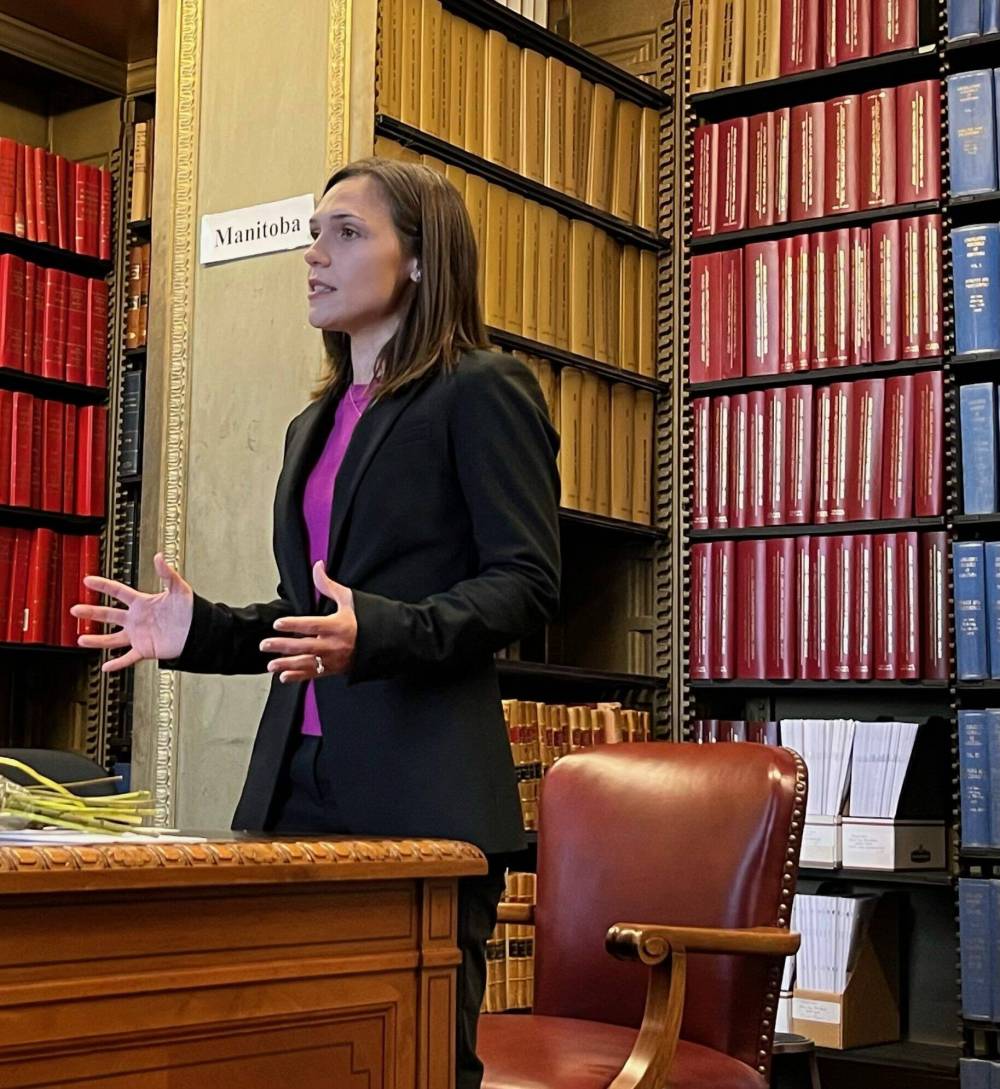
Liberal MLA Cindy Lamoureux introduced Bill 209 in the legislature last month after speaking with a Westman woman who survived domestic violence. The bill, which has passed unanimous second reading, would require provincial judges and justices of the peace to take training on intimate partner violence. (File)
Last summer, Ontario passed Bill 102, making Keira’s Law also the law of the land in the province. It was the passage of the legislation in Ontario that Sprucewoods resident and intimate partner violence survivor Kayla Harder felt set the wheels in motion to create the legislation in Manitoba.
“(The Ontario legislation) kind of set a template in a way for other provinces,” Harder told the Sun.
After experiencing physical, sexual and psychological abuse by her former partner and dealing with the court system while trying to get protection for her kids, Harder became involved in advocacy for survivors of intimate partner violence. She was reaching out to different MLAs and media outlets to create awareness when Lamoureux messaged her back.
Lamoureux told the Sun that Harder had introduced her to Kagan-Viater, and she became more passionate about the issue after hearing the stories of both women.
“I think that ethically, we have a responsibility to make sure that those who are making decisions, especially for survivors, have the best education that they can on the topic,” she said, adding that consultation on the bill involved many different shelters, groups, resource centres and people who have experienced domestic violence and navigated the court system.
Harder described the difficulty that women in abusive relationships face in trying to leave the relationship, or have no choice but to remain, especially when there are children involved, who can often be used by abusers to maintain control over an ex-partner. Then when they do end up going through the justice system to try to get protection or hold their abusers accountable, they feel like they aren’t believed, she said.
“A lot of times survivors aren’t believed and are blamed. So, there are negative outcomes for the children who are caught up in a lot of these circumstances and being trafficked through family courts back to their abusers,” Harder said, adding that children being exposed to domestic violence situations can often continue the cycle of violence once they grow up.
She said the role the bill is to help educate the provincial judiciary on the more subtle, harder to prove aspects of intimate partner violence, like coercive control (a pattern of behaviours meant to control and scare a victim).
“There needs to be more education of the dynamics of what’s actually happening behind closed doors, and that understanding of coercive control and how domestic violence actually behaves,” Harder said. “To understand how to react to that and to act in the children’s best interests and to act in the survivor’s best interests and not perpetuate violence further, because that’s what’s happening now.”
Brandon’s Women’s Resource Centre was consulted by Lamoureux’s office on the legislation and intends to stay involved in support of the bill when it reaches the committee stage, when there will be further debate on the bill.
“What we’re seeing with our clients is that when they go to get protection orders they’re actually interacting with, typically, a judicial justice of the peace, and those staff members were not included in the federal government-mandated domestic violence training,” Cara McCaskill, a sexual assault resource co-ordinator at the centre, said. “So that was a gap that we were seeing.”
Protection orders are currently difficult to get, she said, require a lot of information and require applicants to prove certain things, which can be different for women caught up in a domestic violence situation. Yet, McCaskill said these orders are an important tool for survivors.
“Protection orders are useful in that they provide a recourse for clients to be able to hopefully stop instances of domestic violence in their tracks,” McCaskill said. “It provides a way for them to assert their rights and to have recourse through that protection order to get a remedy if the violence continues.”
Meanwhile, Harder said she’s pleased with the progress of the bill through the legislature, thought there is more work beyond it to address the issue of domestic violence and cycles of abuse.
“Judges are a very important piece (but) there are many other pieces of the ladder rung that survivors and victims get thrown out before they even reach a judge or justice of the peace,” she said. “So, it is very important still and is a great starting point, but there is more that needs to be done aside from this as well, and I’ll continue to keep advocating for that too.”
» gmortfield@brandonsun.com
» Twitter: @geena_mortfield