
Launching more medical residencies is a good start
Advertisement
Read this article for free:
or
Already have an account? Log in here »
We need your support!
Local journalism needs your support!
As we navigate through unprecedented times, our journalists are working harder than ever to bring you the latest local updates to keep you safe and informed.
Now, more than ever, we need your support.
Starting at $15.99 plus taxes every four weeks you can access your Brandon Sun online and full access to all content as it appears on our website.
Subscribe Nowor call circulation directly at (204) 727-0527.
Your pledge helps to ensure we provide the news that matters most to your community!
To continue reading, please subscribe:
Add Brandon Sun access to your Free Press subscription for only an additional
$1 for the first 4 weeks*
- Enjoy unlimited reading on brandonsun.com
- Read the Brandon Sun E-Edition, our digital replica newspaper
*Your next Free Press subscription payment will increase by $1.00 and you will be charged $20.95 plus GST for four weeks. After four weeks, your payment will increase to $24.95 plus GST every four weeks.
Read unlimited articles for free today:
or
Already have an account? Log in here »
Hey there, time traveller!
This article was published 07/05/2024 (900 days ago), so information in it may no longer be current.
Manitoba is filling a record number of medical residencies this summer. That is good news for a province that has among the lowest number of physicians per capita in Canada.
Beginning July 1, 173 medical school graduates will start their two-year residencies across Manitoba. Many of them will be in northern and rural communities, where there is a severe shortage of family physicians and doctors working in hospitals.
That is 17 more than last year and the highest ever for Manitoba. And based on recent information from the province, that number is expected to grow to 190 next year.
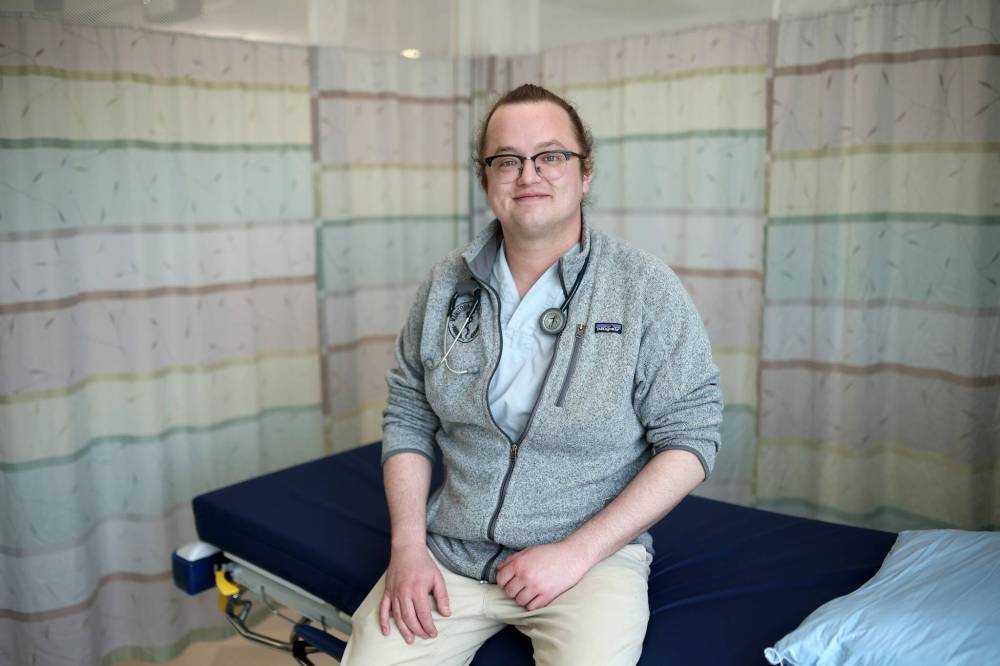
University of Manitoba medical school graduate Stefon Irvine, seen here at the Brandon Regional Health Centre, will be starting a northern and remote family medicine residency this summer. Irvine did much of his training in Thompson, Brandon and several First Nations, including Norway House Cree Nation. (Tim Smith/The Brandon Sun)
The increase did not happen on its own. The provincial government increased funding for medical residencies and the University of Manitoba has stepped up recruitment efforts, including among Indigenous communities.
Last year, the province increased funding for rural and northern medicine residencies to 48 from 34.
That is in stark contrast to the 1990s, when governments across Canada, including in Manitoba, cut funding for medical residencies — a short-sighted move justified at the time to help balance provincial budgets. Those fiscal austerity measures had a long-lasting effect on the medical community. They contributed to Manitoba’s steady decline in physicians per capita from fourth-highest among the provinces in 2002 to second-lowest in 2022.
What this increase means precisely for western Manitoba is, as yet, unclear — the province did not specify how many of the new or existing medical residencies would be taking place in our region.
Considering the difficulty so many communities in Prairie Mountain Health are having in attracting new doctors to a rural lifestyle, this kind of information would seem to be of some importance.
(A recent CBC story suggests that the emergency department in Hamiota has been assigned an international medical graduate, giving the community the equivalent of 3.25 full-time doctors. So that’s a start.)
At any rate, an increase in medical residencies is a good first step toward improving patient care and reducing long wait times in Manitoba, where an estimated 200,000 people do not have a family physician.
But it is not the only measure that is required.
The province must also find ways of keeping doctors in Manitoba through financial and other incentives once they have completed their residencies. Hospitals and clinics must be well-funded to encourage physicians to seek specialties in areas such as emergency medicine.
Boosting the number of doctors in Manitoba alone won’t reduce wait times or solve chronic hospital overcrowding. The province’s severe shortage of nurses and allied health-care workers must also be addressed.
Medical services are provided by teams of front-line staff in operating rooms, intensive care units, medical wards and emergency departments. Without more nurses and allied health-care workers, improvements cannot be made in those areas, no matter how many more doctors are hired.
The provincial NDP government has announced efforts to recruit more front-line staff, but there has been a noticeable lack of detail in its planning.
Concrete measures with specific and realistic objectives are needed to hire more health-care professionals. Vague pronouncements about recruiting more nurses and allied health-care workers without a detailed plan is not good enough.
Government must also ensure that increased health-care funding is going to where it’s needed most.
Too often, health-care dollars are consumed by bureaucratic costs through regional health authorities and other large administrative bodies such as Shared Health, which oversees the delivery of health-care services in the province.
The NDP had promised voters during last year’s provincial election that it would shrink the size of the health bureaucracy in Manitoba. So far it has not done so.
Increasing the number of doctors working in Manitoba is an important part of improving health-care outcomes in the province — in both rural and urban communities. It will go a long way toward ensuring patients who need care can get it in a timely fashion.
But it must be part of a broader strategy to increase front-line staffing levels within a properly funded and efficiently run health-care system to have full effect.
» Winnipeg Free Press and The Brandon Sun