
Study warns of rapid wild boar expansion
Advertisement
Read this article for free:
or
Already have an account? Log in here »
We need your support!
Local journalism needs your support!
As we navigate through unprecedented times, our journalists are working harder than ever to bring you the latest local updates to keep you safe and informed.
Now, more than ever, we need your support.
Starting at $15.99 plus taxes every four weeks you can access your Brandon Sun online and full access to all content as it appears on our website.
Subscribe Nowor call circulation directly at (204) 727-0527.
Your pledge helps to ensure we provide the news that matters most to your community!
To continue reading, please subscribe:
Add Brandon Sun access to your Free Press subscription for only an additional
$1 for the first 4 weeks*
- Enjoy unlimited reading on brandonsun.com
- Read the Brandon Sun E-Edition, our digital replica newspaper
*Your next Free Press subscription payment will increase by $1.00 and you will be charged $20.95 plus GST for four weeks. After four weeks, your payment will increase to $24.95 plus GST every four weeks.
Read unlimited articles for free today:
or
Already have an account? Log in here »
Hey there, time traveller!
This article was published 18/05/2024 (849 days ago), so information in it may no longer be current.
A new study tracking invasive wild boar is warning of the potential for “rapid and uncontrolled” expansion of pigs from the Canadian Prairies.
The study, published in the scientific journal “Biological Invasions,” used GPS satellite collars to track the movement of wild pigs to determine which habitats they prefer and where they are likely to move to.
Prof. Ryan Brook, the University of Saskatchewan academic who led the study, said it identified the risk of pigs spreading south and across the Canada-U.S. border.
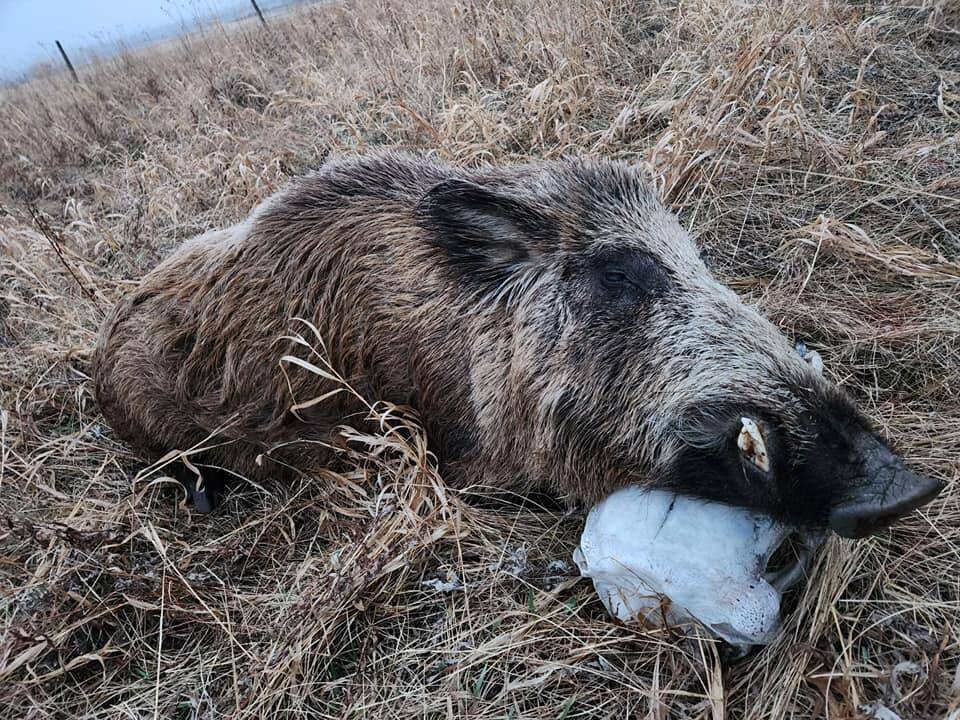
An invasive wild pig harvested by a hunter, with its head resting on a cattle skull. A new study identifies the risk of wild boar spreading south and across the Canada-U.S. border. In Manitoba, most of the animals have been concentrated in and around the Spruce Woods area.
“There are numerous spots where pigs can easily move across the border,” he told the Sun. “But definitely, I believe that the Saskatchewan-Montana point and western Manitoba and North Dakota — those are clearly the big hot spots for risk.”
The study was carried out in collaboration with a U.S.-based wildlife professor, three U.S. Department of Agriculture scientists and one of Brook’s graduate students.
Wild pigs are not native to Canada and were introduced to the country though meat farms in the 1980s and ’90s. When the market collapsed after 2001, many pigs either escaped or were released from the farms and established themselves in the wild, particularly in the Prairie provinces.
Though there is no official estimate of how many wild pigs are in Canada, Brook says there are likely thousands of them. In the U.S., he said, it is estimated that there are seven million wild pigs, many of which are in the southern states.
In Manitoba, most of the wild boar have been concentrated in and around the Spruce Woods area.
Earlier this year, the Sun reported that officials in Ontario and North Dakota had said there were no established wild boar populations in either jurisdiction. Still, Brook said that just because the pigs haven’t yet invaded other areas, it doesn’t mean that they don’t have the potential to do so in the very near future.
“They reproduce, they eat lots of things, they eat almost anything, they do tremendous damage, and they spread — just like cancer cells,” Brook said.
The study, however, was based on a small sample size — about 10 pigs were tracked. While Brook acknowledged the small sample size and that more data is always better, this study, he added, gives them something they can build on with more research funding.
“Fifteen years ago, people would ask me all kinds of questions, and the answer was always, ‘This is what we know from the U.S., this is what we know from Europe, this is what we know from elsewhere,’” he said. “But we have no idea what’s going on in Canada, and Canada is so different. We needed this research to better understand that. And given how big Canada is and these huge lands, open landscapes we have, we shouldn’t be surprised that pigs have huge home ranges and that they can move very large distances.”
The professor said wild pigs are considered to be one of the worst invasive large mammals on the planet, causing widespread crop damage and destroying the native habitats of other species.
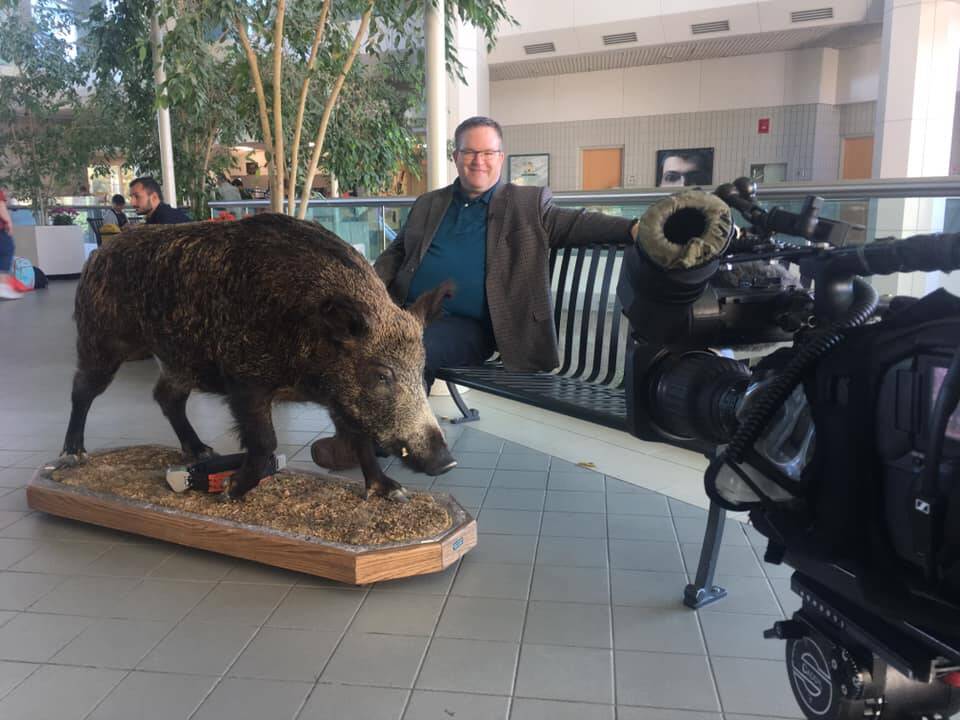
Prof. Ryan Brook, the study’s lead author, seated beside his taxidermied 400-pound invasive wild pig named “Boris Boaraloff” in the College of Agriculture and Bioresources Building in Saskatoon, Sask. (Submitted)
The study also found that wild pigs rely heavily on forest cover to hide from hunters and seek relief from extreme temperatures. They also prefer wetlands, where they can soak in the mud and water to stay cool in the summer and find frogs and salamanders to eat.
While Brook commends the work being done in some of the provinces to address managing wild boar populations, like the Squeal on Pigs initiative, he said that monitoring, ground traps and sight reporting is not enough.
He said active monitoring is needed, as well as addressing sport hunting, which he said causes groups of pigs to disperse. Funding for research and tracking is also required. And using aircraft to capture the pigs would help prevent the animals’ spread.
“You cannot win a war on pigs just with traps alone,” he said. “You need other tools.”
» gmortfield@brandonsun.com
» X: @geena_mortfield